


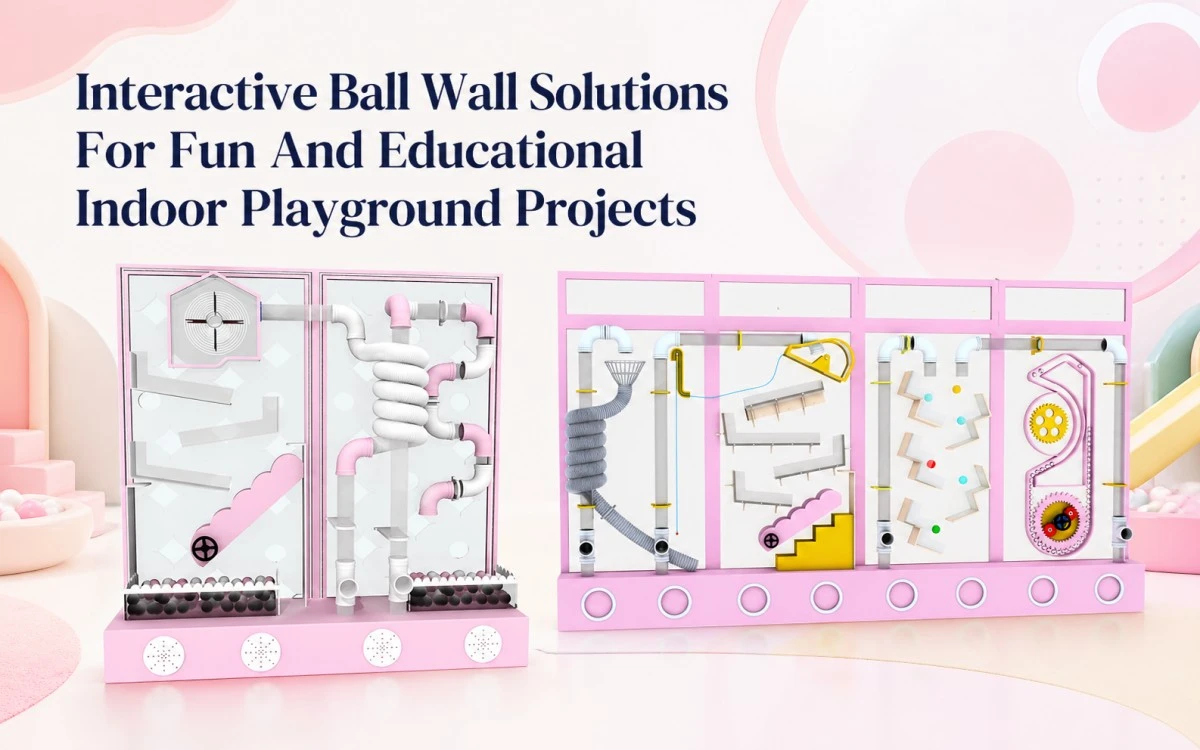
Interactive Ball Wall Solutions For Fun And Educational Indoor Playground Projects
Traditional indoor playground walls often look colorful, but they usually provide limited play value. Children may look at them briefly, lose interest quickly, and move on to other areas. For commercial indoor playground operators, this can reduce attraction, playtime, and overall customer experience.
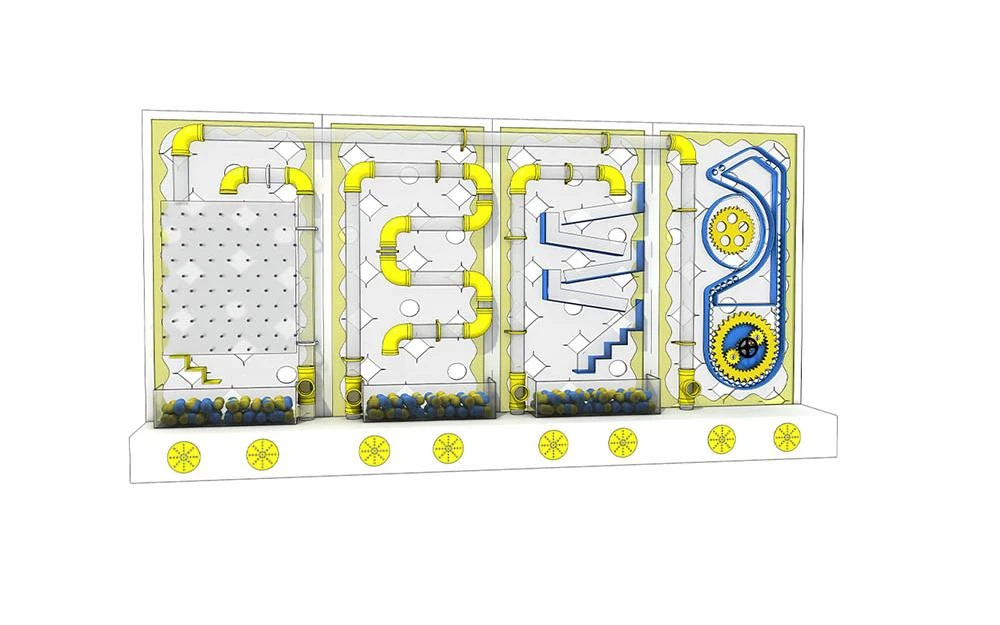
An Interactive Ball Wall is designed to change this problem. It turns a simple wall surface into an engaging play zone where children can throw balls, follow moving routes, operate interactive parts, and explore different ball paths. By combining visual movement, hands-on interaction, airflow play, and creative track design, this wall-based equipment helps indoor playground projects become more fun, educational, space-saving, and memorable.
This solution can integrate multiple play forms, including a ball maze wall, indoor playground ball wall, Interactive Wall Game, and Ball Tube Play System, making it especially suitable for modern indoor ball pool areas, soft play centers, family entertainment spaces, early education rooms, and themed children’s zones.

What Makes an Interactive Ball Wall Better Than a Normal Decorative Wall?
A normal playground wall mainly works as a background decoration. It may improve the visual style of the space, but it does not create real interaction. Children usually pass by after a quick look because there is no game challenge, no movement, and no reason to stay.
An Interactive Ball Wall gives the wall a real play function. Children can place soft balls into the entrance, watch them travel through transparent tubes, follow different routes, and operate simple mechanisms along the way. The entire process is visible, active, and easy to understand, which naturally attracts children to participate again and again.
Compared with a static wall, this type of Interactive Wall Game offers stronger engagement. Children are not only watching; they are touching, thinking, testing, and reacting. They can guess where the ball will go, compare different routes, try new ways to launch the ball, and enjoy instant feedback from every movement.
For commercial playgrounds, this means higher play value in the same space. A well-designed indoor playground ball wall can help extend children’s stay time, improve the overall play experience, and create a stronger visual highlight for photos and videos. It also makes better use of vertical wall space without taking up too much floor area.
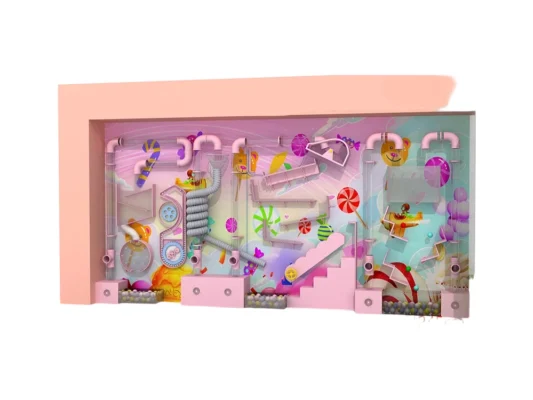
The wall system can be customized with space, castle, forest, ocean, candy, princess, or adventure themes, allowing it to match the interior design of different playground brands and project styles.
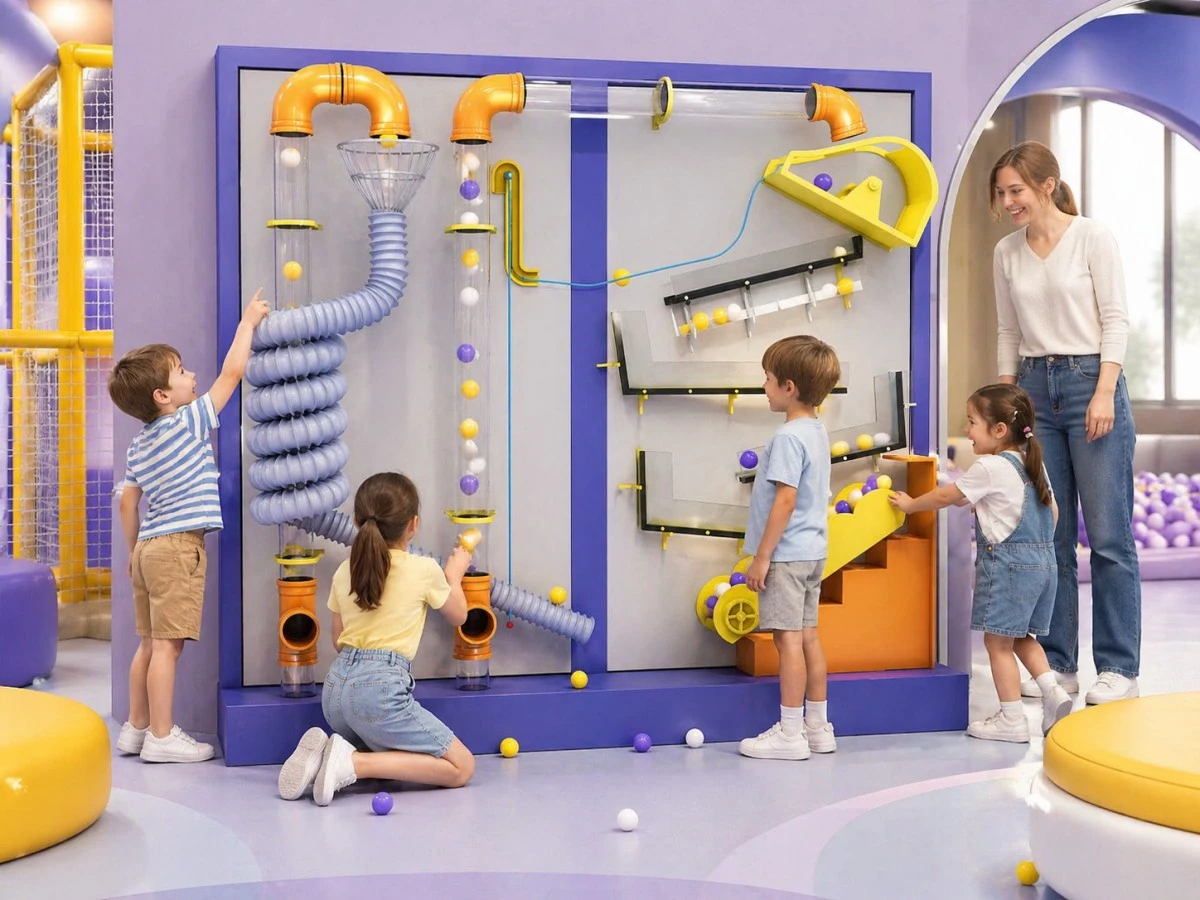
How Does a Ball Maze Wall Support Exploration and Logical Thinking?
A ball maze wall is not only entertaining; it also encourages children to observe, think, and explore. When a child puts a ball into the entrance, the ball moves through visible tracks, turning sections, tubes, small gates, and interactive parts. Children can clearly see the route and understand how each movement affects the next step.
During play, children naturally begin to ask simple questions: Which route is faster? Why did the ball turn here? What happens if I place the ball in another entrance? This kind of active thinking helps develop observation ability, patience, concentration, hand-eye coordination, and basic cause-and-effect logic.
The ball maze wall also supports both solo and group play. One child can explore the route independently, while several children can play together by sharing balls, watching different paths, and helping each other complete the play process. This makes the equipment suitable for social interaction as well as individual discovery.
When airflow tubes are added, the experience becomes even more dynamic. Air power can push soft balls upward, move them through transparent pipes, and create a floating or flying effect. This makes the wall more exciting and gives children a deeper memory of the play experience.
For indoor playground owners, this combination of fun and learning adds more value than ordinary decorative panels. It gives parents a stronger reason to appreciate the facility because children are not only playing, but also learning through movement, observation, and hands-on exploration.
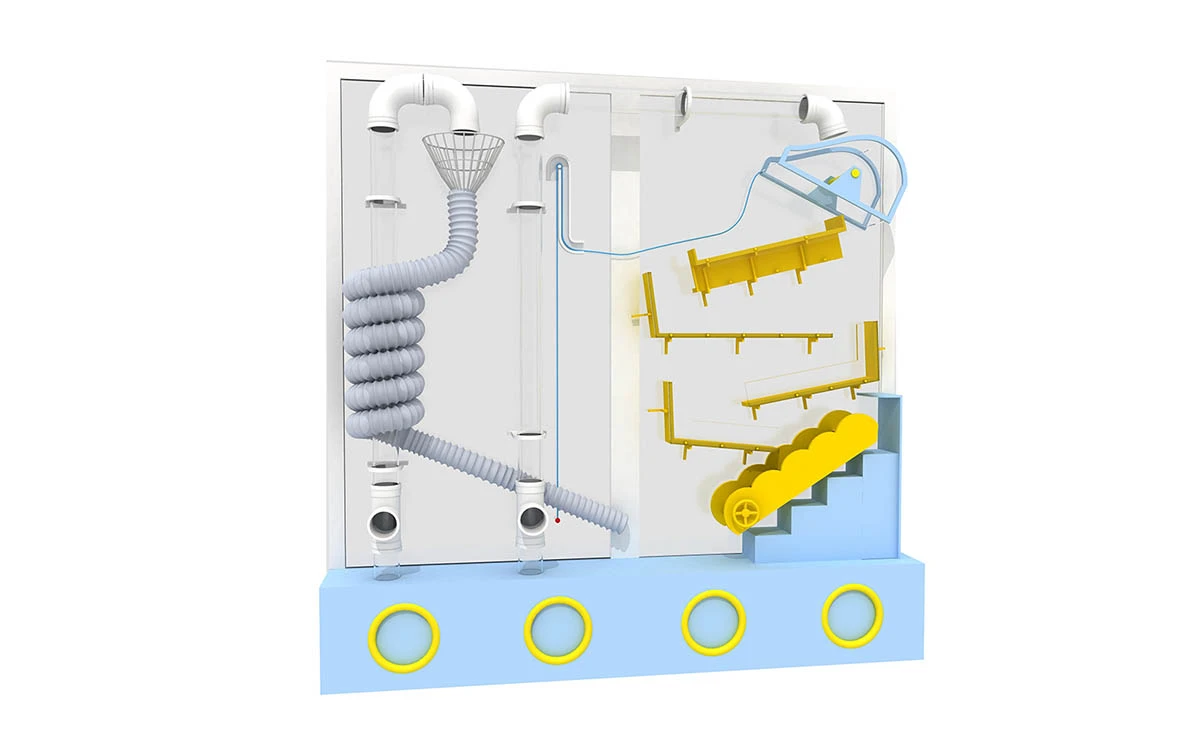
Why Is an Indoor Playground Ball Wall Suitable for Ball Pools and Soft Play Areas?
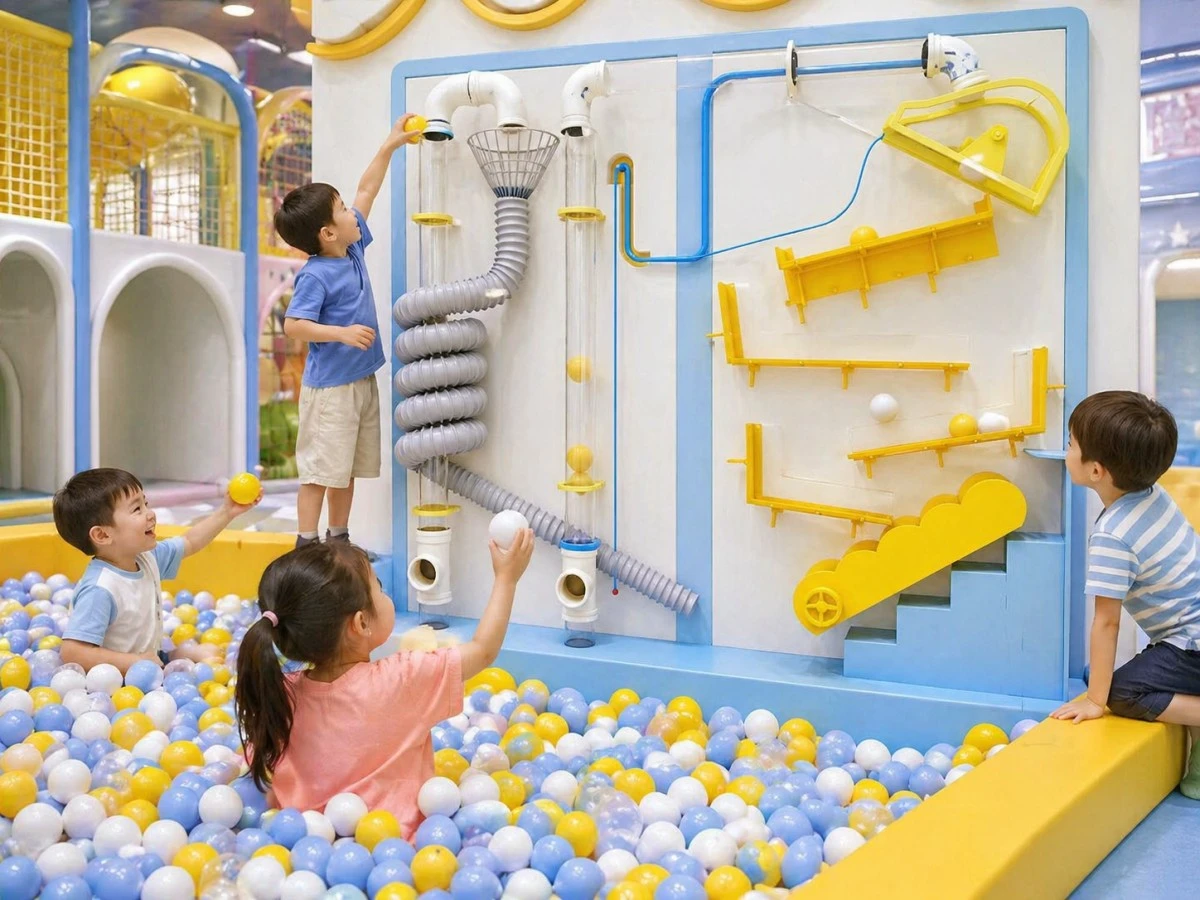
An indoor playground ball wall works especially well with ball pool areas because children can directly use soft balls from the ball pit. This creates a natural connection between the ball pool and the wall play system. Instead of keeping different play zones separate, the wall helps link ball pools, climbing areas, slides, and interactive zones into one more complete play flow.
In many indoor playgrounds, the ball pool is fun but can become repetitive after a short time. By adding an Interactive Ball Wall, the same soft balls gain new play value. Children can pick up balls, place them into the wall system, watch them travel through tubes, and repeat the process in different ways.
For soft play centers, this is a smart space-saving solution. The equipment can be installed along the wall, using vertical space efficiently while leaving the floor open for climbing, crawling, slides, and other play structures. Children can stand safely, reach the interactive parts, and enjoy a hands-on game without needing a large separate area.
The size, height, track complexity, colors, and theme of the indoor playground ball wall can be customized according to the project layout, child age group, and overall playground design. For toddlers, the wall can be lower, simpler, and more colorful. For larger commercial playgrounds, the design can include more tubes, longer ball routes, larger visual effects, and stronger themed decoration.
This makes it suitable for shopping mall playgrounds, kindergarten playrooms, parent-child entertainment centers, hotel kids’ areas, restaurant children’s corners, early education spaces, and children’s museums.
How Does an Interactive Wall Game Increase Parent Satisfaction?
Parents today often look for playground equipment that offers more than simple fun. They prefer facilities that are safe, educational, creative, and meaningful for children’s development. An Interactive Wall Game meets this expectation because it combines entertainment with early learning value.
Children can experience basic physical concepts through play, such as direction change, speed, gravity, airflow, movement, balance, and simple mechanical operation. These ideas are not presented through boring lessons. Instead, children discover them naturally while watching balls move, stop, climb, turn, and drop through different sections.
This makes the Interactive Wall Game highly suitable for early education centers, schools, museums, and parent-child spaces. It can support STEM-inspired play by encouraging children to explore how things move and why different routes create different results.
For commercial operators, this educational value can improve brand image. Parents may feel that the playground is not only a place to consume time, but also a place where children can learn, cooperate, and develop curiosity. This can help increase customer satisfaction, repeat visits, and word-of-mouth recommendations.
A professional manufacturer can also design the system according to safety requirements, age range, play height, wall structure, and project positioning. With rich project experience and strong factory production capability, customized solutions can be developed for different site sizes and business models.

What Makes a Ball Tube Play System More Dynamic and Memorable?
A Ball Tube Play System uses airflow power and transparent tube structures to create a lively moving-ball effect. After children place soft balls into the system, the airflow can push them upward, guide them through curved tubes, move them across the wall, and release them from different exits.
This creates a strong visual experience. Children can clearly see the balls traveling inside colorful transparent tubes, which makes the entire wall feel active and energetic. Compared with static wall toys, a Ball Tube Play System provides stronger movement, faster feedback, and more excitement.
The system is also very suitable for multi-child interaction. Some children can place balls into the entrance, others can follow the ball route, and some can wait near the exit. They may talk, laugh, cooperate, and compete in a friendly way. This improves communication and social play, which is important for indoor playground environments.
A good Ball Tube Play System should be designed with stable airflow, smooth tube connection, safe structure, durable materials, and easy maintenance. The wall should also be visually attractive while remaining practical for daily operation.
For project buyers, customization is important. Different playgrounds may need different wall lengths, tube layouts, ball entrances, outlet positions, color combinations, and themed decorations. An experienced factory can support layout planning, theme design, production, installation guidance, and full project matching, helping customers build a more complete indoor playground solution.

How Can This Equipment Improve Commercial Playground Value?
For indoor playground operators, every square meter matters. Equipment should not only look good, but also attract children, increase playtime, support parent satisfaction, and improve the overall commercial value of the venue.
An Interactive Ball Wall is valuable because it uses wall space efficiently. It does not occupy too much ground area, but it creates a strong interactive play point. This is especially helpful for venues with limited space or projects that want to add more play functions without changing the entire layout.
The wall can also become a visual highlight. Bright colors, transparent tubes, moving balls, themed shapes, and airflow movement make the equipment naturally eye-catching. It can encourage children to gather around, take part in group play, and create shareable moments for parents.
For business owners, this kind of equipment can help enrich the play structure, reduce the feeling of repetition, and make the venue more competitive. It is suitable for new playground projects as well as upgrades of existing indoor play areas.
A capable supplier can provide custom design, factory production, material selection, theme matching, and project support according to different market needs. Whether the project is for a shopping mall, school, hotel, museum, or family entertainment center, customized wall-based ball play equipment can help create a more attractive and practical indoor playground experience.
Conclusion
An Interactive Ball Wall brings new value to indoor playground projects by turning ordinary wall space into an active, educational, and visually engaging play area. It combines the fun of a ball maze wall, the space-saving advantage of an indoor playground ball wall, the learning value of an Interactive Wall Game, and the dynamic movement of a Ball Tube Play System.
For children, it offers exploration, movement, teamwork, and curiosity. For parents, it provides educational and safe play value. For playground owners, it helps improve attraction, stay time, space efficiency, and project competitiveness.
With professional design support, strong manufacturing capability, and flexible customization options, this type of wall-based interactive equipment can be adapted to many indoor playground projects. Customers planning a new indoor ball play area or upgrading an existing venue can send an inquiry to discuss layout, theme, size, production details, and customized project solutions.


 English
  Español
  Français
  Deutsch
  Português