


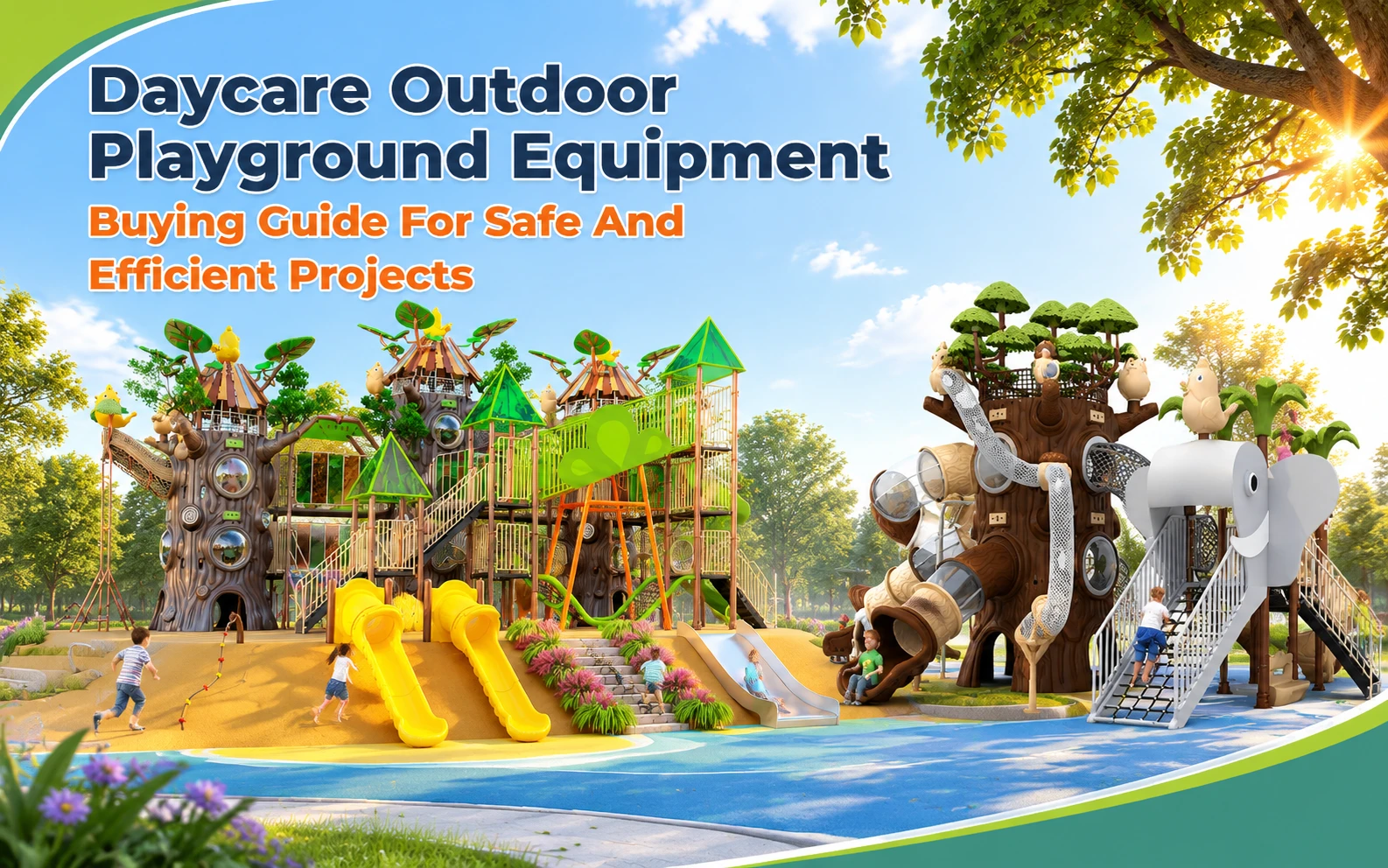
Choosing daycare outdoor playground equipment is a strategic decision for any childcare center. The playground must support physical development, social interaction, imaginative learning, and daily outdoor routines while remaining easy for teachers to supervise and maintain. A visually attractive structure may capture attention, but buyers also need to understand age suitability, safety standards, installation conditions, material quality, maintenance requirements, and the complete project budget.
For daycare owners, the correct daycare outdoor playground equipment should solve practical problems rather than create new ones. It should fit the available space, match the number and age of children, withstand frequent use, provide clear supervision lines, and remain manageable throughout its service life.
A successful daycare outdoor playground equipment project begins with accurate planning rather than product selection. Buyers who understand their site, users, safety responsibilities, and operational needs are more likely to receive an appropriate design and an accurate quotation.
This guide combines information, procurement advice, safety planning, budget analysis, customization, installation, and maintenance guidance from the perspective of what daycare customers actually want to know before placing an order.
What Should Buyers Confirm Before Choosing Daycare Outdoor Playground Equipment?
Before requesting a quotation, buyers should define how the playground will be used. The first questions should include the age range of the children, the maximum number of users at one time, the available site size, the expected daily play schedule, the local climate, the supervision method, and the planned opening date. These details directly affect the design of daycare outdoor playground equipment.
The number of children matters because it determines the required activity capacity. A playground intended for ten children does not need the same number of entrances, slides, platforms, or independent play activities as a playground serving fifty children. Buyers should provide both the total enrollment and the maximum number of children expected to use the outdoor area simultaneously.
A site drawing is especially valuable. It should show the total dimensions, entrances, fences, walls, trees, drainage points, walkways, emergency access routes, and nearby buildings. Photographs taken from different directions can help the supplier understand the actual condition of the space.
Without accurate site information, a supplier may recommend daycare outdoor playground equipment that looks suitable in a catalog but does not fit the real installation area. The result may be inadequate safety distances, poor circulation, blocked supervision, or unexpected changes during installation.
Buyers should also define their educational goals. Some daycare centers want more climbing, balancing, and coordination activities. Others prefer sensory panels, musical elements, role-play houses, sand and water stations, nature-inspired features, or quiet social areas.
When learning goals are clearly communicated, daycare outdoor playground equipment can become part of the daycare curriculum rather than an isolated recreational product. Different activity zones can support physical exercise, communication, problem-solving, creativity, and cooperative play.
The quotation scope must also be confirmed. Buyers should ask whether the price includes the equipment, safety surfacing, shipping, foundations, installation hardware, drainage work, shade structures, spare parts, manuals, and installation guidance.
Comparing only the equipment price can be misleading because different suppliers may include very different project items. A complete daycare outdoor playground equipment inquiry should clearly describe the required products, services, delivery responsibilities, and installation support.
How Should Daycare Outdoor Playground Equipment Match Different Age Groups?
Age suitability is one of the most important factors in daycare outdoor playground equipment planning. Children under two years old require different activities from children aged two to five. Their balance, reach, coordination, judgment, movement speed, and ability to recognize danger are not the same.
For infants and young toddlers, daycare outdoor playground equipment should focus on crawling, pulling up, early walking, sensory exploration, and simple cause-and-effect play. Low ramps, short tunnels, activity panels, small rocking features, ground-level play tables, and protected social spaces are generally more appropriate than elevated platforms or difficult climbing routes.
Low-level activities allow younger children to explore independently while remaining close to the ground. Handholds should be easy to reach, walking surfaces should be stable, and transitions between activities should be simple. Openings, barriers, and access points must also be designed for smaller body dimensions.
For children aged two to five, daycare outdoor playground equipment can include short slides, low climbing steps, crawl tunnels, small bridges, steering panels, spring riders, beginner balance beams, themed playhouses, and musical panels. The equipment should provide an achievable challenge without requiring movements that exceed the children’s physical development.
Preschool equipment should not simply be a reduced version of a playground designed for older children. Platform heights, handrails, guardrails, climbing spacing, slide dimensions, access steps, and activity difficulty should all reflect the abilities of preschool users.
When multiple age groups share the same outdoor area, clear separation is important. Separate play zones can reduce collisions between fast-moving preschoolers and younger toddlers. Color coding, fences, landscaping, distance, or scheduled use can help create safer operating conditions.
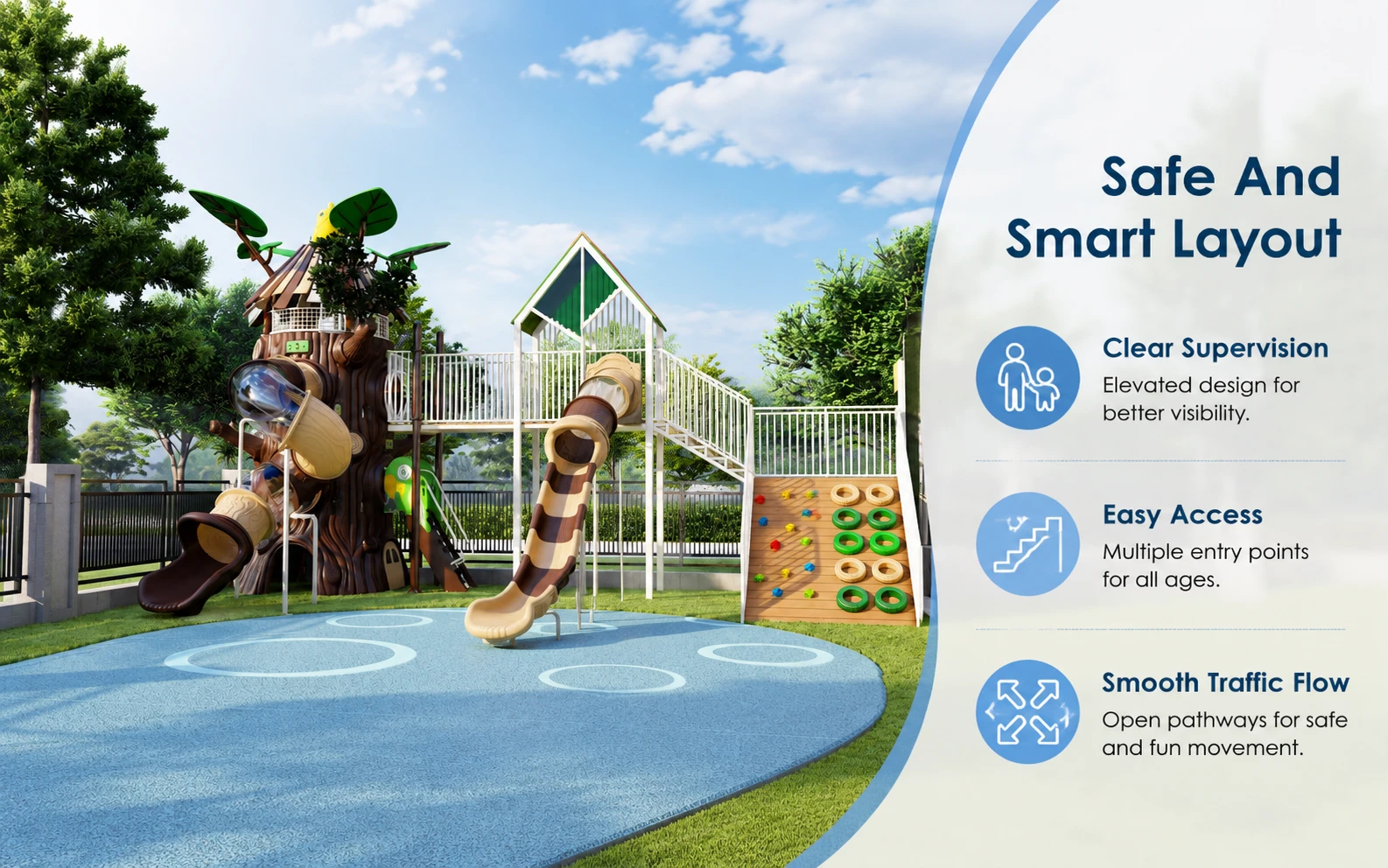
Supervision should also influence the layout of daycare outdoor playground equipment. Staff should be able to see slide exits, climbing points, tunnels, quiet corners, activity panels, and entrance areas from practical supervision positions.
Large decorative walls may look impressive but can block visibility. Long tunnels and enclosed playhouses should be positioned carefully so that teachers can monitor children without constantly walking around the structure. A well-designed playground creates visual interest without producing hidden areas.
Which Safety Standards Matter For Daycare Outdoor Playground Equipment?
Safety planning for daycare outdoor playground equipment should begin during the design stage rather than after installation. Buyers should confirm which standards apply in the destination country and whether local childcare licensing regulations add further requirements.
In the United States, public playground projects commonly refer to ASTM F1487, ASTM F2373 for children under two, ASTM F1292 for impact-attenuating surfacing, ASTM F1951 for the accessibility of surface systems, the CPSC Public Playground Safety Handbook, and applicable ADA accessibility requirements.
European projects commonly refer to EN 1176 for playground equipment and EN 1177 for impact-attenuating playground surfacing. Other countries may use these standards, adopt modified versions, or enforce their own national requirements.
Buyers should not assume that one certificate automatically proves that an entire project complies with every local rule. The final layout, foundations, installation quality, safety surfacing, fall zones, and site conditions can all affect compliance.
Every daycare outdoor playground equipment safety review should consider the complete installed environment rather than only the individual product components.
Buyers should request technical drawings showing equipment dimensions, use zones, fall heights, footing locations, circulation routes, and surfacing boundaries. The daycare outdoor playground equipment should be checked for entrapment openings, protrusions, sharp edges, pinch points, exposed hardware, unstable components, and conflicts between moving equipment and walking routes.
Protective surfacing is a major part of playground safety. The chosen surface material must match the fall height of the installed equipment. Common options include engineered wood fiber, rubber tiles, poured-in-place rubber, artificial grass with an impact-attenuating layer, sand, and other locally approved materials.
Each surface type has different installation, drainage, cleaning, accessibility, maintenance, and replacement requirements. Loose-fill materials may require regular leveling and replenishment, while unitary rubber surfaces may have a higher initial cost but provide more stable wheelchair access.
The surfacing underneath daycare outdoor playground equipment should extend throughout the required use zone. Buyers should also consider edge containment, water drainage, surface temperature, cleaning procedures, and the local availability of replacement materials.
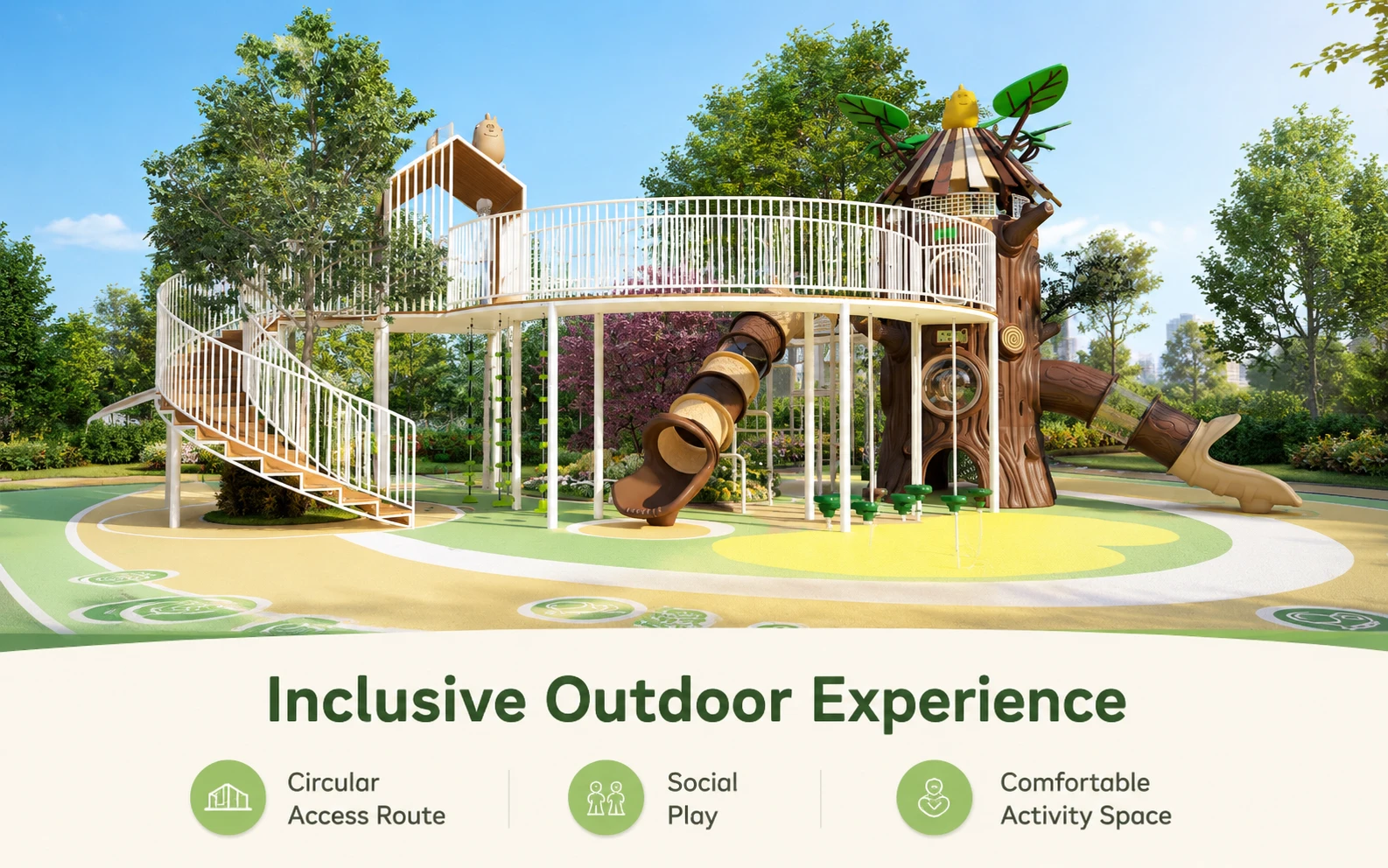
Accessibility should be integrated into the design from the beginning. Inclusive daycare outdoor playground equipment can include accessible ground-level panels, wide pathways, transfer platforms, sensory features, musical activities, social spaces, and play elements that do not require climbing.
Inclusive design does not mean that every child must use every activity in exactly the same way. It means providing meaningful opportunities for children with different mobility, sensory, communication, and developmental needs to participate in the same play environment.
Which Materials And Equipment Types Provide Better Long-Term Value?
The best daycare outdoor playground equipment is not always the largest structure or the design with the most decorative elements. A balanced playground usually combines gross-motor activities, sensory play, social interaction, imaginative play, and quiet activities.
Composite play structures are useful because they organize several activities within one footprint. Slides, tunnels, bridges, low climbing elements, roofs, and themed panels can be combined into a compact system. This is especially helpful when a daycare has limited outdoor space.
Freestanding daycare outdoor playground equipment such as spring riders, balance beams, stepping pods, musical panels, playhouses, drawing boards, and sand-and-water stations can add variety and reduce crowding around the main structure.
Open space should also be preserved. Children need areas for running, group games, wheeled toys, ball activities, and teacher-led outdoor lessons. Filling every available part of the yard with fixed equipment can reduce the flexibility of the playground.
Material selection affects durability, maintenance, appearance, and the comfort of users. Powder-coated or galvanized steel can provide structural strength, but buyers should examine the quality of welding, surface preparation, coating thickness, and corrosion protection.
Rotationally molded plastic is commonly used for slides, roofs, tunnels, barriers, and decorative components. It can create rounded shapes and colorful surfaces without the sharp corners found in some fabricated materials.
HDPE panels are often used for activity boards, signs, barriers, themed decorations, and interactive walls. High-quality HDPE offers good moisture resistance, color consistency, and relatively simple maintenance.
Fasteners and connectors are also important. Stainless-steel hardware, covered bolt ends, secure clamps, and replaceable components can improve the long-term performance of daycare outdoor playground equipment. Buyers should ask whether commonly worn parts can be replaced individually.
For hot climates, the design should include shade planning, heat-resistant materials, ventilation, and careful slide orientation. Dark surfaces and exposed metal components may become uncomfortable under direct sunlight.
In coastal or rainy areas, corrosion resistance, sealed connections, drainage, and foundation details become more important. In cold climates, buyers should consider freeze-thaw conditions, material performance at low temperatures, snow accumulation, and seasonal maintenance.
Long-term value should be measured by daily use rather than visual impact alone. A large decorative element may increase the price without increasing activity capacity. In contrast, a double slide, crawl route, accessible panel, or social platform may be used repeatedly throughout the day.
Effective daycare outdoor playground equipment gives every major component a practical purpose. It creates enough activity choices to reduce waiting while avoiding unnecessary features that increase cost and maintenance.
How Much Should Buyers Budget For Daycare Outdoor Playground Equipment?
The total budget for daycare outdoor playground equipment should include much more than the factory price. Equipment, freight, import charges, site preparation, foundations, installation, safety surfacing, drainage, fencing, shade, landscaping, inspection, spare parts, and contingency should all be considered.
The equipment price is normally affected by the total size, number of activities, structural materials, plastic components, theme complexity, custom colors, accessibility features, and quantity ordered. Customized designs may also require additional engineering or mold-related work.
Site preparation can significantly affect the final cost. A flat site with good access and existing drainage will usually cost less than a site that requires demolition, grading, excavation, concrete work, retaining edges, or special lifting equipment.
Safety surfacing may represent a substantial part of the project budget. The price depends on the surface type, total area, required impact performance, ground preparation, drainage, installation method, and local labor cost.
The budget for daycare outdoor playground equipment should also include delivery and unloading conditions. Buyers need to confirm whether large trucks or containers can reach the site, whether unloading equipment is available, and whether products must be moved through narrow entrances or existing buildings.
When comparing quotations, buyers should calculate the cost per usable activity, expected user capacity, warranty coverage, maintenance requirements, spare-part availability, and estimated service life.
A cheaper daycare outdoor playground equipment package may become expensive if coatings fail, plastic parts crack, hardware loosens frequently, or replacement components are difficult to obtain. The initial purchase price is only one part of the long-term cost.
A practical budget should reflect the daycare center’s priorities. When the project focuses on sensory development, inclusive play, physical coordination, or imaginative learning, funds should be allocated to those functions first.
For a small site, a customized daycare outdoor playground equipment layout may provide better value than a large standard structure that leaves insufficient circulation space. Customization can improve capacity and activity variety without increasing the total footprint.
Buyers should reserve a contingency amount for changes during installation. Unexpected drainage problems, foundation adjustments, access limitations, permit requirements, or inspection requests can affect the final cost. A realistic budget reduces delays and allows the project to move smoothly from design to opening.
How Can Buyers Manage Customization, Installation, And Maintenance?
A custom daycare outdoor playground equipment project should follow a clear and documented process. It normally includes site analysis, concept design, age-group review, capacity review, safety evaluation, material confirmation, color approval, technical drawings, production, trial assembly, packaging, shipping, foundation preparation, installation, inspection, and handover.
At the concept stage, buyers should review more than the product appearance. They should examine entrances, activity flow, supervision lines, age separation, circulation space, fall zones, accessibility, and the location of safety surfacing.
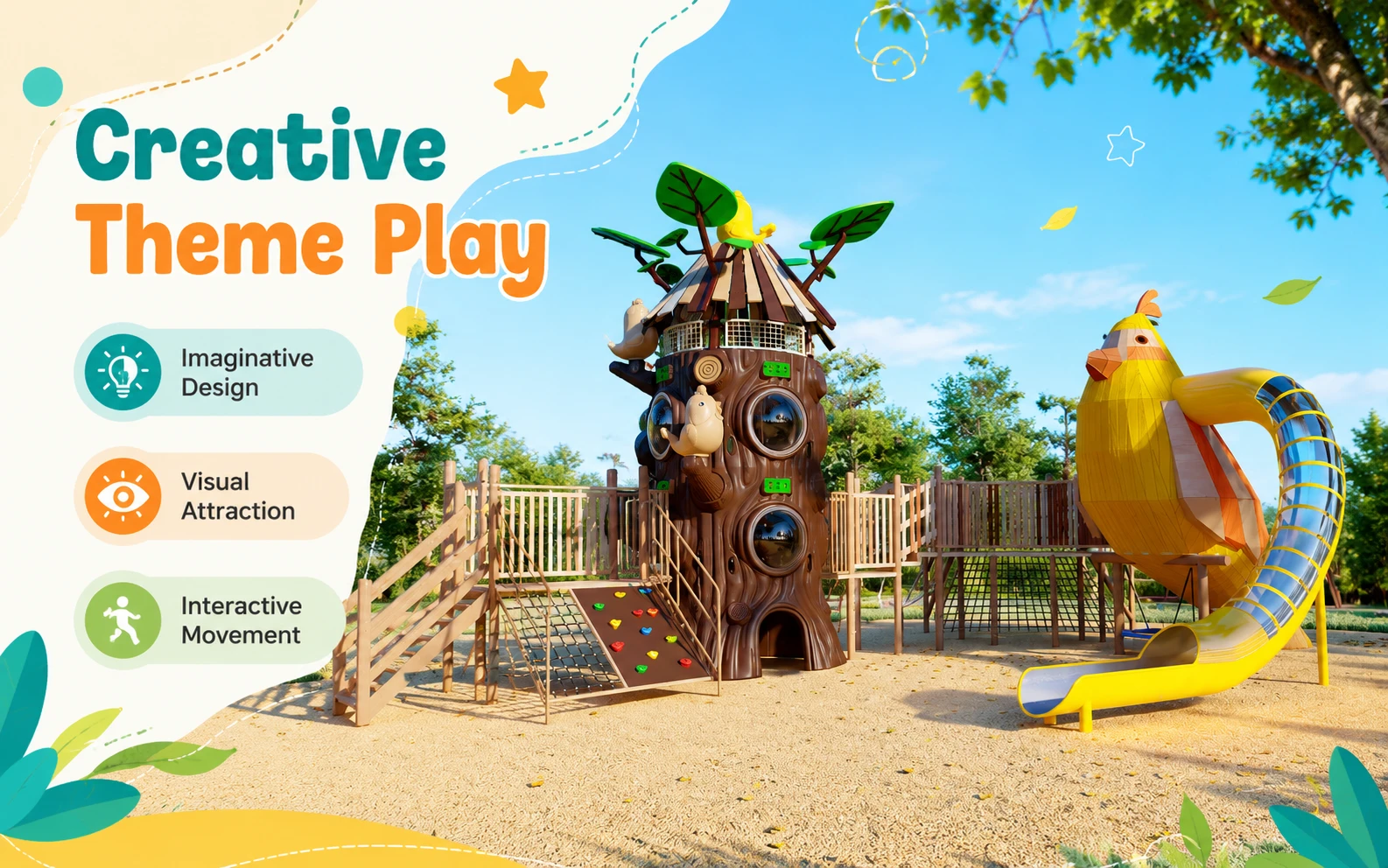
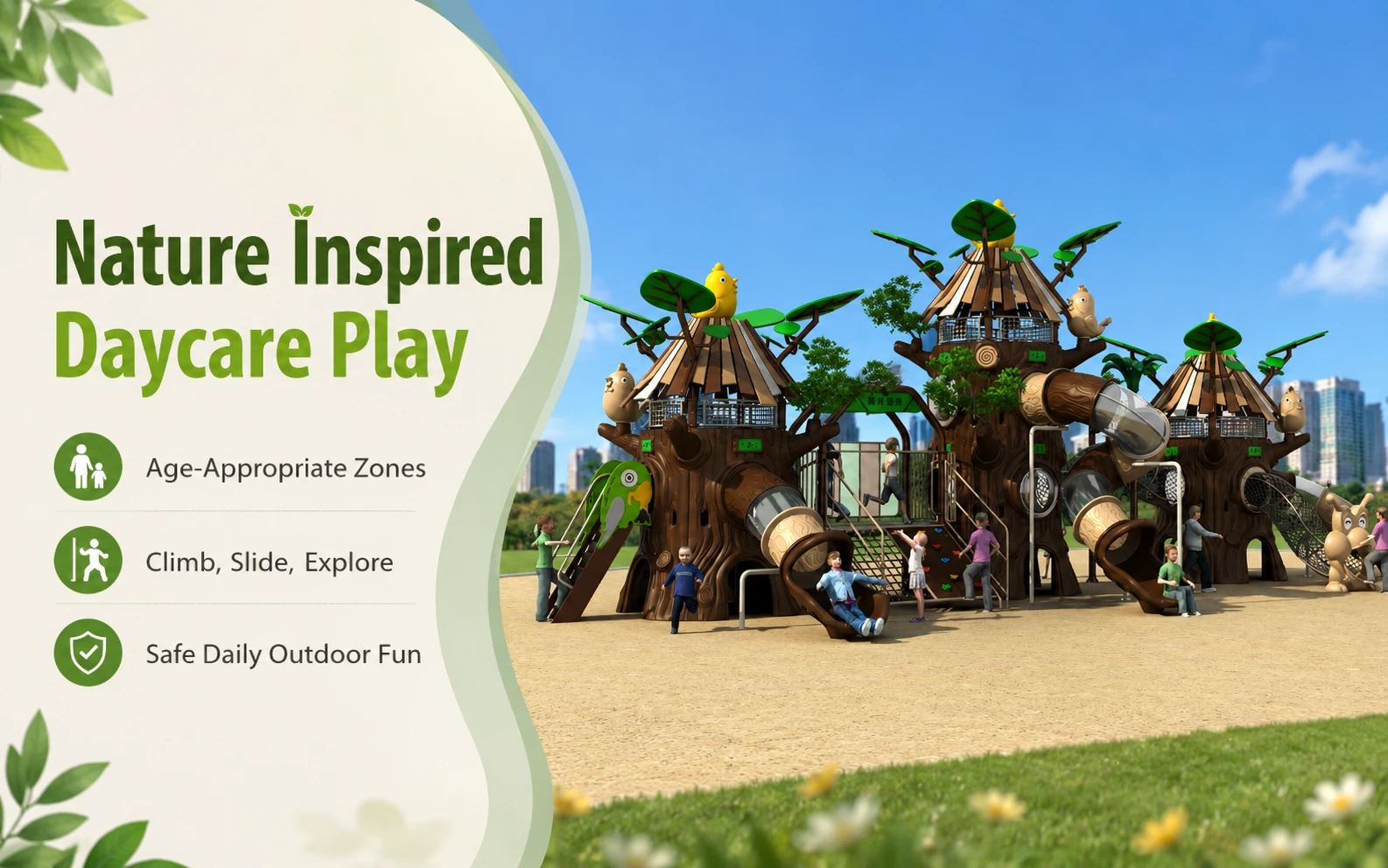
The color and theme should support the daycare environment without reducing visibility or creating excessive visual clutter. Themes can be based on nature, animals, transportation, castles, oceans, communities, or educational subjects.
Buyers should request a complete bill of materials, product drawings, foundation plans, installation instructions, packing lists, maintenance manuals, warranty terms, and spare-parts policy for the selected daycare outdoor playground equipment.
For international projects, the shipping method, container loading plan, export documents, delivery responsibility, customs scope, and installation support should be confirmed before production begins. Buyers should also identify who will receive, unload, store, and inspect the products after arrival.
Factory capability becomes especially important when the project includes special dimensions, custom themes, logos, exclusive colors, inclusive features, or phased delivery. A reliable supplier should have design, engineering, rotational molding, cutting, welding, sandblasting, painting, assembly, inspection, and packaging capabilities.
Trial assembly before shipment can help identify missing parts, incorrect connections, alignment problems, or unclear installation steps. It also allows the supplier to photograph important connection points and prepare more practical installation guidance.
After installation, daycare outdoor playground equipment requires routine inspection. Staff should check for debris, loose hardware, damaged surfacing, sharp edges, hot surfaces, water accumulation, worn moving parts, vandalism, and insect nests.
High-use areas such as slide entrances, steps, handrails, bridges, moving components, and surfacing beneath exits may require more frequent attention. Any damaged or unsafe component should be restricted from use until it has been repaired.
More detailed operational and annual inspections should follow local requirements and the manufacturer’s recommendations. Maintenance records should include the inspection date, problem found, corrective action, replacement component, and responsible person.
These records help the daycare center manage risk, plan maintenance expenses, and demonstrate that the playground is being actively monitored.
The most reliable purchasing question is not “Which playground is cheapest?” It is “Which daycare outdoor playground equipment system best fits our children, site, regulations, staff, schedule, and long-term operating plan?”
When buyers provide accurate site information, select age-appropriate activities, review safety requirements, and request complete technical documentation, a daycare outdoor playground equipment project becomes easier to compare, safer to install, and more predictable to maintain.


 English
  Español
  Français
  Deutsch
  Português