


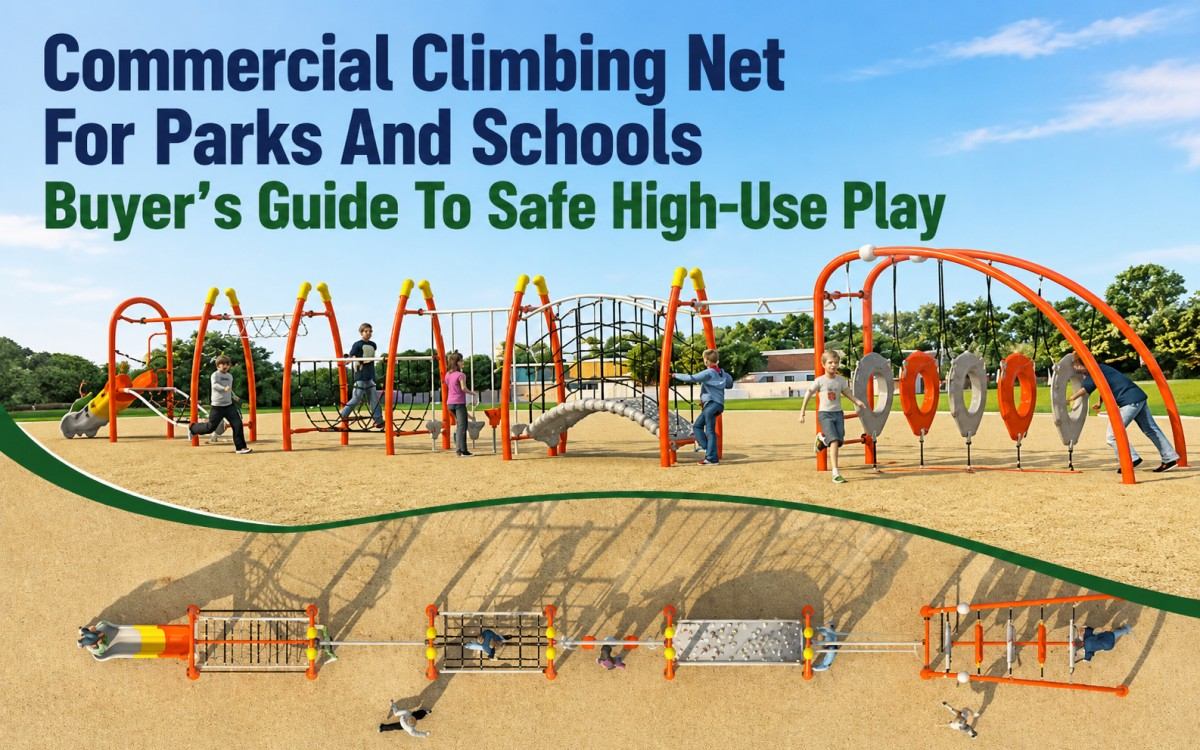
Commercial Climbing Net For Parks And Schools Buyer’s Guide To Safe High-Use Play
Buying a commercial climbing net for parks and schools is not simply a matter of selecting an attractive shape from a catalogue. Buyers need to know whether the structure fits the site, serves the intended age group, supports busy daily use, meets local safety requirements, and can be installed and maintained without unexpected costs.
A well-designed commercial climbing net for parks and schools creates several activities within one open structure. Children can climb vertically, move sideways, balance across flexible routes, choose different paths, and interact with other users. Parks gain a visible play landmark, while schools gain an active structure with open sightlines for supervision. Major commercial playground manufacturers similarly emphasise varied movement, route choice, physical challenge, coordination, and problem-solving as central benefits of rope climbing equipment.
This guide combines procurement advice, material selection, safety planning, custom design, installation, and after-sales support. It explains what customers should request before approving a commercial climbing net for parks and schools. For procurement teams, the commercial climbing net for parks and schools should be evaluated as a complete site system rather than an isolated product.
What Buyers Should Define Before Requesting A Quote
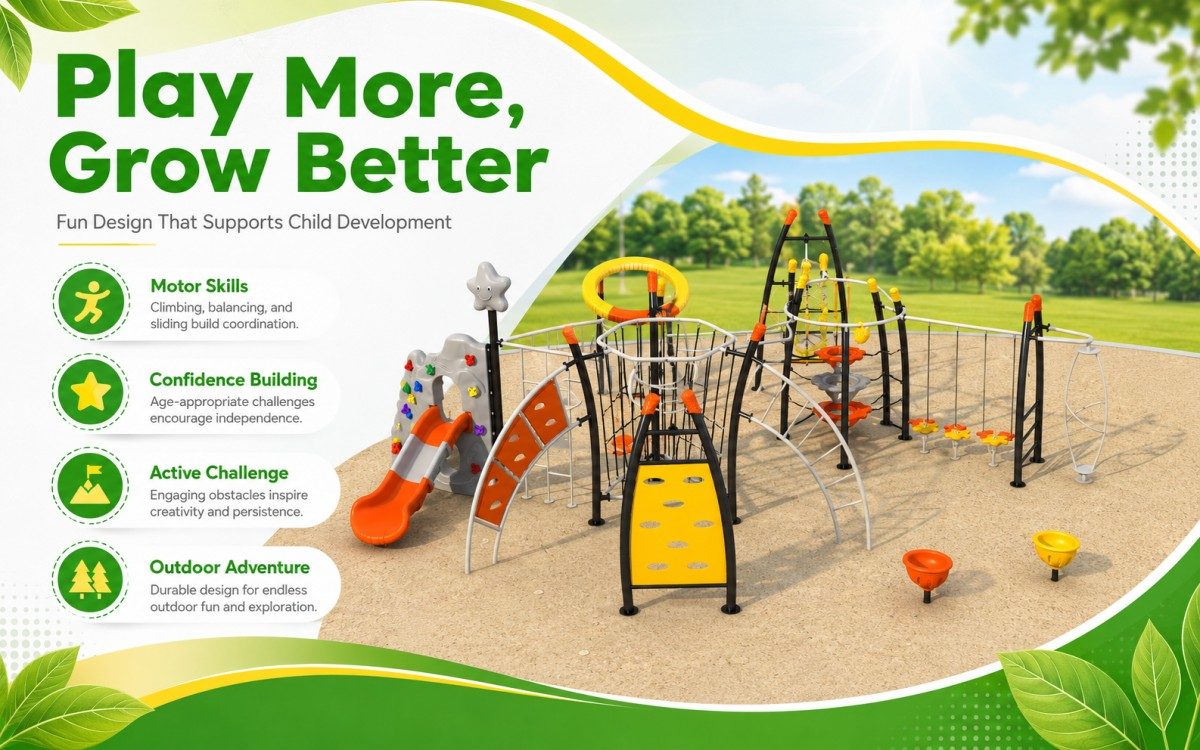
The first question is not “How much does it cost?” The first question is “What must this equipment achieve?” A quotation for a commercial climbing net for parks and schools is only useful when the supplier understands the actual site and operating conditions. The correct brief prevents the commercial climbing net for parks and schools from being oversized, underused, or difficult to install.
Start with the usable installation area rather than the total site area. The product footprint, use zone, protective surfacing, drainage, access routes, trees, fences, underground services, and nearby equipment all affect the layout. A tall net tower may fit on a basic plan but become unsuitable after the safety area is included.
Define the target age group and expected peak use. A primary school may need progressive challenges, several entry points, and fast circulation during short break periods. A public park may require easier and harder routes for mixed ages. When a commercial climbing net for parks and schools has only one narrow entrance, queues and crowding can reduce its real capacity. Multiple access points, progressive challenges, open layouts, and clear sightlines are especially important for busy school playgrounds.
A site-ready commercial climbing net for parks and schools begins with complete project information. Send the manufacturer a dimensioned plan, site photographs, target ages, preferred theme, estimated user capacity, required safety standard, surfacing plan, budget range, and delivery deadline. These details allow the supplier to recommend the correct commercial climbing net for parks and schools instead of offering the largest model within the budget.
The manufacturer should also know whether the site is level, sloped, paved, landscaped, coastal, exposed to strong sunlight, or located in a cold climate. These conditions can affect the foundation design, corrosion-protection method, rope specification, drainage plan, installation process, and future inspection schedule.
Which Climbing Net Structure Fits The Site And Users
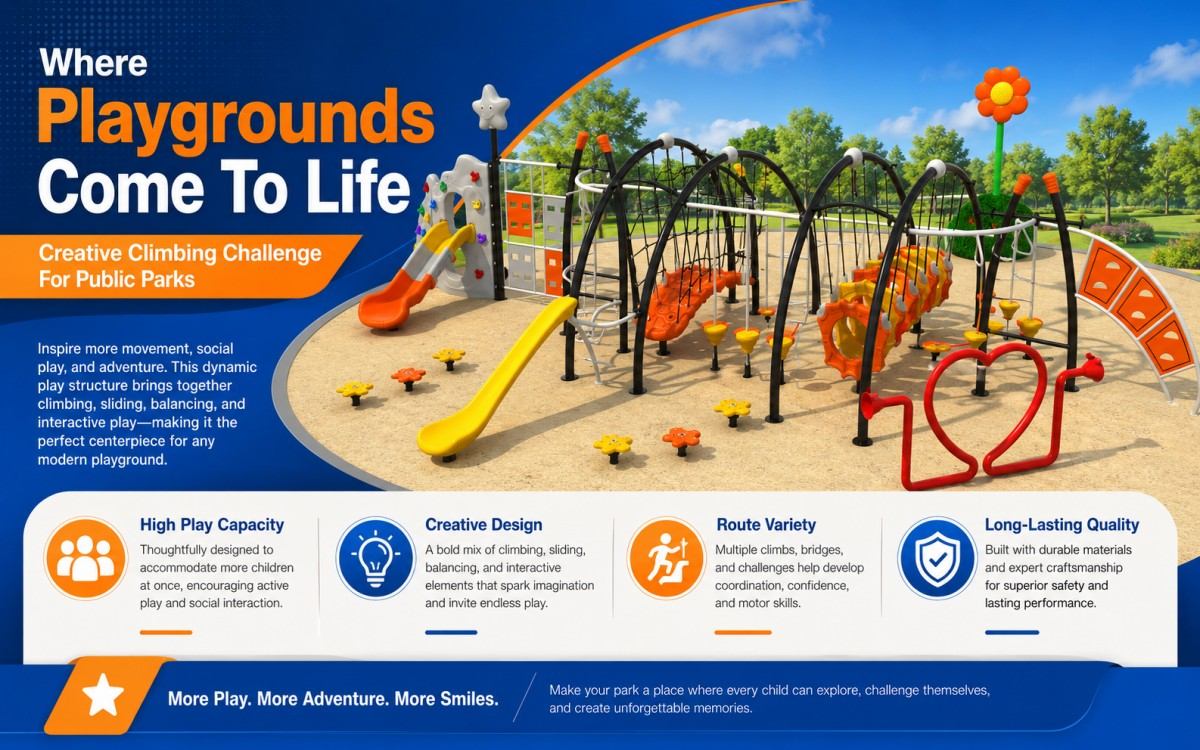
The structure type determines the play experience. Flat or inclined rope panels suit compact sites and can connect platforms. Domes and arches offer three-dimensional climbing with a lower profile. Pyramid or central-mast nets provide height and landmark value. Net tunnels create horizontal movement, while low-rope courses distribute balancing and obstacle activities across a longer area. Choosing the right commercial climbing net for parks and schools begins with matching movement patterns to the available space. Leading rope-play suppliers organise their ranges around spatial nets, planar nets, domes, towers, low-rope courses, modular combinations, and customised sculptures.
For schools, a commercial climbing net for parks and schools should normally prioritise capacity, route variety, and supervision over extreme height. Horizontal movement, branching routes, and several access points keep more children active at the same time. Multiple access points can also reduce bottlenecks during busy school breaks, while open layouts support staff sightlines.
For parks, the commercial climbing net for parks and schools may need stronger visual identity. A sculptural frame, themed tower, spatial net, or combination of nets, slides, bridges, and panels can become the centrepiece. However, height alone does not create play value. A lower structure with crossings, decisions, resting areas, and different routes may engage more children than a tall unit with one repetitive path.
Age-appropriate challenge is another important consideration. Younger children generally need lower climbing heights, closer access points, easier transitions, and clear routes back to the ground. Older children may prefer flexible ropes, wider route choices, suspended crossings, climbing tunnels, higher platforms, and activities that require planning.
Accessibility should be planned from the beginning. Not every user will climb to the top, so the commercial climbing net for parks and schools can connect with ground-level activities, transfer points, sensory panels, social spaces, hammocks, or lower challenge elements. Inclusive design means creating meaningful participation at several levels, not adding one isolated accessible feature.
Buyers should therefore compare structures according to usable play capacity, challenge range, route diversity, supervision, accessibility, footprint, and maintenance needs. Comparing products by height or appearance alone can result in a visually impressive structure that performs poorly during actual operation.
How Materials And Connections Determine Service Life
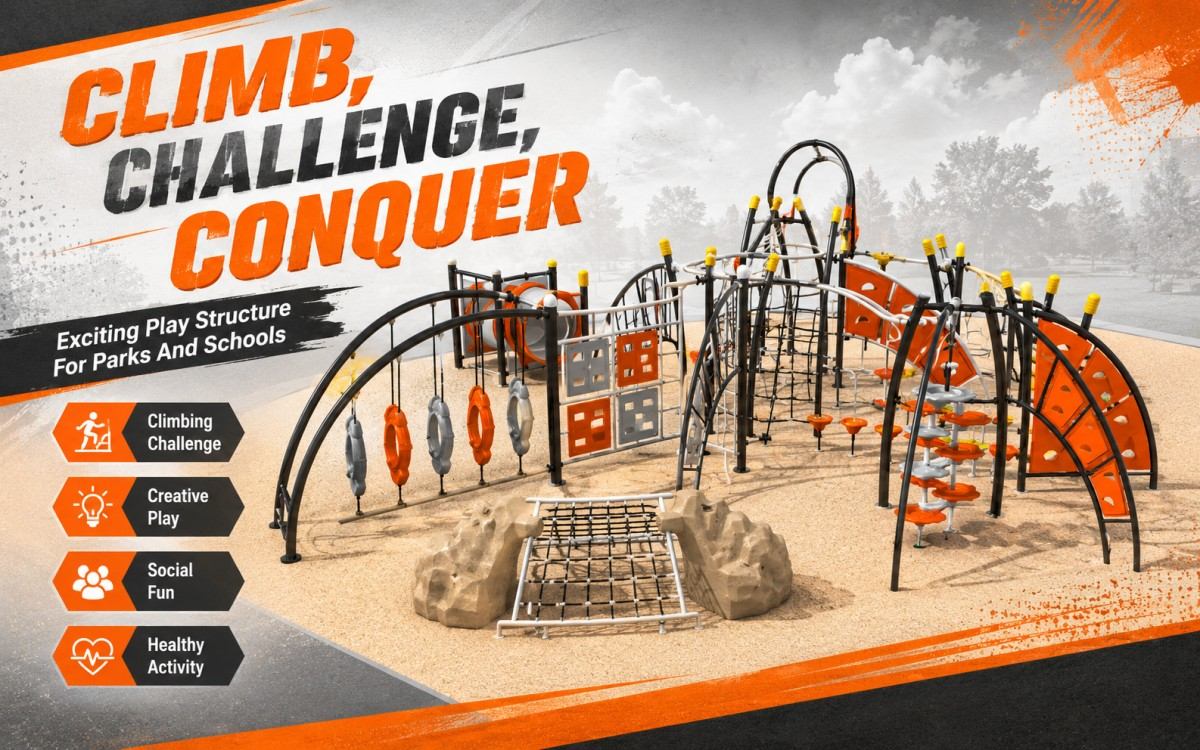
The rope is the most visible material, but the long-term performance of a commercial climbing net for parks and schools also depends on internal reinforcement, joints, terminations, tensioning parts, support frames, coatings, foundations, and replaceable wear components. Every material choice in a commercial climbing net for parks and schools should be reviewed as part of one connected load-bearing system.
For heavy public use, buyers commonly specify multi-strand synthetic rope with internal steel reinforcement. The outer fibres should be suitable for ultraviolet exposure, moisture, abrasion, and repeated hand contact. Ask the supplier to identify the rope material, diameter, cable construction, connector material, and relevant test information. “Outdoor rope” is not a complete specification for a commercial climbing net for parks and schools. Commercial net suppliers commonly use steel-reinforced or steel-cored synthetic ropes to improve structural strength and outdoor durability.
Inspect the connection design as carefully as the rope. Cross joints should retain the intended mesh shape without sharp edges or uncomfortable pressure points. Rope ends should be protected from direct wear. Tensioning parts should resist unauthorised adjustment, and exposed hardware should suit the local climate.
Coastal air, high humidity, intense sunlight, freezing weather, and industrial pollution can require different corrosion-control choices. Buyers should tell the manufacturer where the equipment will be installed instead of assuming that one standard material specification is suitable for every country.
The frame of a commercial climbing net for parks and schools is often steel, although timber covers or decorative panels may be added. Ask about tube dimensions, wall thickness, welding control, galvanising or other corrosion protection, powder coating, drainage openings, and treatment around welds and cut edges. These details reveal more about durability than a glossy product image.
Buyers should also examine the connectors positioned close to children’s hands and feet. Connection points should be smooth, secure, difficult to loosen without tools, and arranged so that they do not create unexpected snagging or impact hazards.
Durability planning for a commercial climbing net for parks and schools includes future repair as well as initial strength. A practical commercial climbing net for parks and schools should permit local repair. Request a component list and confirm that ropes, clamps, connectors, caps, and tensioning parts can be ordered separately. Replaceable sections can reduce future downtime and avoid the cost of changing the complete net.
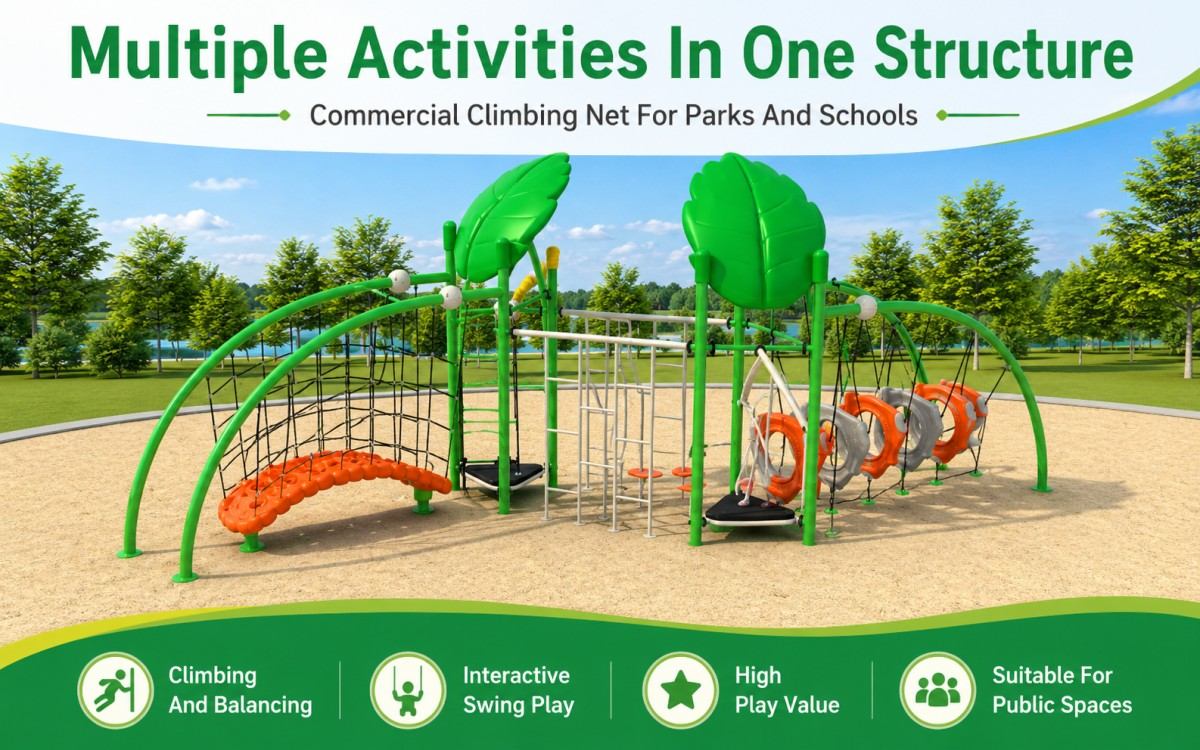
Which Safety Documents And Design Details Matter
Safety planning begins before production. The required standard depends on the project location and contract. US public playground projects commonly reference ASTM F1487-25, and impact-attenuating surfacing is covered by ASTM F1292-22. European and UK projects commonly work with EN 1176 and EN 1177, while Canadian projects use CSA Z614. Buyers should confirm the required edition and local authority rules before ordering a commercial climbing net for parks and schools. Compliance review for a commercial climbing net for parks and schools should cover both the equipment and the surrounding play area.
Ask the supplier to state the intended age group, overall dimensions, maximum free-fall height, required use zone, anchoring method, foundation plan, surfacing requirement, and inspection points. For every commercial climbing net for parks and schools, review mesh openings and transitions for head, neck, finger, clothing, and limb entrapment risks.
Also check protrusions, accessible bolt ends, sharp edges, crush points, suspended components, and areas where a user could fall onto another part of the equipment. A climbing route should not create a hidden opening that allows part of a child’s body to pass through while preventing safe withdrawal.
Climbing equipment should provide a reasonable way to descend, and transitions between nets, platforms, bridges, and slides need secure hand support. The drawing should also consider children moving in different directions at the same time. A safe commercial climbing net for parks and schools is designed for real group behaviour, not only for one child following the intended route. The CPSC handbook specifically addresses descent routes, hand support at transitions, entrapment, use zones, and protective surfacing for public climbing equipment.
Protective surfacing must match the final fall height and cover the required use zone. Exposed foundations and obstacles should not remain within landing and circulation areas. Drainage is also important because displaced loose-fill material, standing water, lifted tiles, or damaged rubber can reduce long-term surface performance.
Do not finalise surfacing before the commercial climbing net for parks and schools design is frozen. Changes in height, footprint, platform position, attached slides, or exit direction can change the surfacing area, material specification, and total project cost.
Request model-specific drawings, installation instructions, maintenance guidance, product identification, material information, and relevant compliance or test documents. A generic certificate is not enough when it does not clearly correspond to the ordered commercial climbing net for parks and schools.
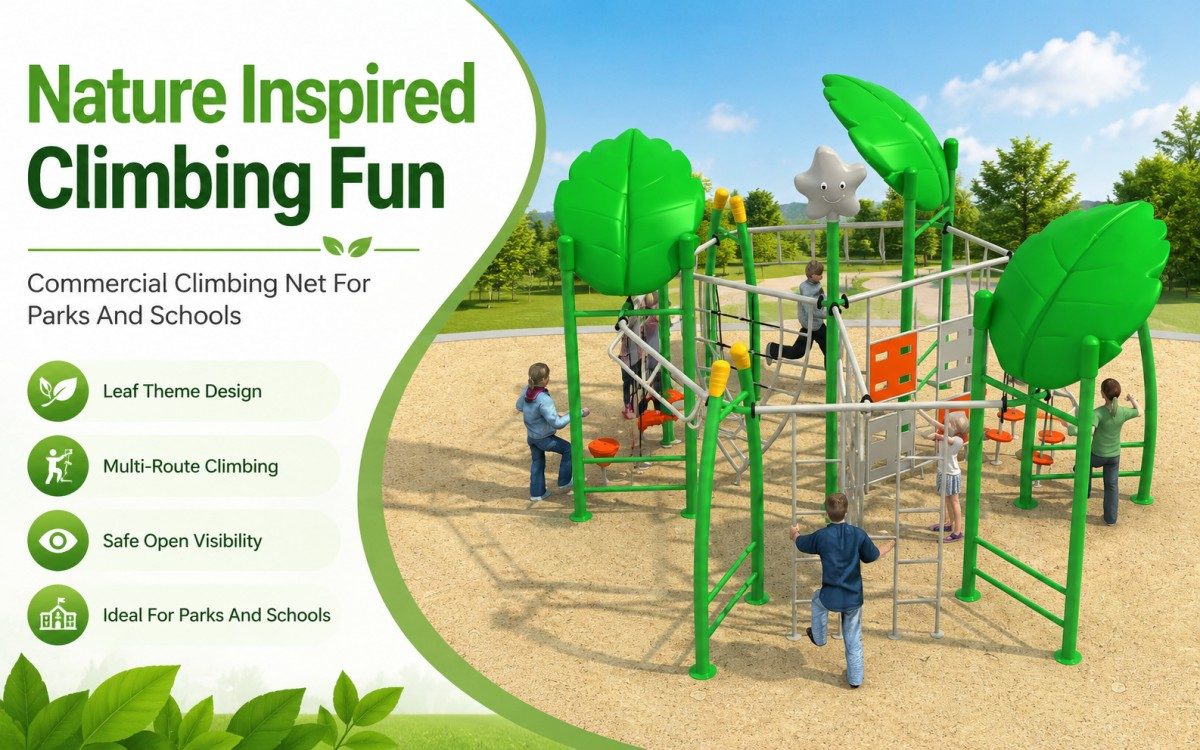
How Custom Design Controls Budget And User Flow
Customisation is useful when it solves a site or operating problem. Changing colours alone does not create a project-specific commercial climbing net for parks and schools. Effective customisation adjusts the footprint, route difficulty, entry positions, height, capacity, theme, surfacing boundary, and connection with other equipment. A successful commercial climbing net for parks and schools uses custom design to improve function before adding decoration.
A narrow schoolyard may use a linear route with side entries instead of a wide central tower. This allows children to enter at several points and reduces concentration around one access route. Lower horizontal elements can also provide useful activity without blocking views across the playground.
A park with a slope may connect two levels, subject to engineering and safety review. A community playground can combine lower nets, social hammocks, climbing panels, and one spatial net. In each case, the commercial climbing net for parks and schools should respond to the site rather than forcing the site to accept a standard product.
The colour scheme can coordinate with school branding, surrounding architecture, park landscaping, or a selected theme. Decorative HDPE panels, roofs, tunnels, slides, animal shapes, nature themes, space themes, and adventure elements can be added where they contribute to the overall experience.
Budget must cover the installed system, not only the equipment. Freight, import charges, foundations, concrete, lifting equipment, labour, surfacing, fencing, drainage, preparation, inspection, and spare parts may sit outside the product price. A professional quotation for a commercial climbing net for parks and schools should separate included items from exclusions.
Ask for a base option, a recommended option, and an enhanced option. The base version should meet the essential brief. The recommended version can improve capacity or route variety. The enhanced version may add height, themed panels, tunnels, slides, or extra climbing paths. This makes it easier to see which upgrades add real value to the commercial climbing net for parks and schools.
As a direct playground equipment manufacturer, our factory can support custom colours, layouts, themes, slides, platforms, tunnels, and climbing combinations. We can prepare drawings around the customer’s dimensions, coordinate production and trial assembly where applicable, and provide packing and installation documents for the ordered commercial climbing net for parks and schools.
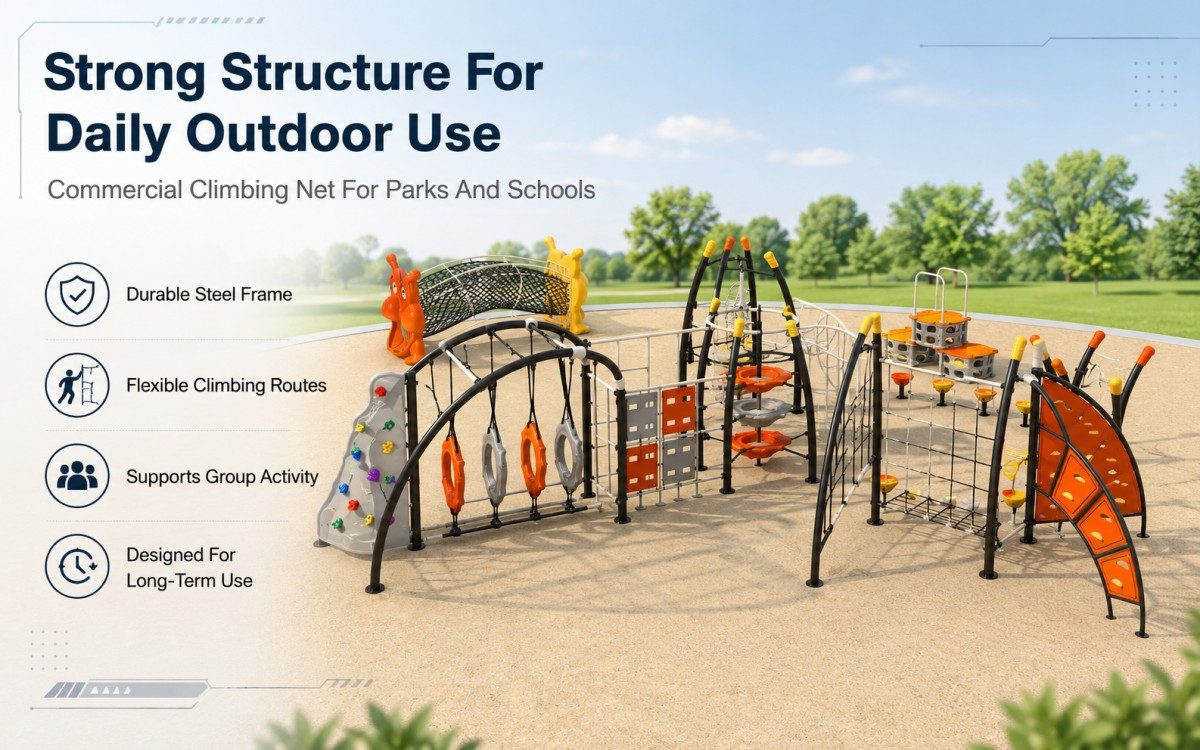
How Installation Inspection And Supplier Support Reduce Risk
Even a correctly designed commercial climbing net for parks and schools can fail to perform as intended if foundations are misplaced, posts are misaligned, connectors are fitted incorrectly, or rope tension is uneven. Installation should follow the approved foundation dimensions, curing requirements, assembly sequence, fastening guidance, and tensioning instructions.
Before shipment, request a packing list, marked component drawings, foundation plan, assembly manual, hardware schedule, and photographs or video of key steps. Numbered parts and clear labels reduce site errors. For complex designs, factory trial assembly can help identify missing parts and confirm the appearance of the commercial climbing net for parks and schools before packing.
The installation team should confirm the locations of underground utilities before excavation. Concrete foundations must be completed according to the approved dimensions and allowed to cure properly before the net reaches its final operating tension. Attempting to correct inaccurate foundations by forcing posts or ropes into position can place unintended stress on the entire structure.
After installation, complete a documented handover inspection. Check foundations, post alignment, rope tension, connector security, mesh shape, clearances, surfacing coverage, exposed hardware, sharp edges, entrances, and transitions. Where independent inspection is required, complete it before opening the commercial climbing net for parks and schools.
Routine care should focus on wear, damage, looseness, corrosion, vandalism, surfacing displacement, and changes in rope tension. The CPSC recommends systematic inspection, written maintenance procedures, and prompt repair in accordance with the manufacturer’s instructions. Busy schools may require more frequent visual checks than lightly used parks.
Keep inspection records, photographs, repair dates, and replacement-part details for the commercial climbing net for parks and schools. These records help operators identify recurring wear, plan replacement parts, demonstrate responsible management, and prevent minor defects from becoming larger problems.
Long-term support for a commercial climbing net for parks and schools should be confirmed before the purchase order. Confirm the warranty scope, spare-part availability, response process, and method for identifying replacement ropes. Buyers should also confirm whether the supplier can provide remote assembly guidance, replacement drawings, installation videos, or updated component lists.
The best purchase is not simply the lowest-priced commercial climbing net for parks and schools. It is a solution that arrives with clear documents, can be installed correctly, remains easy to inspect, and can be maintained throughout its service life.
Send your site dimensions, project location, target age group, design preference, required standard, surfacing type, and budget to receive a practical commercial climbing net for parks and schools proposal developed for the real site.


 English
  Español
  Français
  Deutsch
  Português