


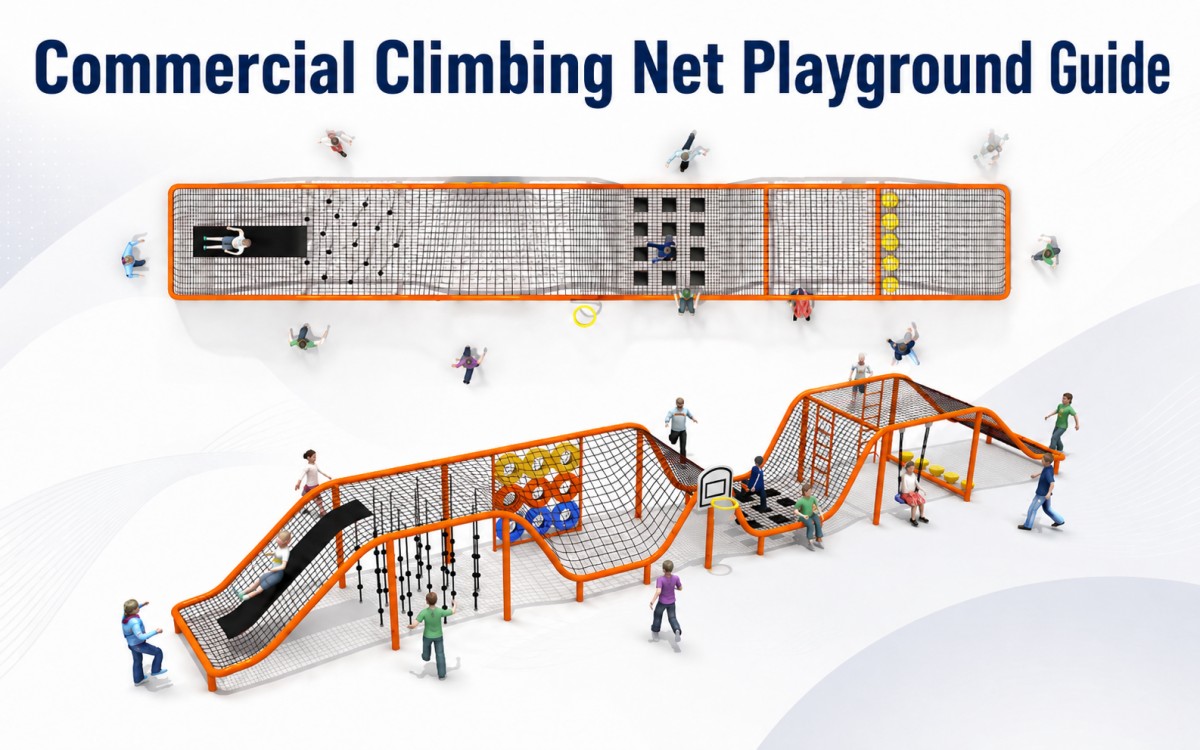
Kids rope net climbers are essential playground components for commercial projects like schools, parks, and resorts. They deliver a high-activity, low-maintenance play solution that attracts children and satisfies facility planners.
A kids rope net climber is a play structure made of rope netting, often combined with a frame, designed for climbing activities. It promotes motor skills, coordination, and group play.
This guide covers types, safety standards, customization, and procurement steps for B2B buyers. Whether you are specifying for a school playground, a hotel kids’ club, or a public park, you need a supplier that meets your timeline and certification requirements. We focus on what matters: material durability, fall-height compliance, and long-term value. No fluff, no brand names — just practical information for your next project.
If you are sourcing through a children’s playground equipment manufacturer or integrating rope net climbers into an outdoor playground equipment package, the following sections will help you evaluate options and prepare a clear RFQ.
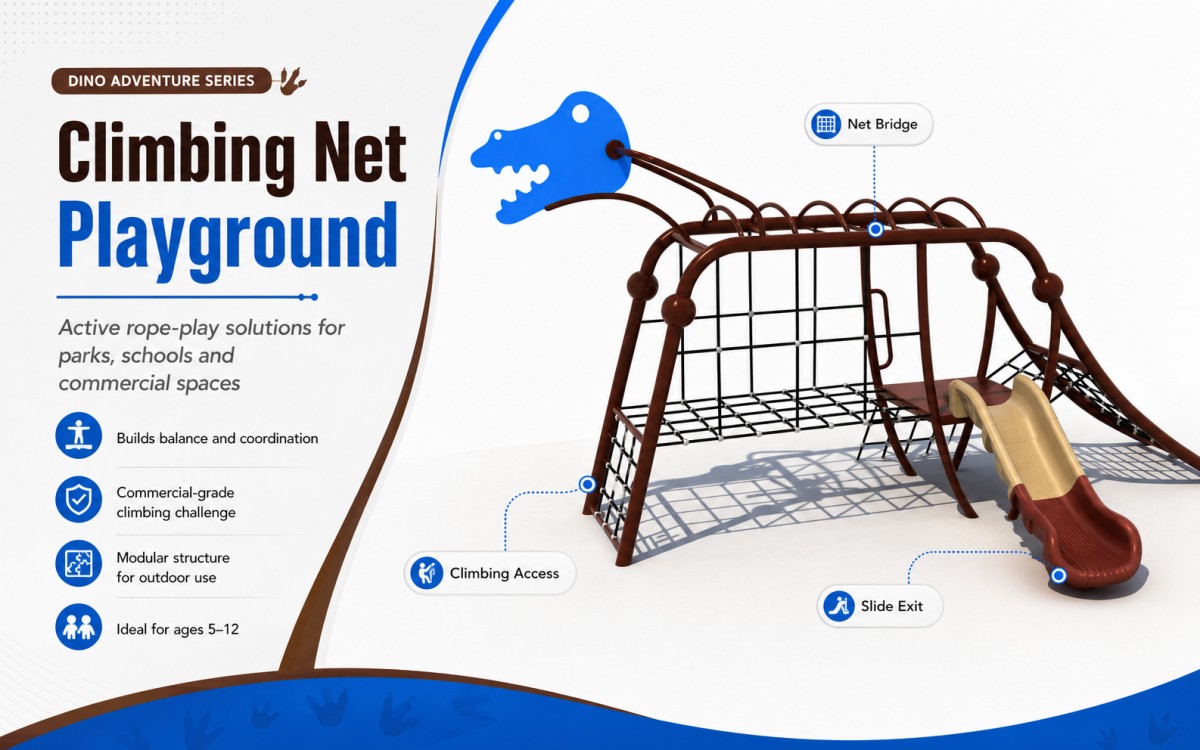
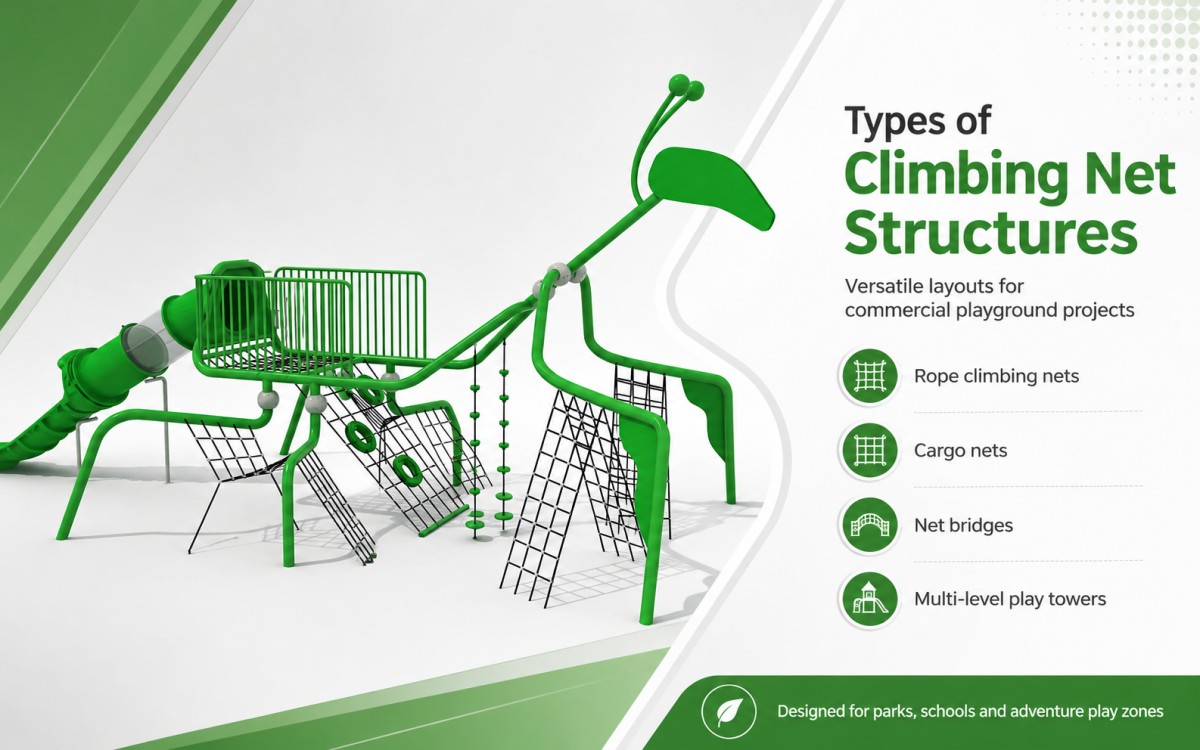
Types and Applications of Kids Rope Net Climbers for Commercial Playgrounds
The main rope net climber designs used in commercial projects are pyramid, arch, cube, and custom shapes. Each serves a specific play function and fits different site footprints. Materials are typically polyester rope (16 mm diameter, UV-stabilised) and hot-dip galvanized steel frames for corrosion resistance. Outdoor installations can last 8–10 years with routine inspection, while indoor models often use powder-coated steel to match interior colour schemes.
Pyramid Rope Net Climber
- Structure: Four-sided sloping net converging at a top platform or ring.
- Typical height: 2.0–3.5 m; base footprint from 3 m × 3 m to 5 m × 5 m.
- Age group: 5–12 years.
- Applications: School outdoor playgrounds, public parks, and community recreation centres – the pyramid shape provides a challenging climb that develops upper‑body strength and group coordination.
- Buyer note: Requires a minimum fall‑zone of 2.5 m around the base. Suitable for both open‑air and covered installations.
Arch Rope Net Climber
- Structure: A curved tunnel‑shaped net suspended between two or more support posts. The net forms an arched pathway or bridge.
- Typical dimensions: Height 1.5–2.2 m, length 2.5–5.0 m, width 1.0–1.5 m.
- Age group: 3–10 years.
- Applications: Connecting zones within a larger playground, such as linking soft‑play areas in shopping malls or hotels. Also popular in themed indoor playground equipment layouts.
- Buyer note: The arch design works well in narrow corridors or as a transition between different play levels. Smaller footprint than a pyramid, so more flexible for indoor soft play centres.
Cube Rope Net Climber
- Structure: A cubic or rectangular frame with netting on two or more sides, often with a deck or platform on top.
- Typical dimensions: 1.5 m × 1.5 m × 1.5 m (single cube) or stacked multi‑cube configurations up to 2.5 m high.
- Age group: 2–6 years.
- Applications: Indoor soft play zones, preschools, and smaller commercial fitness play areas. The enclosed feel gives younger children confidence.
- Buyer note: Low fall height (max 1.0 m without additional safety surfacing). Often combined with slides or climbing walls in a modular system.
Custom‑Shape Rope Net Climbers
- Structure: Free‑form designs – spheres, tunnels, bridges, animal shapes, or brand‑specific logos – built to site‑specific drawings.
- Typical dimensions: Vary by project; spans from 1.5 m to 8 m.
- Age group: Broad; custom designs can be tuned for toddler zones or older children.
- Applications: Theme parks, resort water‑play areas, branded kids’ clubs in hotels, and flagship playgrounds in shopping malls. Custom shapes allow you to differentiate your facility.
- Buyer note: Requires a longer lead time (6–10 weeks for engineering and prototyping) and higher MOQ for frame fabrication. Verify that the supplier’s rope tensioning system allows for safe adjustment during installation.
Design Comparison at a Glance
| Design | Typical Height | Primary Footprint | Recommended Age Group |
|---|---|---|---|
| Pyramid | 2.0–3.5 m | 3 m × 3 m – 5 m × 5 m | 5–12 years |
| Arch | 1.5–2.2 m | 2.5 m × 1.5 m – 5 m × 2.0 m | 3–10 years |
| Cube | 1.5–2.5 m | 1.5 m × 1.5 m – 2.5 m × 2.5 m | 2–6 years |
| Custom | Up to 8 m | Project‑defined | Variable |
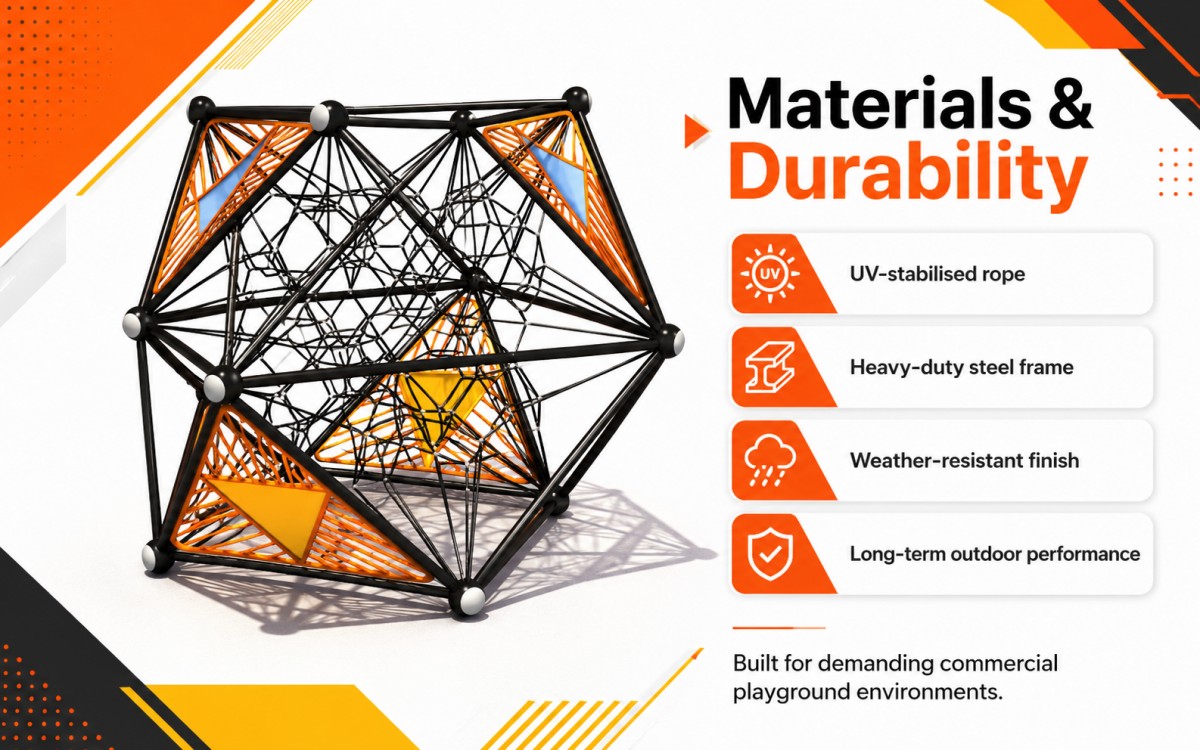
All designs share two material standards: polyester rope with a breaking strength of 2,000 N per knot and a hot‑dip galvanized steel frame (minimum 60 µm coating). When specifying for outdoor playground equipment, confirm that the rope is treated against UV and moisture to avoid fraying within the first three years.
Schools and public parks most often choose pyramid climbers for durability and capacity. Shopping malls and hotels favour arch and custom shapes because they integrate with overall interior themes. For indoor play centres, cube and low‑arch models dominate, especially in the indoor soft play category, where fall heights must be kept below 1.0 m.
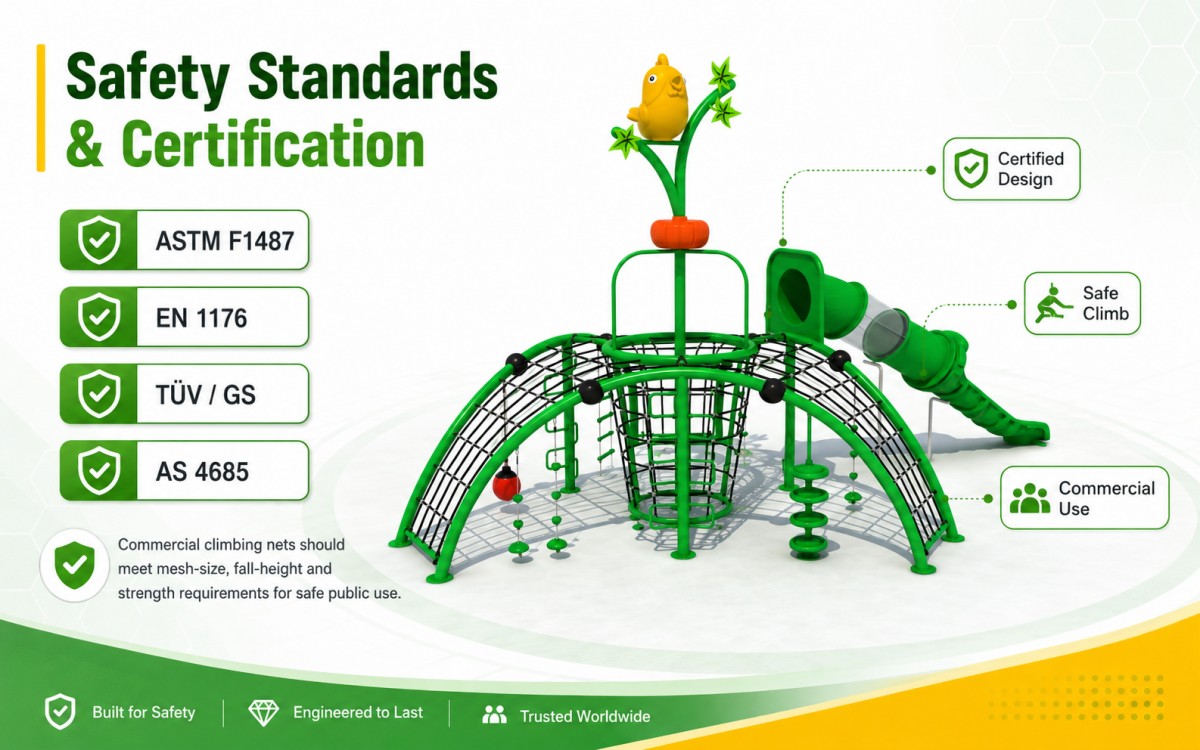
Once you have identified the right design for your space, the next step is verifying that the climber meets mandatory safety standards such as EN 1176 or ASTM F1487.
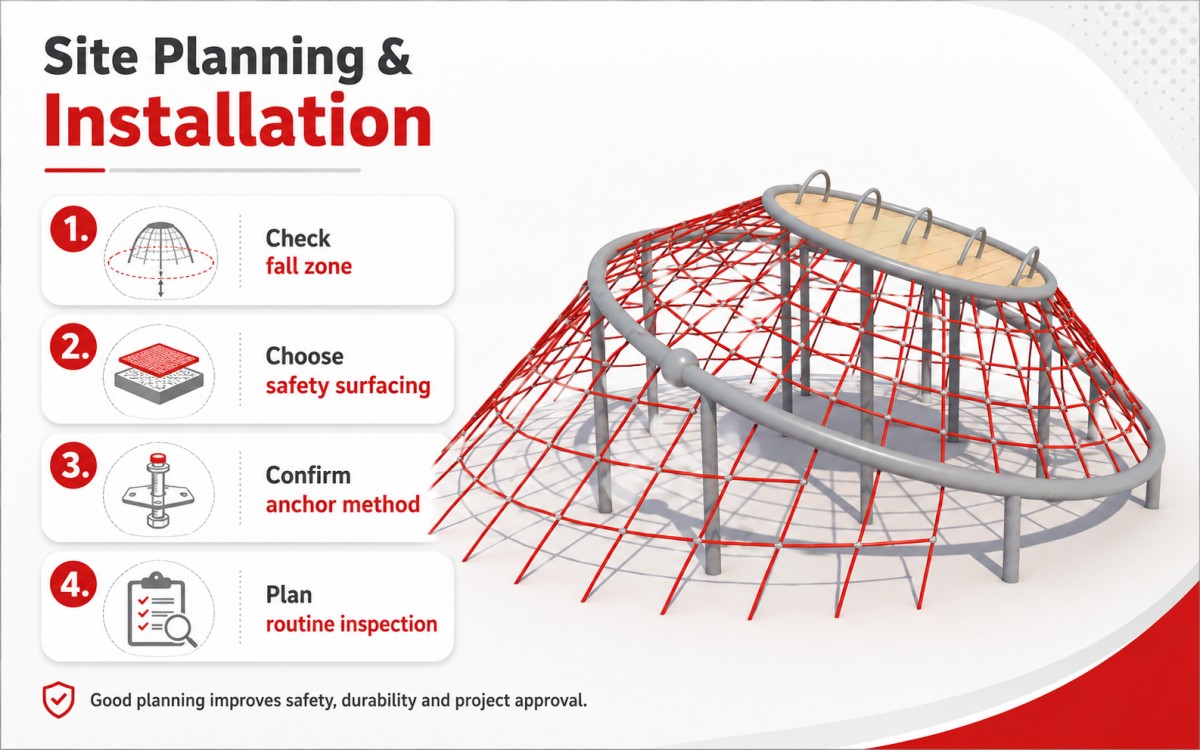
Key Safety Standards and Certifications for Importers
Before products can be shipped to a new market, you must verify the climber meets the destination’s safety standards. ASTM F1487 is the mandatory consumer safety specification for public playground equipment in North America. It covers maximum fall height (typically ≤1.8 m for net climbers without protective surfacing), load-bearing capacity per climbing element (≥285 kg distributed), entanglement hazards by limiting rope openings to 89–230 mm, and overall structural integrity. Non‑compliance means customs holds, liability exposure, and retailer rejection.
EN 1176 applies across Europe and is required for CE marking. The standard evaluates the design, installation, and inspection of playground equipment. Key metrics include minimum impact-absorbing surface dimensions, head‑and‑neck entrapment prevention, and rope strength (minimum breaking load 2 kN for horizontal climbing ropes). A certified EN 1176 climber in a water playground, for example, must also meet additional pool‑side corrosion resistance rules. Without the CE mark, you cannot sell into EU member states.
TÜV/GS marks are voluntary but widely recognised in Central Europe. The GS (Geprüfte Sicherheit) mark from TÜV SÜD, TÜV Rheinland, or similar confirms third‑party testing beyond the minimum norm. It signals higher quality to buyers such as school district planners or hotel chains. Demand the original certificate, not a photocopy. Check the test lab’s accreditation (ISO/IEC 17025) and that the certificate lists the exact model you are procuring.
| Standard | Region | Key Requirements | Certification Bodies |
|---|---|---|---|
| ASTM F1487 | North America | Fall height ≤1.8 m, load ≥285 kg per element, opening limits 89–230 mm, structural stability | Intertek, UL, SGS (third-party) |
| EN 1176 (CE) | Europe | Impact surfacing dimensions, head entrapment prevention, rope breaking load ≥2 kN | Notified bodies such as TÜV Nord, DEKRA, ICS |
| TÜV/GS Mark | Germany, Central EU | Voluntary third‑party test covering all EN 1176 items plus additional durability checks | TÜV SÜD, TÜV Rheinland, TÜV Nord |
When verifying supplier certificates, request the test report and confirm the model number matches. Check the certificate issue date – most standards are revised periodically (e.g., ASTM F1487‑21). Ask the supplier for a letter of conformity from the manufacturer, and, for large orders, consider hiring a third‑party inspection company to witness load testing during production. Smart importers also cross‑check the product’s label: a genuine CE mark includes the four‑digit ID of the notified body.
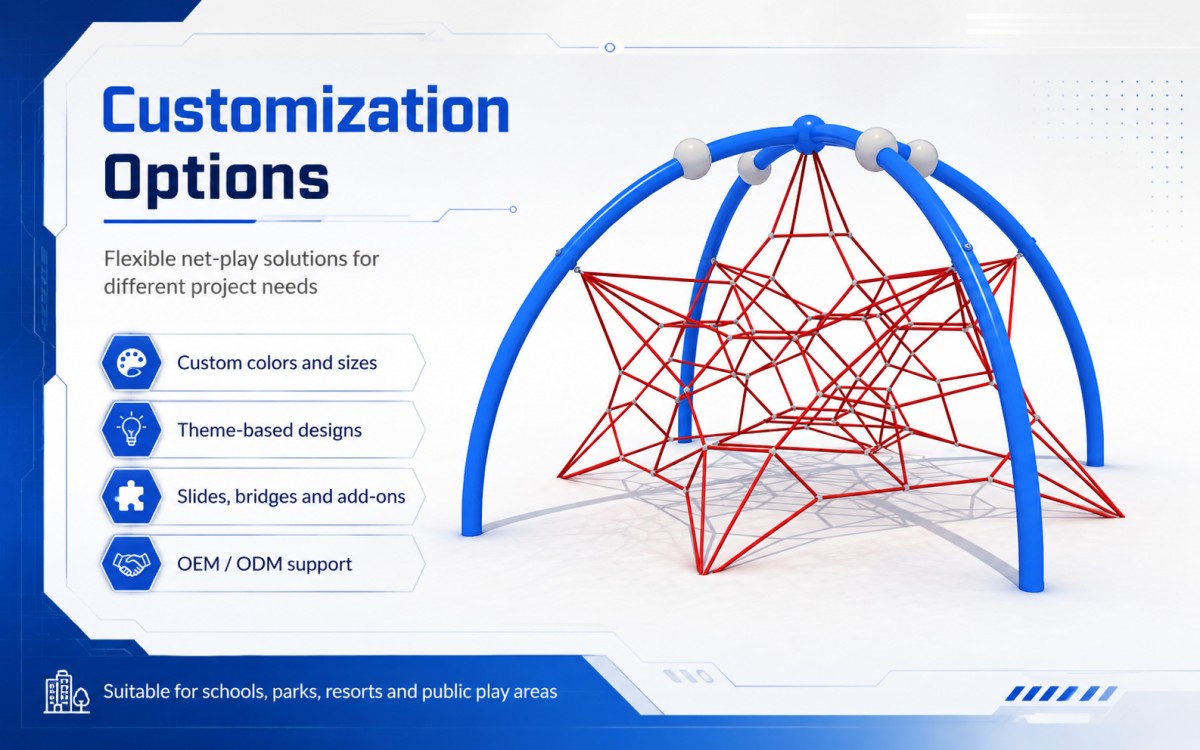
Custom Kids Rope Net Climbers: OEM/ODM Options for Playground Brands
Customisation is often the deciding factor when a playground brand wants to stand out. OEM/ODM rope net climbers let you tailor every element to your project’s site constraints and your brand’s visual identity. Below are the key areas you can customise, plus the typical procurement process.
Shape and Size
Standard designs (pyramid, arch, cube) work for many sites, but custom shapes allow tighter fit-to-space.
– Adjust footprint, height, and climbing angle to fit irregular areas (e.g., between columns in a mall).
– Alter the net’s inclination from steep (challenge) to gentle (junior play).
– Example: a hotel with a narrow pool‑deck area ordered a rectangular, low‑profile rope net climber instead of a square pyramid.
Frame Material: Steel vs. Aluminium
The frame choice affects weight, corrosion resistance, and cost.
– Galvanised steel – higher load capacity; standard for public parks; powder‑coat colour available (RAL codes).
– Aluminium – lighter, rust‑proof; preferred for rooftop playgrounds or areas near saltwater; higher unit cost.
– Both materials can be laser‑cut with your brand logo or serial number.
Rope Colour and Material
Rope selection defines the climber’s look and safety performance.
– Polyester rope (12–16 mm diameter) with UV‑stabilised colour: choose from 10+ Pantone or RAL shades.
– Add reflective strands or two‑tone weaving for themed play areas (e.g., forest‑green ropes for a nature‑themed custom playground).
– Optional anti‑slip coating on the rope nodes for extra grip in wet climates.
Logo Integration and Custom Packaging
Branding turns a generic climber into a signature piece for your chain or franchise.
– Laser‑etch or emboss your logo on the frame’s top plate or end caps.
– Print brand guidelines onto a weather‑rated label stitched into the rope net.
– Packaging: knock‑down flat‑pack for container shipping or pre‑assembled for local projects – both can carry your brand’s carton print and assembly manual.
The OEM/ODM Process
Working with a factory that offers full customisation follows a proven path:
1. Design brief – share your site plan, target age group, and any aesthetic references (e.g., kindergarten furniture colour palette).
2. Sample approval – a 3D rendering first, then a physical sample of the rope, frame section, and logo placement.
3. Production – the factory sources materials, cuts frames, weaves nets, and assembles test sections.
4. Quality control – load tests per ASTM or EN standards, inspection of weld quality and colour fastness, then packing.
The main benefit? You get a children furniture look that matches your branding, while meeting unique site demands – whether it’s a curved footprint for a shopping‑centre atrium or a colour‑coded climber for a chain of family resorts.
How to Prepare an RFQ for Kids Rope Net Climbers
Once you have defined your custom design and safety requirements, the next stage is to communicate those needs clearly to suppliers. A well-structured RFQ reduces misunderstandings and speeds up the sourcing cycle. Below is a practical checklist for procurement teams.
- Specifications
- Overall dimensions (length, width, height) and maximum fall height
- Maximum user weight per climbing face (e.g., 50 kg per child or 500 kg static load)
- Rope material and diameter (e.g., 16 mm polyester with UV stabilisation)
- Frame material and finish (e.g., hot-dip galvanised steel or powder-coated aluminium in RAL colour)
- Net mesh size and knot type (e.g., figure-eight knots spaced 150 mm apart)
- Certification Copies
- Request test reports for ASTM F1487 or EN 1176 compliance
- Ask for TÜV/GS certificate if serving the European market
- Verify that the certificates are current and cover the exact model
- Commercial Terms
- Minimum order quantity (MOQ) per SKU and per shipment
- Packaging type: knock-down (flat-pack) or fully assembled? Include packing dimensions and weight per carton
- Lead time from order confirmation to ex-works date
- Shipping terms (EXW, FOB, CIF) and available ports
- Warranty and After-Sales
- Warranty period for rope (typically 1–2 years) and frame (3–5 years)
- Replacement parts availability and pricing
- Technical support for installation and maintenance
Best practice: Ask the supplier for at least two reference projects with similar rope net climbers. Request a pre-production sample or video inspection of the first article before mass production. This step alone can flag dimensional or finish issues early.
By following this RFQ checklist, you ensure that every supplier responds on the same basis, making comparison straightforward and reducing the risk of hidden costs later.
About JQ Playground (Wenzhou Jiqi Amusement Equipment Co., Ltd.)
JQ Playground (Wenzhou Jiqi Amusement Equipment Co., Ltd.) is a leading children’s playground equipment manufacturer with 30+ years of industry experience. The company integrates design, customization, large-scale manufacturing, sales, and after-sales service. Main product range: Outdoor Playground, Indoor Playground, Indoor Soft Play, Water Playground, PE Board Playground, Custom Playground, Children Furniture, Outdoor Fitness Equipment, Pet Playground, and Playground Facility. Factory: 60,000+ square metres, 100+ patents, ISO/BSCI/Sedex/TÜV/ASTM/CE/CPC certified. Services cover site planning, design, manufacturing, installation guidance, and after-sales support for parks, communities, schools, commercial complexes, tourism projects, and government facilities worldwide. Contact: [email protected] / +86 18906666228.


 English
  Español
  Français
  Deutsch
  Português