


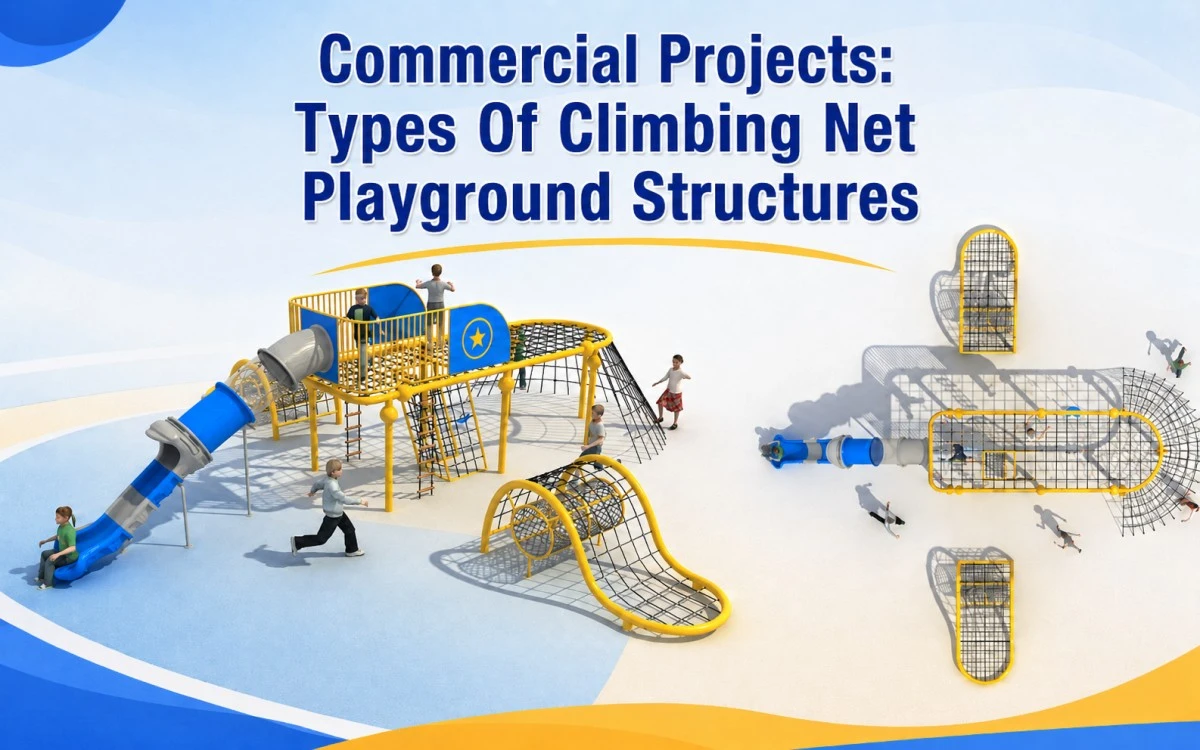
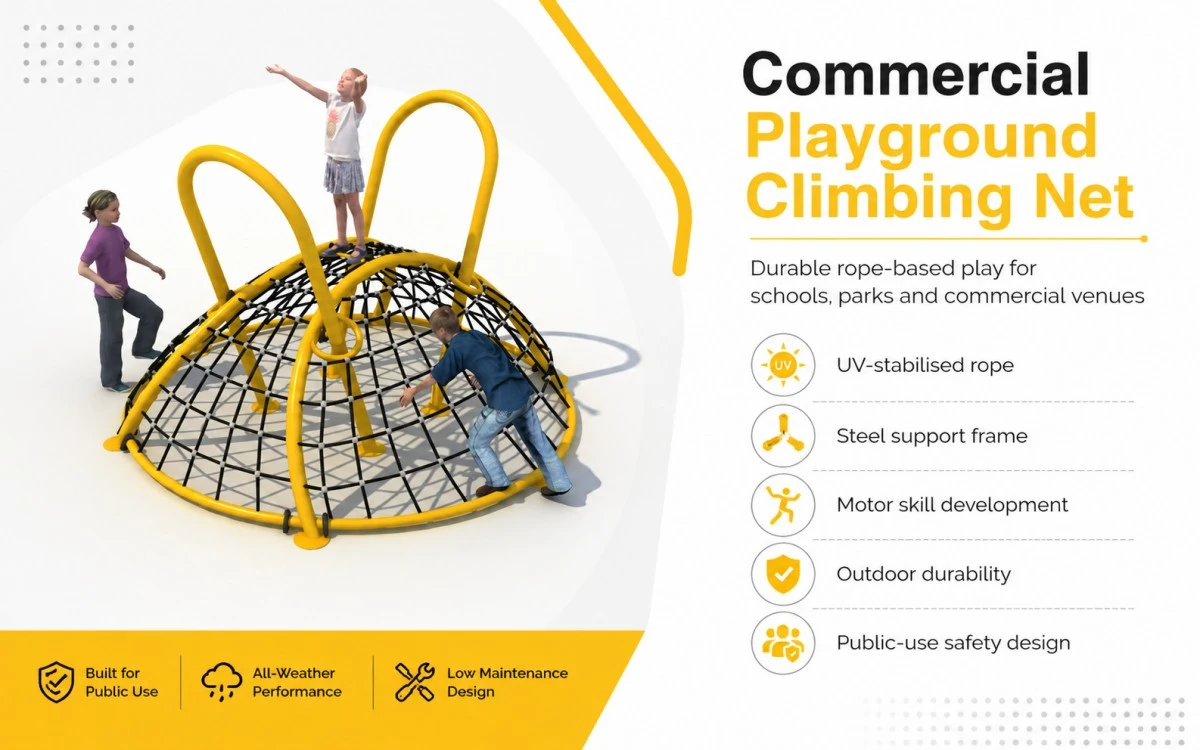
A commercial playground climbing net is a durable, rope-based structure designed for public play areas, offering climbing challenges while meeting strict safety regulations for schools, parks, and commercial venues.
This category of play equipment – a commercial climbing net – is typically constructed from UV-stabilised polyester or polypropylene rope with a braided core for high tensile strength. The net is attached to steel support poles or frames using galvanised hardware. Its purpose is to provide a climbing activity that builds motor skills and confidence in children, while withstanding years of public use.
When sourcing a climbing net for your next project, you need to evaluate material durability, safety certifications, and installation requirements. These factors determine long-term performance, compliance, and value – whether you are a children’s playground equipment manufacturer, a contractor, or specifying outdoor playground equipment for a large commercial site. Getting them right from the start avoids costly retrofits and liability issues.
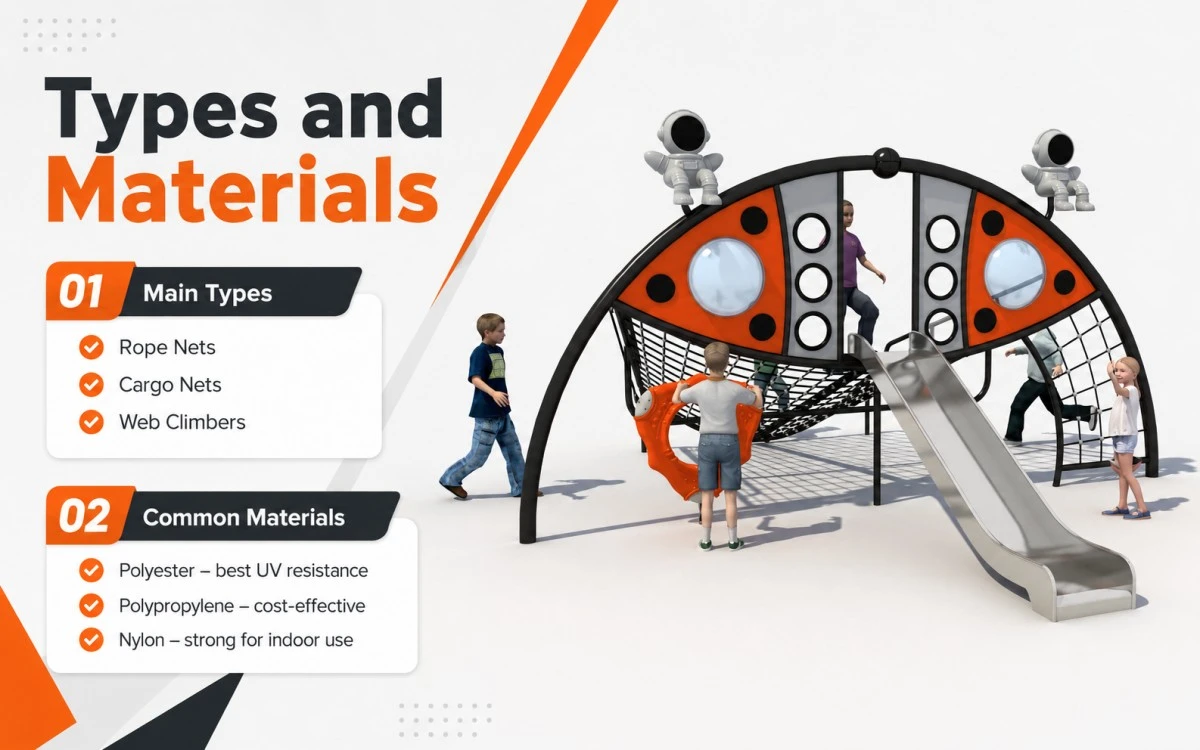
Commercial climbing net playgrounds fall into several distinct structure types, each engineered for specific The three principal types are rope nets, cargo nets, and web climbers. Rope nets are flat or angled panels hung between posts. Cargo nets are flexible grid structures often used for angled climbing. Web climbers form three-dimensional shapes like tunnels and domes from tensioned rope. For every type, material selection drives long-term performance.
Common rope materials:
- Polyester – Excellent UV resistance (800–1,000 hours), minimal water absorption, retains tensile strength outdoors. Preferred for permanent outdoor playground equipment.
- Polypropylene – Low cost and buoyant, but UV degrades it after 200–300 hours unless stabilised. Best for indoor playground equipment or temporary installations.
- Nylon – High strength and abrasion resistance, but absorbs moisture (15% strength loss when wet). Commonly used in indoor soft play zones where UV exposure is limited.
Commercial-grade nets must include UV stabilisers and fire-retardant additives to meet EN 1176 or ASTM F1487. Rope construction also matters: twisted rope offers flexibility and knot retention; braided rope provides a smoother surface with higher wear resistance. Hardware such as stainless steel thimbles and aluminium clamps prevent abrasion at connection points. For corrosive environments, specify marine-grade hardware to extend service life.
Key Safety Standards and Certifications for Importing Climbing Nets
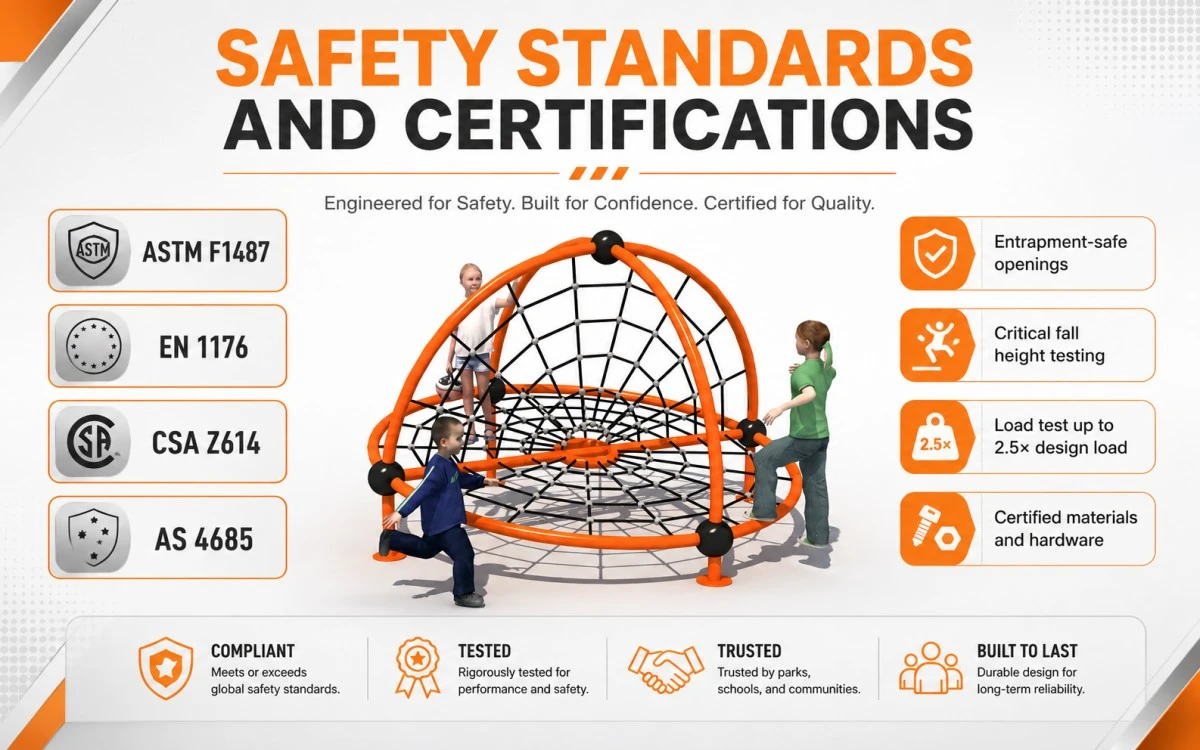
Compliance with global safety standards is not optional — it is a legal and liability requirement for any commercial playground climbing net you import. Buyers must verify that products meet the specific standard for the target market. The four primary benchmarks are ASTM F1487 (USA), EN 1176 (Europe), CSA Z614 (Canada), and AS 4685 (Australia). Each standard defines testing for fall height, entanglement prevention, load capacity, and material toxicity.
- ASTM F1487 (USA): Requires fall height testing up to the critical fall height of the net, anti-entrapment openings (no gaps between 89 mm and 230 mm), and structural load tests at 2.5 times the design live load. Third-party certification by bodies like TÜV or Intertek is common.
- EN 1176 (Europe): Mandates entanglement-free design, head and neck entrapment checks, and impact attenuation using the HIC (Head Injury Criterion) test. CE marking based on EN 1176 is required for EU market access.
- CSA Z614 (Canada): Similar to ASTM but with stricter fall zone surfacing requirements for water playground applications. Nets on PE board playground structures must also meet flammability and UV stability benchmarks.
- AS 4685 (Australia): References EN 1176 but adds specific requirements for extreme UV exposure and corrosion resistance in coastal environments.
You should request certification documentation from the supplier, including a Declaration of Conformity for CE marking or an ASTM test report from an accredited lab. Without verifiable compliance, you risk project delays, insurance voids, and injury liability that far outweigh the cost of certified nets.
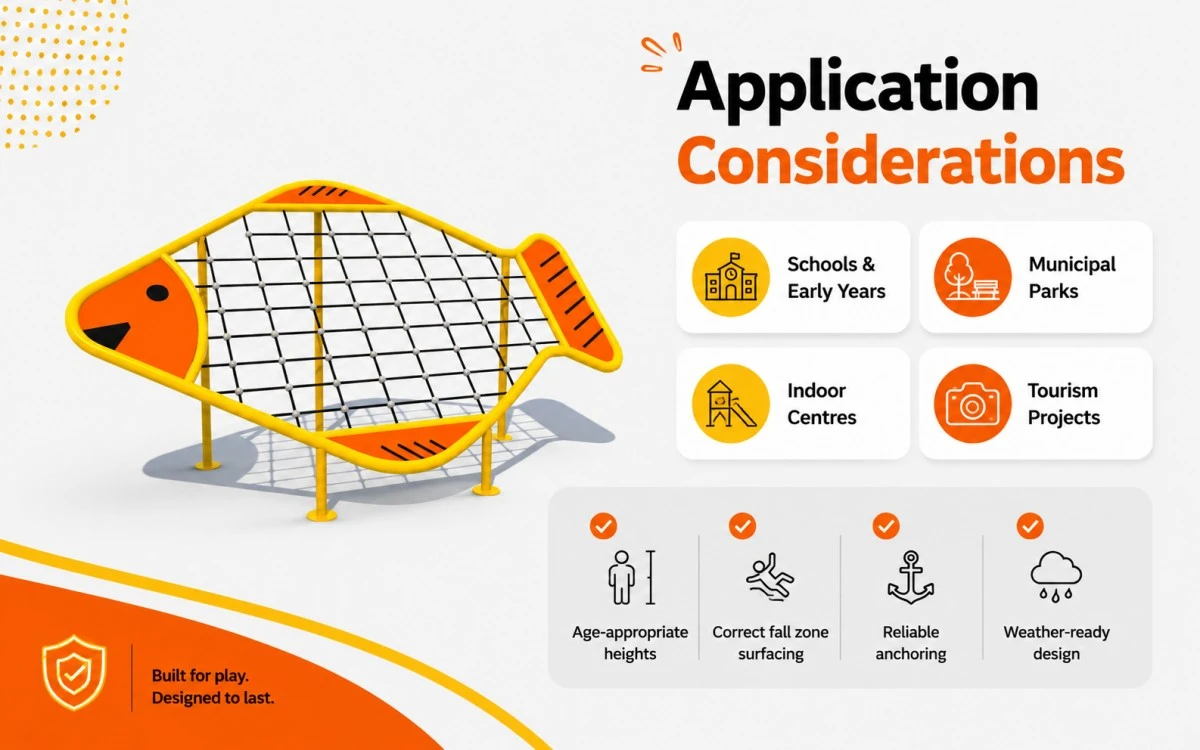
Application Considerations for Climbing Nets in Diverse Commercial Settings
Once you have verified certification compliance, the next step is matching the climbing net design to the actual site conditions. Each commercial setting imposes different demands on fall zone surfacing, anchoring, and clearance. Choosing the wrong combination leads to safety gaps, early wear, or installation delays.
Schools and Early Childhood Centres
For school playgrounds, age-appropriate net heights are governed by standard use zones. For children aged 2–5, keep net access points below 1.5 m to limit fall potential. For primary-age users (5–12 years), heights of 2.0–2.4 m are common. Fall zone surfacing here typically uses poured-in-place rubber or bonded rubber mulch to meet critical fall heights of 1.5–2.4 m. Use zone dimensions extend at least 1.8 m from the net’s outermost edge per ASTM F1487. Anchoring often employs concrete footings cast 600 mm deep to prevent movement under dynamic loads.
Municipal Parks
Public parks see high turnover and variable weather. Ground-stake anchoring works only on flat, stable terrain with proper compaction; otherwise, concrete footings are safer. For slope adaptation, net posts should be stepped or the net tensioned with adjustable turnbuckles to follow grade changes. Shade integration — using shade sails above the net — reduces UV degradation of the ropes and keeps surface temperatures tolerable. Fall zone surfacing here is often loose-fill rubber mulch at 200–300 mm depth, requiring periodic top-ups.
Shopping Malls and Indoor Centres
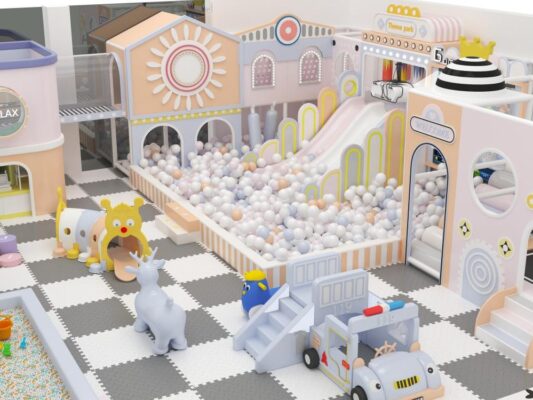
Indoor settings allow lighter nets but demand fire-retardant materials (certified to BS 5867 or EN 13501). Anchoring must secure to structural concrete slabs, often with chemical anchors rather than stakes. Fall zone surfacing is typically poured-in-place rubber or foam mat tiles, 40–60 mm thick. Net heights can reach 4 m for older children but require a use zone of at least 2.5 m horizontally. Consider integrating these nets into a custom playground layout that includes slides or climbing walls.
Tourism and Hospitality Projects
Resorts and tourist attractions often want nets with larger dimensions and higher load capacity to handle adult users. Net heights of 3–4 m are common, with fall zones of 3 m min. Anchoring should use concrete footings with steel base plates rated for 250 kg per anchor point. For coastal sites, specify marine-grade stainless-steel hardware and UV-stabilised polypropylene rope. Adding shade integration as part of the project brief prevents heat build-up and extends net life. Many tourism operators also request nets colour-matched to the surrounding children furniture or themed play areas.
Customisation and OEM/ODM Options for Commercial Climbing Nets
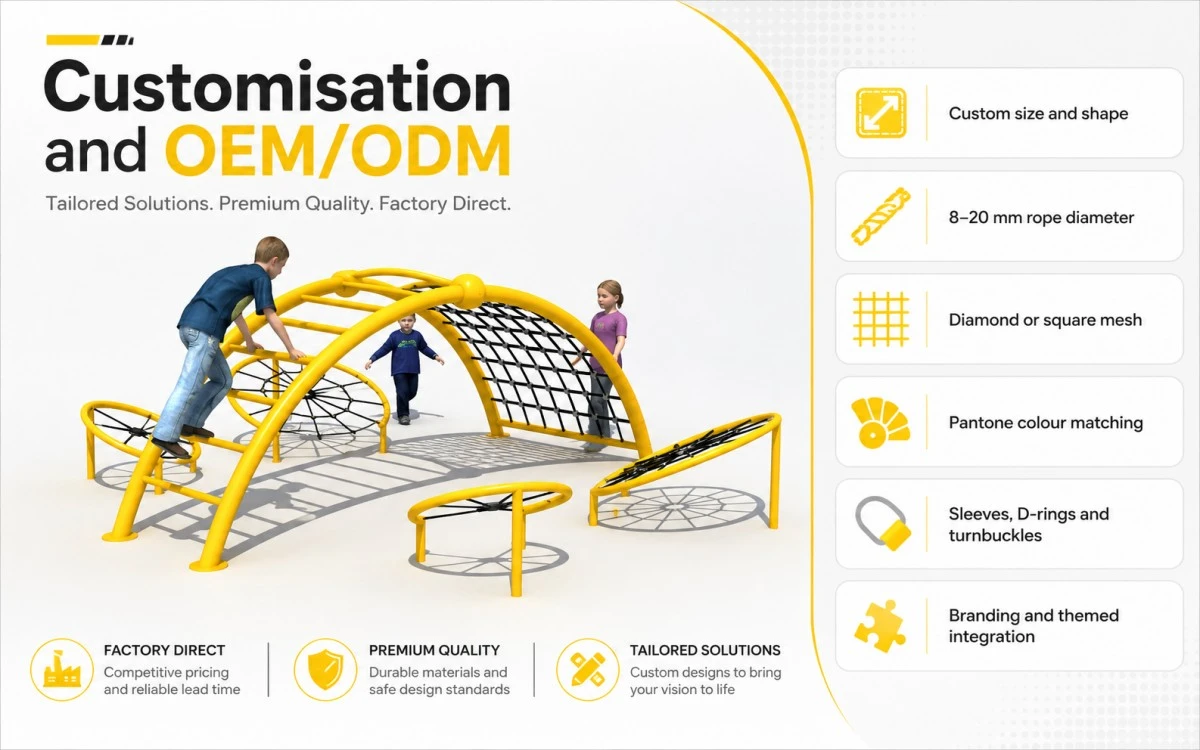
Customisation turns a standard net into a solution that fits your site’s exact dimensions, load requirements, and visual identity. Roof-top and indoor play centres often need nets that integrate with existing outdoor fitness equipment or themed zones. For pet playground areas, rope diameter and mesh size must suit animal size and safety.
Typical customisation variables include:
- Net size – length, width, and overall shape (rectangle, triangle, freeform)
- Rope diameter – 8 mm to 20 mm, depending on user age and load class
- Mesh pattern – diamond mesh (more flexible, common for climbing) or square mesh (stiffer, often used for cargo nets)
- Colour – any Pantone match; UV-stabilised polyester holds colour up to 5+ years outdoors
- Integration points – sleeves, D-rings, or turnbuckles for attachment to steel posts, timber frames, or concrete footings
- Branding – embroidered logos, woven tags, or colour-coded ropes for corporate identity
The OEM/ODM process typically involves a design consultation where you share drawings or site photos, followed by a sample net for load and fit testing. Once approved, bulk production starts with batch-lot traceability. Leading suppliers like JQ Playground offer customised solutions for unique project requirements, covering everything from kindergarten safety nets to high-capacity ropes for adventure parks. Requesting a sample before full production minimises fit issues on site.
Indoor vs. Outdoor Materials
Indoor climbing nets for play centres typically use polyester rope (non-UV-stabilised, lower cost) with zinc-plated fittings. Outdoor installations demand UV-stabilised polyethylene rope, a stainless steel or galvanised core, and powder-coated aluminium or steel frames to withstand sun and rain. Wheelchair-accessible net ramps – sloped at 15 degrees with side hand ropes – are becoming a standard inclusive add-on for both settings. Always specify the expected operating environment when requesting a quotation; material substitution impacts both durability and certification paperwork.
Key Considerations for Site Planning and Installation
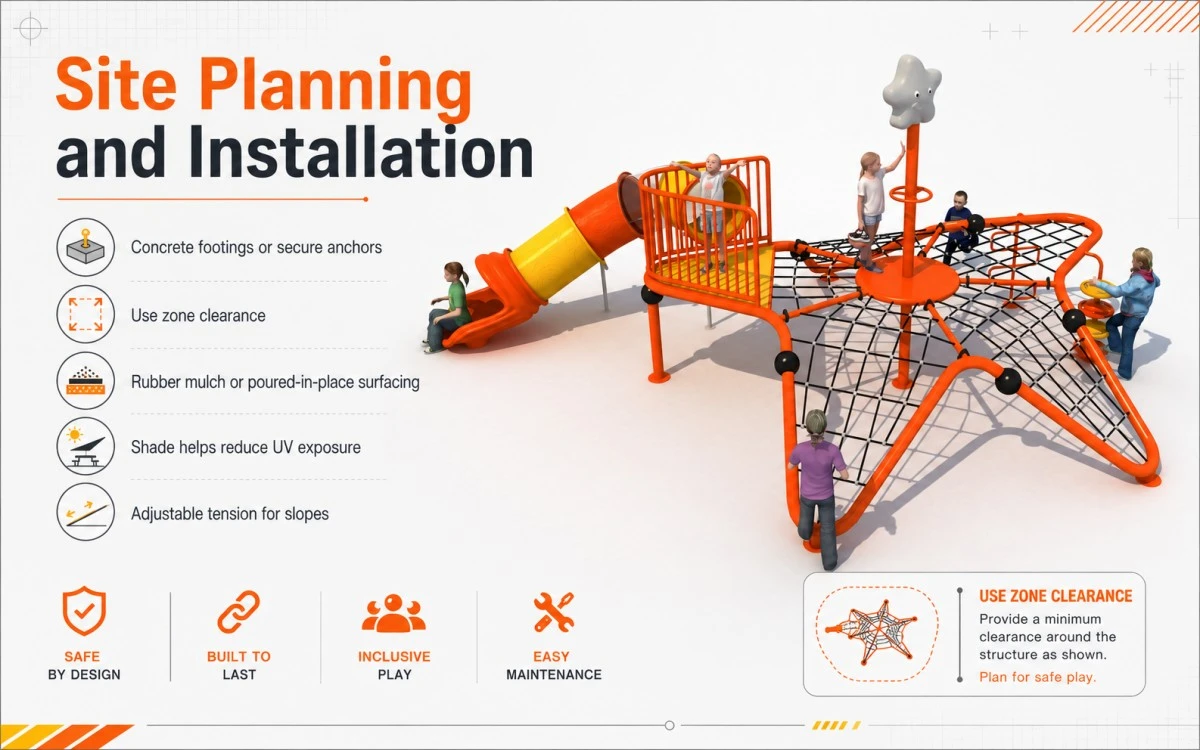
Site planning determines whether your climbing net playground passes inspection on day one or requires costly rework. Start with a flat, compacted base that drains away from the structure. Standing water accelerates rope degradation and creates a slip hazard on the surfacing layer.
Follow three planning steps before ordering equipment:
- Evaluate space and fall height – measure the available area and identify the tallest point of the climb. The required fall zone radius equals the fall height plus 1.5 m in all directions. For a 2.5 m-high net structure, you need a clear circle of at least 4 m radius.
- Select surfacing – rubber tiles, loose-fill sand, synthetic turf, or poured-in-place rubber. Each material has a critical fall height rating. A 1.5 m fall height typically needs 100 mm of loose-fill material; rubber tiles of 40 mm thickness may suffice for the same height under EN 1176.
- Confirm anchor points – concrete footings suit permanent installations on stable soil. Ground screws are faster to install and removable, making them ideal for rented or temporary sites.
About JQ Playground (Wenzhou Jiqi Amusement Equipment Co., Ltd.)
JQ Playground (Wenzhou Jiqi Amusement Equipment Co., Ltd.) is a leading children’s playground equipment manufacturer with 30+ years of industry experience. The company integrates design, customization, large-scale manufacturing, sales, and after-sales service. Main product range: Outdoor Playground, Indoor Playground, Indoor Soft Play, Water Playground, PE Board Playground, Custom Playground, Children Furniture, Outdoor Fitness Equipment, Pet Playground, and Playground Facility. Factory: 60,000+ square metres, 100+ patents, ISO/BSCI/Sedex/TÜV/ASTM/CE/CPC certified. Services cover site planning, design, manufacturing, installation guidance, and after-sales support for parks, communities, schools, commercial complexes, tourism projects, and government facilities worldwide. Contact: [email protected] / +86 18906666228.


 English
  Español
  Français
  Deutsch
  Português