


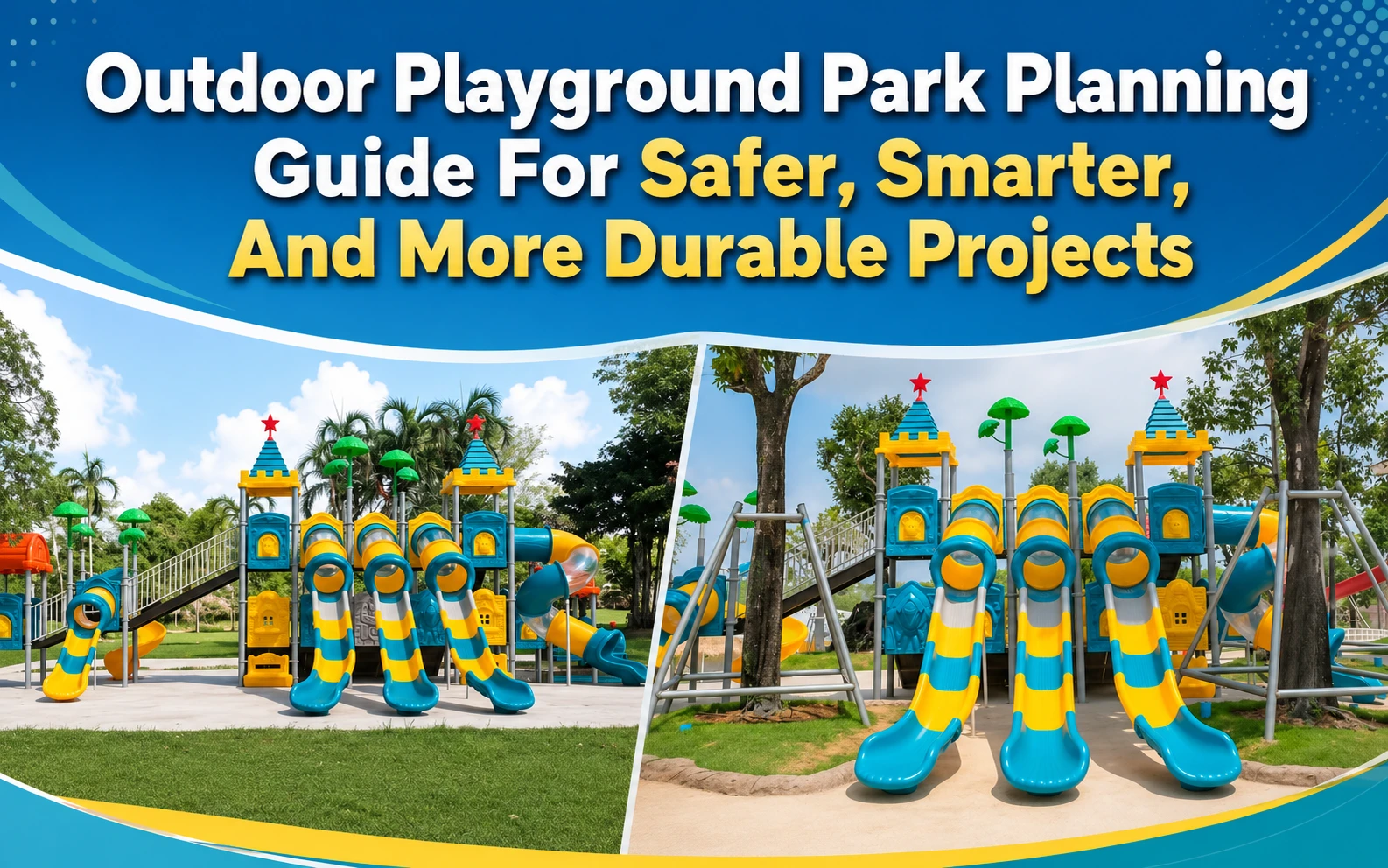
Choosing equipment is only one part of building an outdoor playground park. Buyers also need to control site circulation, safety surfacing, age separation, accessibility, installation conditions, delivery schedules, and long-term maintenance. A visually impressive structure can still become an expensive problem when the layout creates congestion, the quotation excludes civil work, or replacement parts are difficult to obtain.
This guide combines procurement, budgeting, safety, customization, materials, factory evaluation, installation, and after-sales planning. It is written for municipal buyers, schools, real estate developers, resorts, contractors, distributors, and operators who need an outdoor playground park that can be approved, installed, operated, and maintained—not merely photographed for a catalog.
Define The Outdoor Playground Park Project Before Selecting Equipment
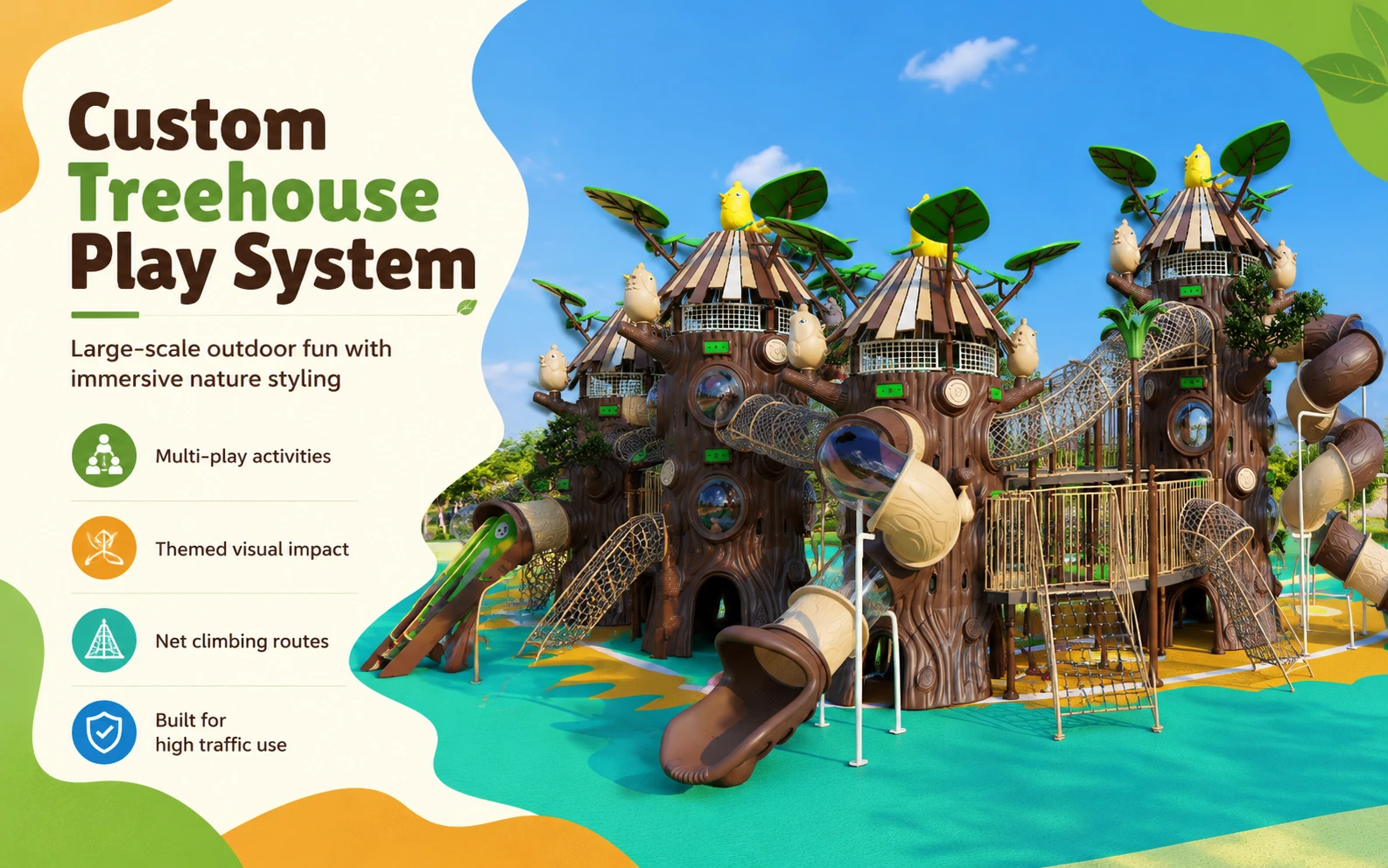
The first useful question is not “Which slide looks best?” It is “Who will use this space, how often, and under what operating conditions?” Before requesting a design for an outdoor playground park, prepare the site dimensions, boundary shape, entrance position, ground levels, underground utilities, drainage points, existing trees, nearby roads, expected daily capacity, target age groups, and local approval requirements. Photographs and a simple site plan help, but a surveyed drawing is better when the outdoor playground park has slopes, retaining walls, manholes, or irregular boundaries.
Usage changes the design. A neighborhood outdoor playground park may experience heavy use after school and on weekends, while a resort playground may need strong visual theming and activities that encourage longer family stays. A school project usually needs clear supervision, predictable circulation, and separation from vehicle areas. A commercial project may place more emphasis on visitor flow, landmark structures, photo points, and repeat-play value.
Buyers should also define success in measurable terms. Is the goal to serve 80 children at once, create separate zones for ages 2–5 and 5–12, provide wheelchair-accessible play, add shaded guardian seating, or complete installation before a public opening date? Clear priorities allow the manufacturer to design the outdoor playground park around project outcomes rather than filling empty space with unrelated products.
A complete outdoor playground park design brief should include the total budget, but it should also state what the budget must cover. Equipment-only budgets are different from turnkey budgets that include freight, foundations, surfacing, drainage, shade, fencing, lighting, installation, testing, and landscaping. When these boundaries are unclear, quotations that appear inexpensive are often incomplete.
Plan The Outdoor Playground Park Around Age Groups And Movement
A successful outdoor playground park needs more than a large combined play structure. Children should be able to move between active, social, sensory, imaginative, and quiet activities without repeatedly crossing swing paths, slide exits, or high-speed circulation routes. The outdoor playground park layout should create an understandable sequence from the entrance to play zones, seating, drinking water, toilets, and exit points.
For mixed-age sites, divide the outdoor playground park into developmentally appropriate areas. The current U.S. CPSC handbook identifies preschool-age children as ages 2–5 and school-age children as ages 5–12. It also recommends visible separation or buffer zones where different age groups share one playground. Benches, planting, low fences, or circulation paths can form the buffer without making the site feel divided.
The younger zone can use low platforms, short slides, spring riders, sensory panels, crawl tunnels, sand play, gentle balancing elements, and open areas where caregivers can stay close. The older zone can include taller climbing routes, rope nets, overhead challenges, spiral slides, group spinners, obstacle elements, and more complex balance activities. A well-planned outdoor playground park offers graduated difficulty, so children can choose a manageable challenge and return to try harder routes later.
In an outdoor playground park, sight lines matter as much as equipment choice. Avoid placing large opaque panels where they block supervision across the site. Position guardian seating where adults can see entrances, toddler areas, and high-activity zones. Separate moving equipment from circulation paths and leave clear landing and use zones around slides, swings, rotating equipment, and climbers.
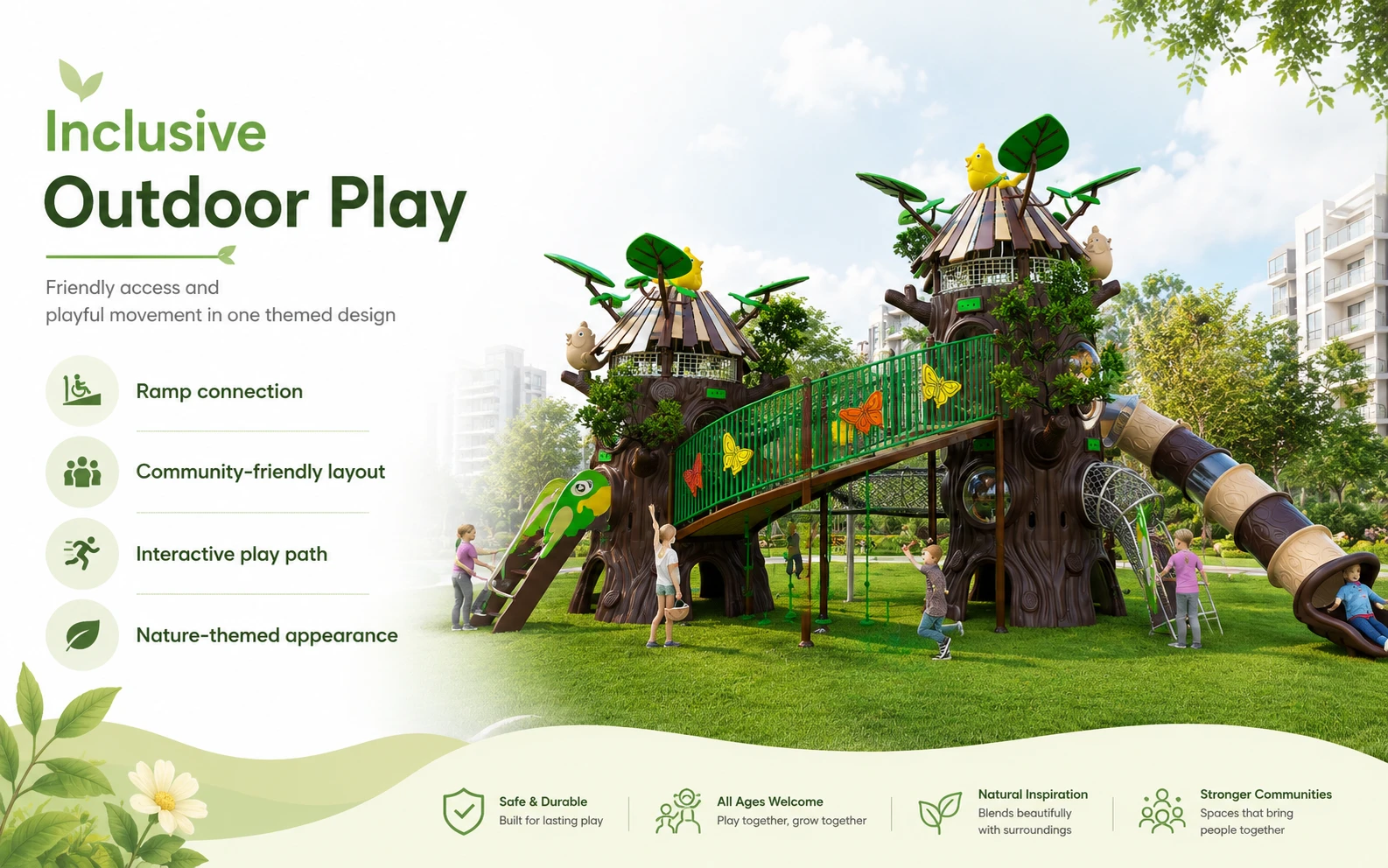
Inclusive planning should be integrated from the beginning, not added as one isolated panel near the entrance. In the United States, play areas for children aged two and older are addressed by ADA play-area requirements, including accessible routes and accessible play components. The Access Board also notes that accessible play should be integrated into the general playground setting.
An inclusive outdoor playground park can combine ramp access, transfer opportunities, ground-level activities, sensory experiences, social play, and comfortable circulation for children and caregivers with different abilities. Accessibility should affect the entire route through the playground, not only the entrance.
Match Outdoor Playground Park Safety Standards To The Destination Market
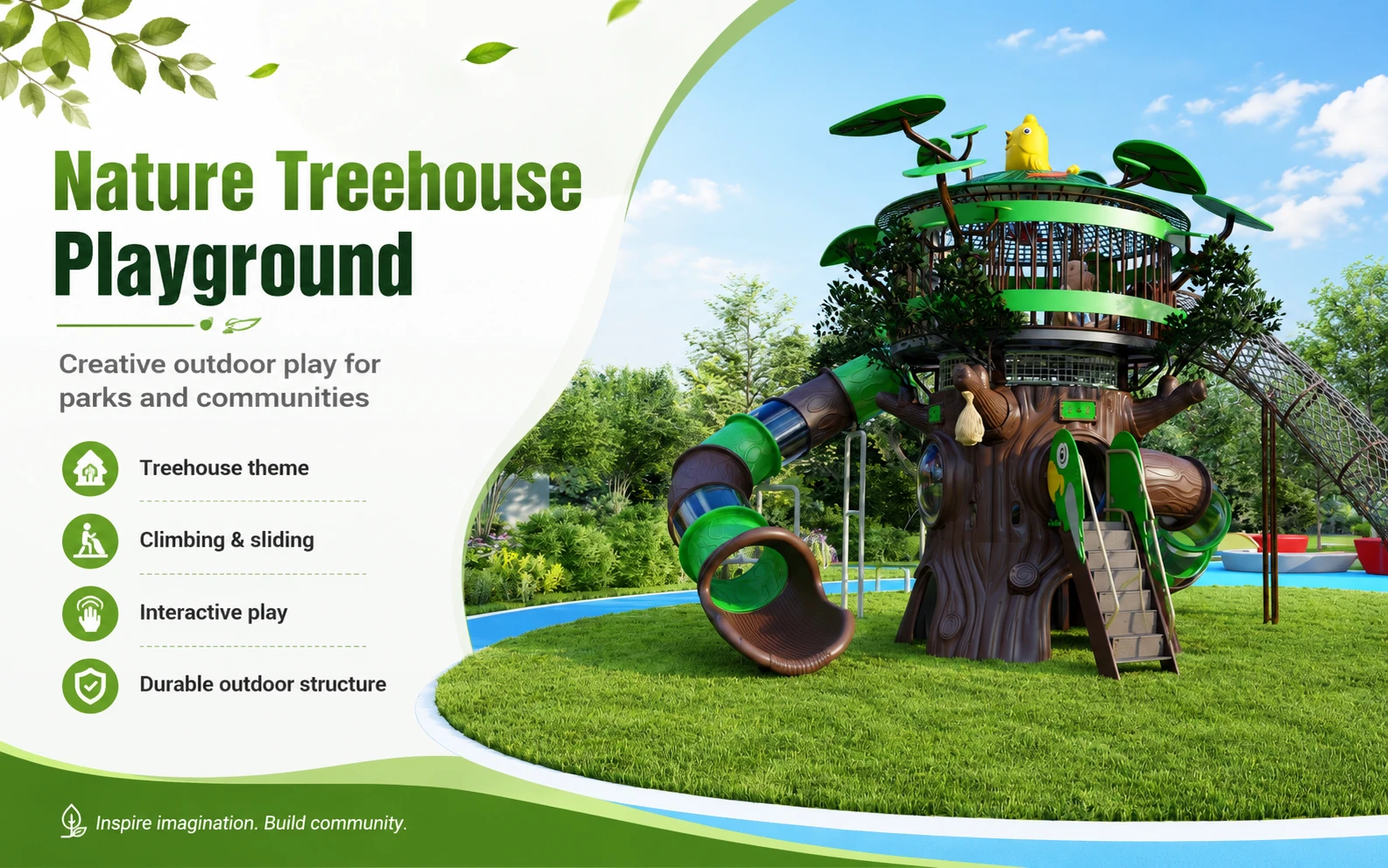
Safety compliance for an outdoor playground park should be confirmed before detailed design because standards influence platform heights, barriers, openings, use zones, surfacing, fasteners, entrapment checks, and installation documentation.
For U.S. public-use projects, buyers commonly specify the applicable edition of ASTM F1487 for public playground equipment and ASTM F1292 for impact-attenuating surfacing. ASTM describes F1487 as a safety and performance specification for public playground equipment, while F1292 establishes impact-attenuation requirements for surfacing within equipment use zones.
For European and many international projects, the tender may reference the EN 1176 series for playground equipment and surfacing, together with relevant local requirements. The current BS EN 1176-1 publication covers general safety requirements and test methods, while later parts address specific equipment categories and inspection or maintenance guidance.
The destination country, outdoor playground park owner, and local authority should confirm the exact standard edition. A supplier should not simply write “ASTM compliant” or “EN certified” on a quotation. Ask for test reports, material certificates, structural information, layout drawings with use zones, installation instructions, and a list showing which products or components are covered by each document.
Surfacing must be selected together with equipment fall heights. Falls remain a major playground hazard pattern, and the CPSC emphasizes the installation and maintenance of protective surfacing under and around equipment.
For an outdoor playground park, poured-in-place rubber, rubber tiles, engineered wood fiber, artificial turf systems, and other materials each have different implications for accessibility, drainage, heat, repair, cleaning, and lifecycle cost. The cheapest surface on the quotation may not be the cheapest surface to operate.
Safety also continues after handover. The owner needs inspection routines for loose fasteners, worn ropes, damaged panels, corrosion, cracked plastic, surfacing displacement, drainage problems, unauthorized modifications, and vandalism. The outdoor playground park should be delivered with inspection points and replacement-part information, not only a general warranty statement.
Choose Outdoor Playground Park Materials For Climate And Lifecycle Cost
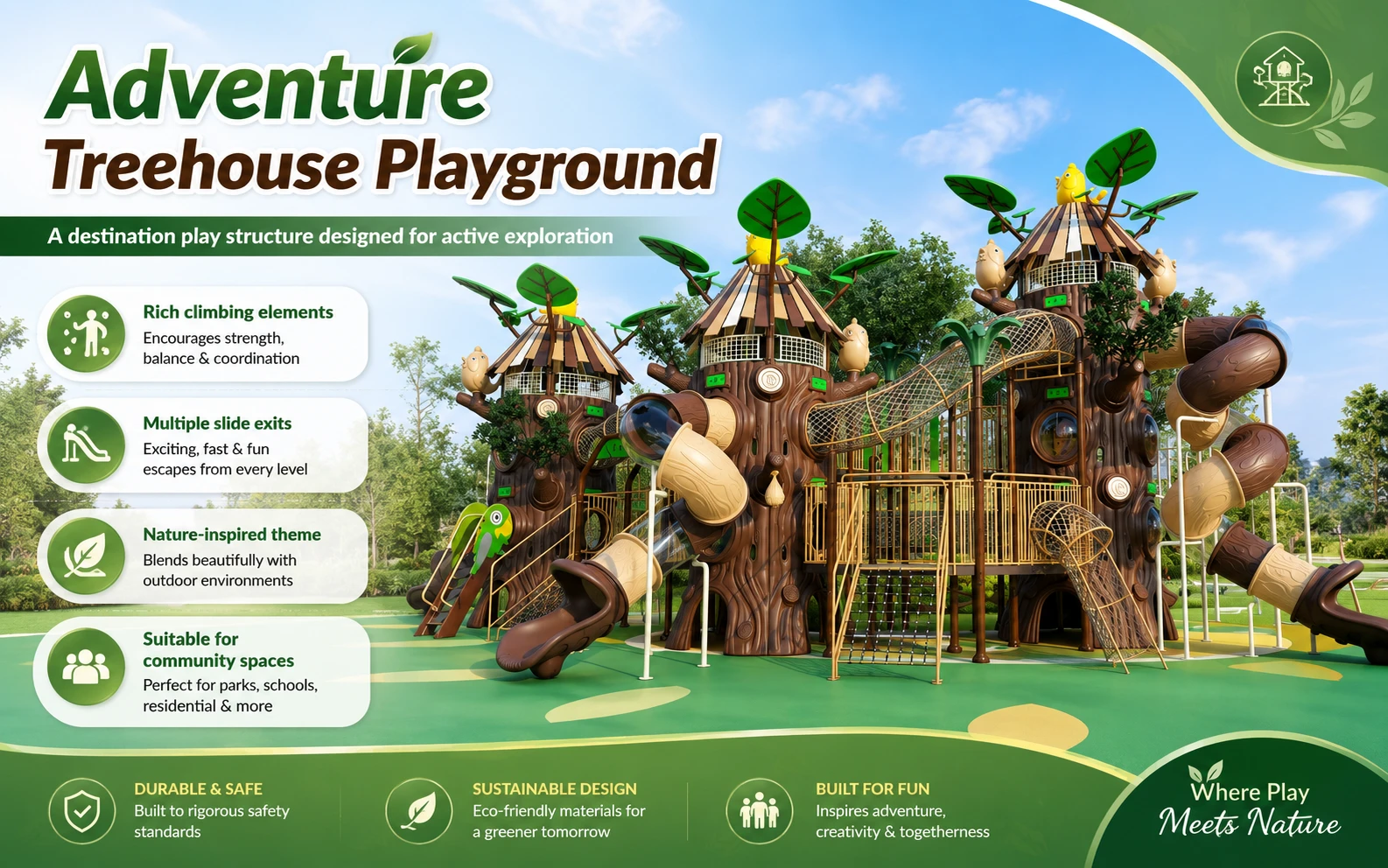
Material selection for an outdoor playground park should respond to the local environment. A coastal outdoor playground park faces salt, humidity, and corrosion. A desert site faces strong ultraviolet exposure, hot surfaces, dust, and large temperature changes. Cold regions need materials and connections that tolerate freeze-thaw cycles, while tropical projects require drainage, mildew control, and coatings suitable for persistent moisture.
For outdoor playground park structural frames, buyers should examine steel grade, wall thickness, welding quality, galvanizing method, powder-coating system, connection design, and protection at cut edges or drilled holes. Powder coating alone should not be treated as the entire corrosion strategy. Ask how the steel is prepared, whether internal moisture can drain, and how damaged coatings can be repaired on site.
Rotationally molded LLDPE is widely used for slides and shaped plastic components because it can form smooth, rounded, child-friendly parts. HDPE or PE panels are useful for guard panels, roofs, activity boards, themed graphics, and decorative shapes.
In a commercial outdoor playground park, buyers should ask about UV stabilization, material thickness, color consistency, edge finishing, and replaceability. Ropes and nets should be evaluated for internal reinforcement, UV resistance, connector design, and expected wear at high-contact points.
Small components deserve close attention. Stainless or corrosion-resistant fasteners, tamper-resistant caps, protected bearings, durable handgrips, and clearly labeled hardware packages can reduce installation errors and maintenance downtime. A single unavailable connector can close a major route through the outdoor playground park, so the supplier should provide a spare-parts list and identify standard versus custom components.
Lifecycle cost is a better comparison tool than purchase price alone. Estimate how frequently surfacing must be topped up or repaired, how easily graffiti can be removed, whether panels can be replaced individually, whether local technicians can service bearings, and how long spare parts remain available.
An outdoor playground park with modular components may cost more initially but can be easier to repair, expand, or refresh than a system that depends on unique one-off parts.
Build An Outdoor Playground Park Budget And Compare Quotations Correctly
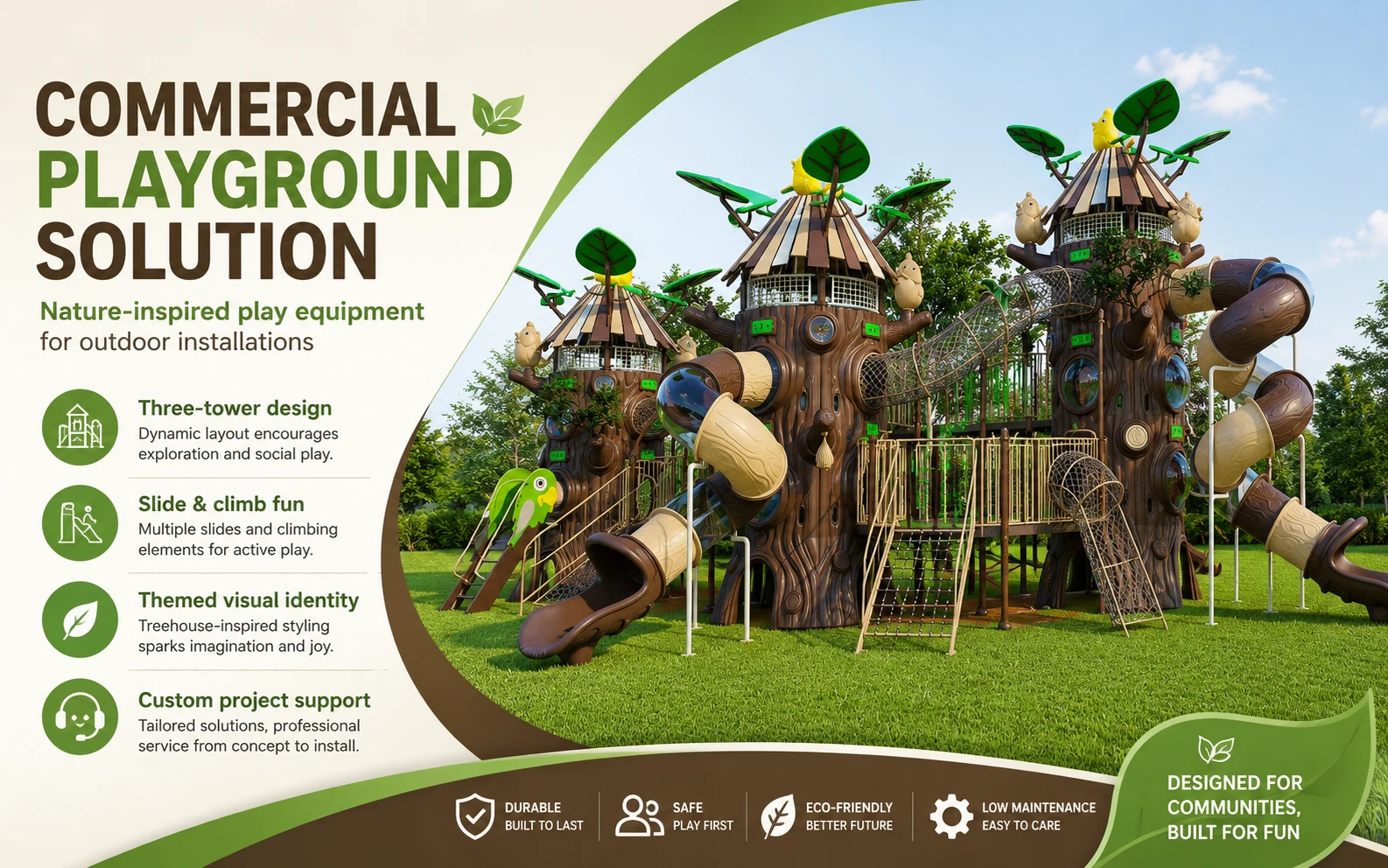
A professional outdoor playground park budget separates equipment from the rest of the site. Major commercial suppliers commonly remind buyers that playground equipment may represent only part of the total project cost. One current KOMPAN planning guide uses approximately 60% for equipment and 20% for safety surfacing as an illustrative breakdown, with the balance covering services such as installation and shipping. Actual percentages vary significantly by country, site condition, labor, freight, drainage, and civil works.
For an outdoor playground park, create budget lines for design, equipment, safety surfacing, shade, site furniture, fencing, landscaping, foundations, drainage, electrical work, freight, customs, unloading, storage, installation, testing, signage, spare parts, and contingency. Existing sites may also require demolition and disposal. Public projects may need third-party inspection, tender documentation, performance bonds, or local professional review.
When comparing outdoor playground park quotations, normalize the scope. Check whether each supplier includes the same platform sizes, steel specifications, plastic thicknesses, rope construction, coatings, hardware grades, surfacing area, fall-height requirement, packaging, freight terms, installation support, and warranty coverage.
A low quotation for an outdoor playground park may exclude foundations, use-zone surfacing, installation tools, inland delivery, or replacement parts. The final project cost may therefore be higher than a more complete quotation that initially appears expensive.
Ask for a bill of materials or an equipment schedule rather than relying only on a rendering. The rendering communicates appearance, but the schedule shows quantities, dimensions, age ranges, capacity, materials, and product codes. Request a layout with overall dimensions and safety zones, then check whether the design leaves sufficient circulation and usable open space.
Budget decisions should protect the features that are difficult to change later. It is easier to add graphics, benches, or small freestanding items in a later phase than to correct inadequate drainage, undersized foundations, inaccessible circulation, or poorly arranged age zones.
When funds are limited, phase the outdoor playground park around a complete site plan so later additions connect logically instead of creating isolated equipment clusters.
Evaluate The Outdoor Playground Park Manufacturer From Design To After-Sales
The strongest supplier is not necessarily the company with the largest catalog. Buyers need a manufacturer that can translate site information into a buildable outdoor playground park, control production quality, pack parts logically, provide export documents, support installation, and supply replacement components after opening.
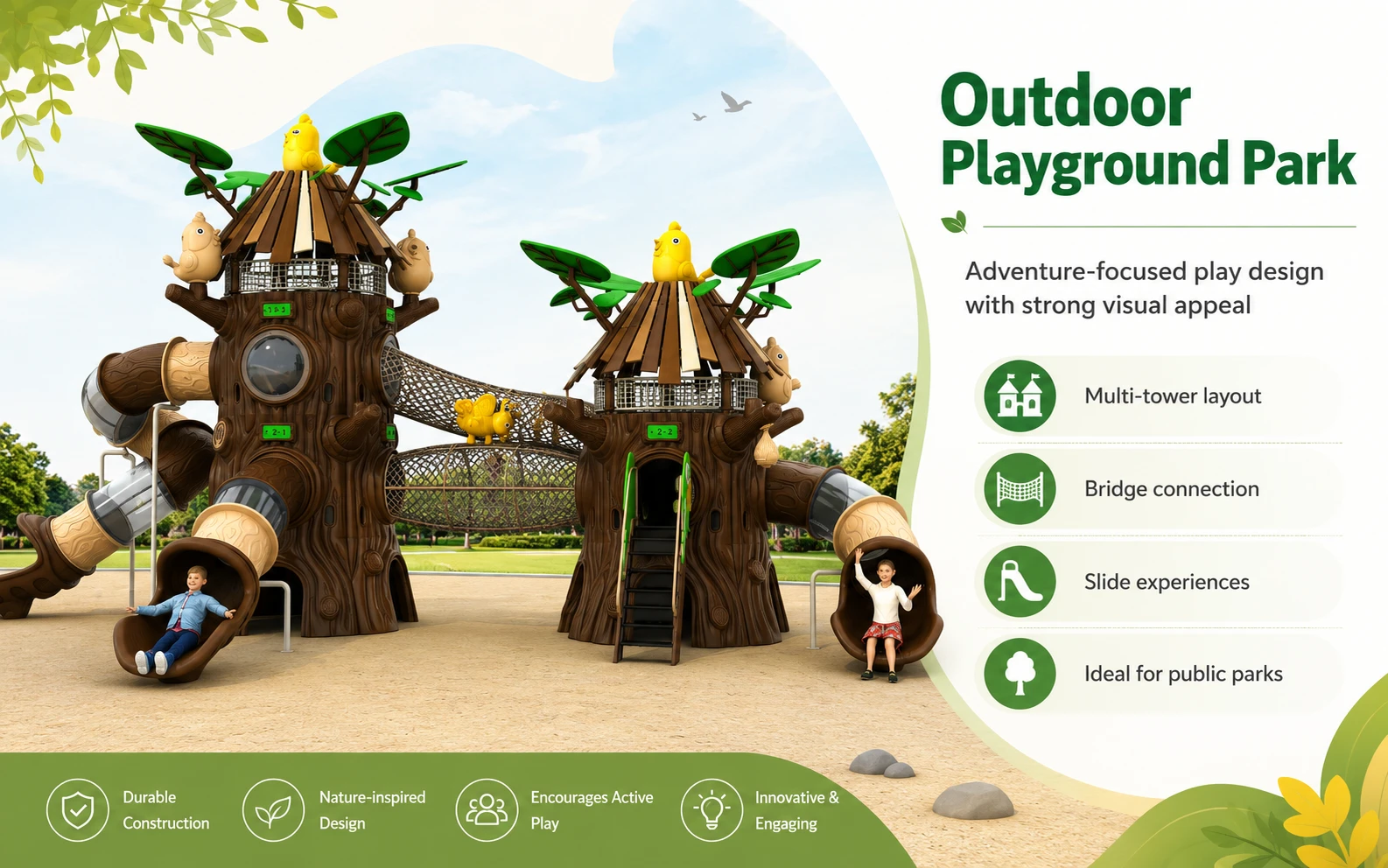
Start by reviewing the outdoor playground park design process. A capable team should ask about age groups, capacity, climate, local standards, budget, theme, site restrictions, supervision, and maintenance resources. It should provide a layout, 3D rendering, equipment list, material description, and revision process. The design should explain why equipment is positioned in each area, not simply show bright colors.
Factory evaluation should include raw-material control, cutting, welding, grinding, rotational molding, surface preparation, coating, trial assembly, inspection, packaging, and loading.
Our project workflow is supported by a production base of more than 60,000 square meters, an R&D and design team of more than ten people, in-house manufacturing processes, customized site planning, export packaging, installation guidance, and long-term parts support. These capabilities are valuable when an outdoor playground park includes custom themes, irregular layouts, mixed materials, or several product categories.
Before outdoor playground park production, confirm the approved drawings, colors, product codes, logos, safety requirements, packing marks, documentation, and delivery milestones. During production, request progress updates at defined stages rather than waiting until the shipping date.
For a custom outdoor playground park, trial assembly or component matching can reveal missing connections, incorrect hole positions, or color inconsistencies before the goods leave the factory.
Packaging should follow the installation sequence where possible. Parts need labels that match drawings, hardware should be grouped and identified, vulnerable coatings and plastic surfaces should be protected, and the container loading plan should reduce movement and damage.
Installation support may include foundation drawings, step-by-step manuals, videos, online guidance, supervisor dispatch, or a complete installation team, depending on the contract.
Finally, define after-sales responsibilities in writing. Confirm warranty scope, response procedures, spare-parts pricing, recommended inspection intervals, maintenance manuals, and support for discontinued components.
A well-procured outdoor playground park is not finished when the container arrives or when the opening ribbon is cut. It succeeds when the site remains safe, attractive, repairable, and enjoyable through years of daily use.
Before requesting a final proposal, send the supplier your site drawing, target age groups, expected capacity, destination country, preferred opening date, theme direction, and total project scope. With this information, the outdoor playground park manufacturer can prepare a more accurate outdoor playground park layout, equipment schedule, quotation, production plan, shipping plan, and installation recommendation.


 English
  Español
  Français
  Deutsch
  Português