


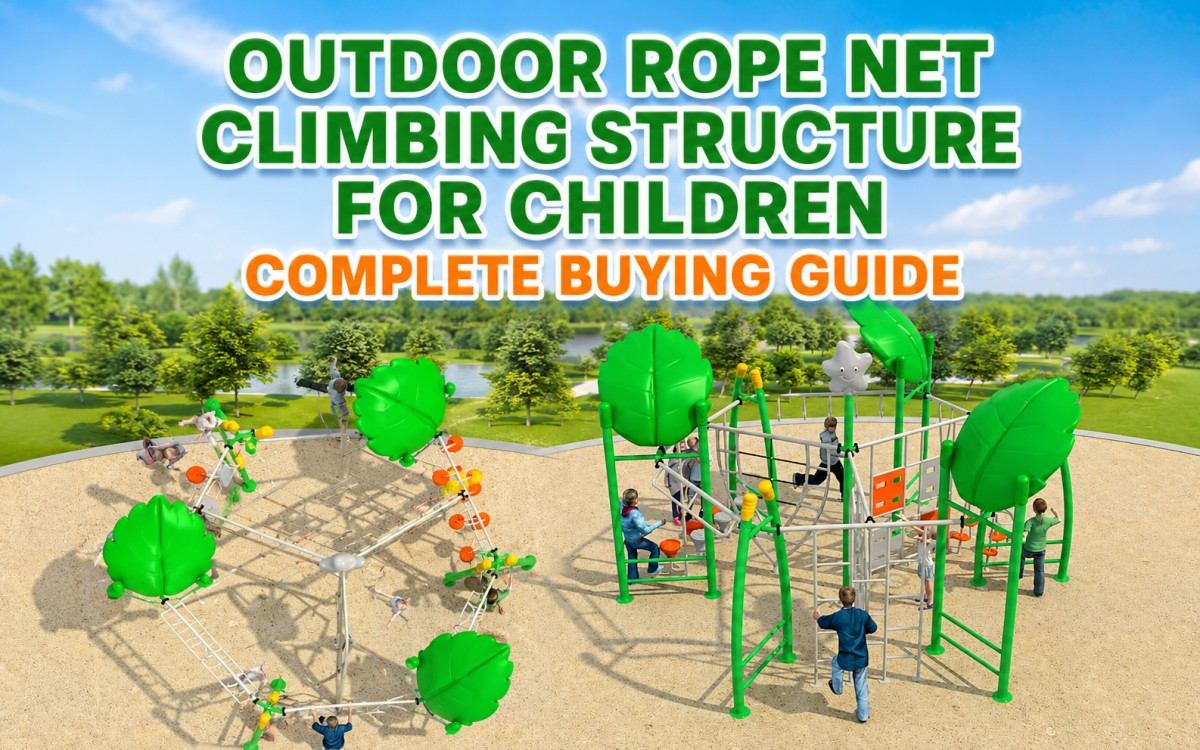
Outdoor Rope Net Climbing Structure For Children Complete Buying Guide
An outdoor rope net climbing structure for children is often the visual centre of a school, park, residential community, resort, or commercial play area. Buyers, however, need more than an attractive product image. They need to know whether the outdoor rope net climbing structure for children suits the site, age group, climate, safety target, installation conditions, budget, and maintenance capacity. This guide combines product introduction, procurement advice, material analysis, safety standards, and custom-project planning to help purchasers evaluate an outdoor rope net climbing structure for children as a complete project.
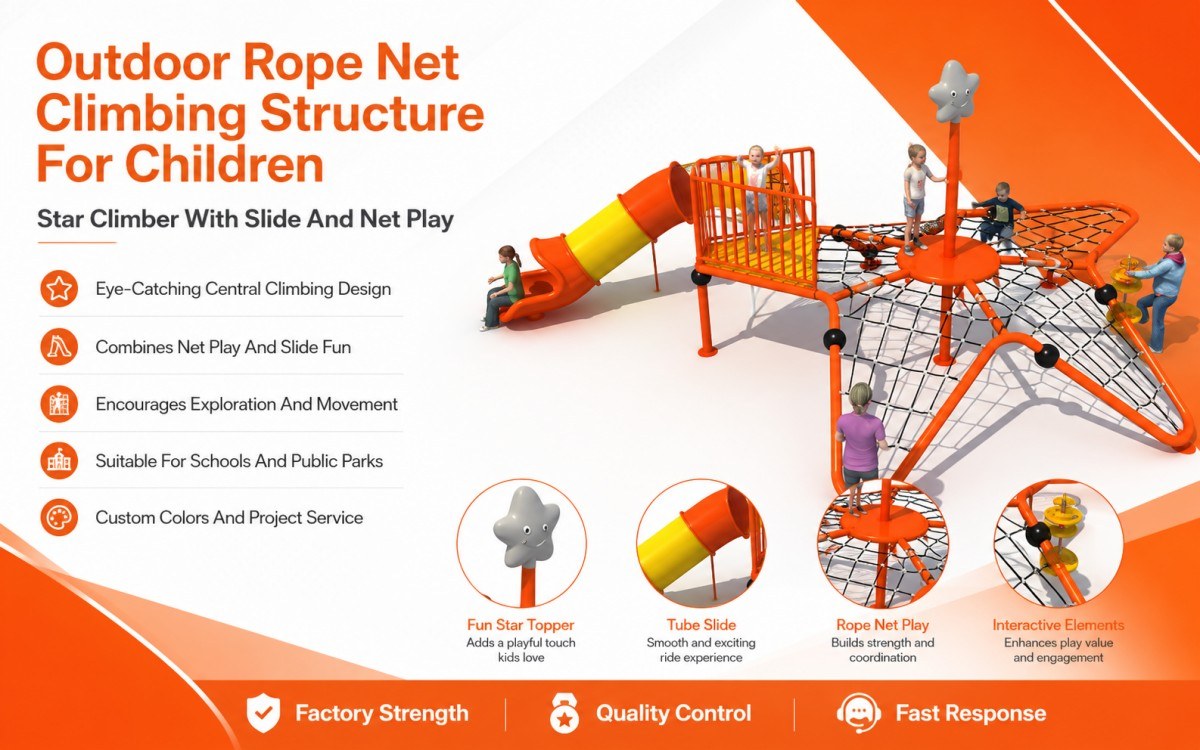
Choose The Right Design For The Site And Users
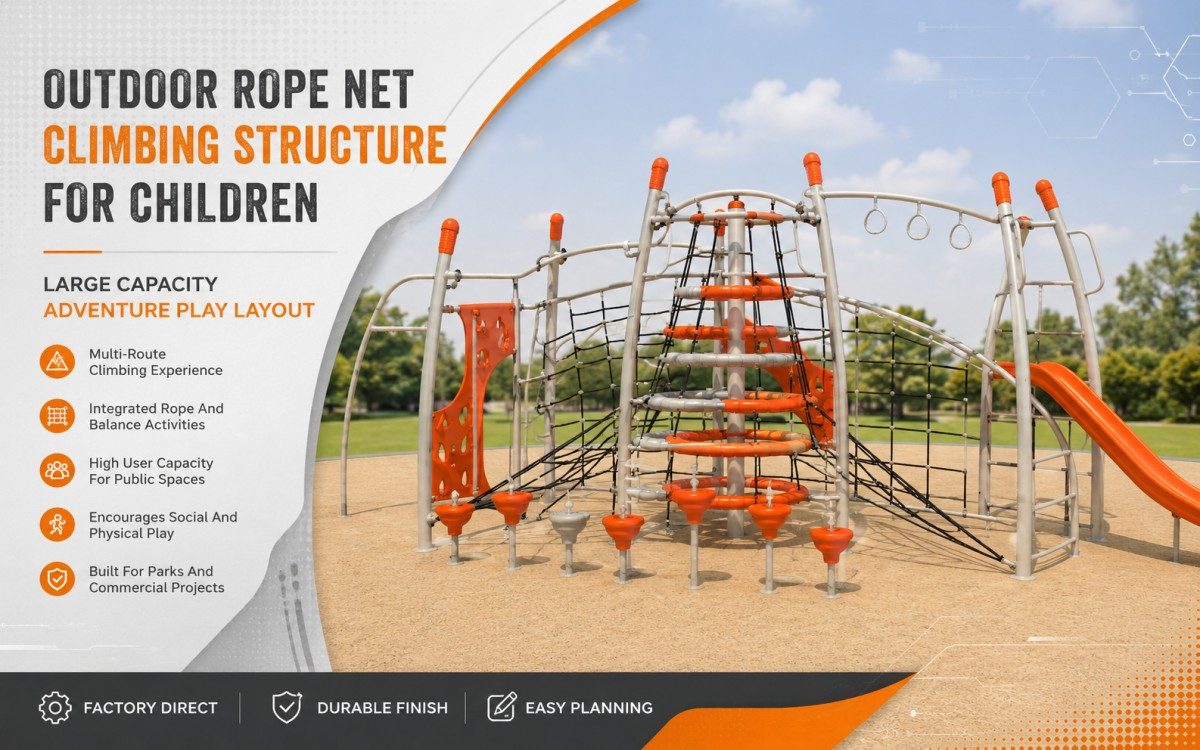
Start with the result the play area must deliver. A compact outdoor rope net climbing structure for children can add an active climbing corner beside slides and swings. A large spatial net can become a landmark that attracts families, increases play capacity, and gives older children a more challenging activity.
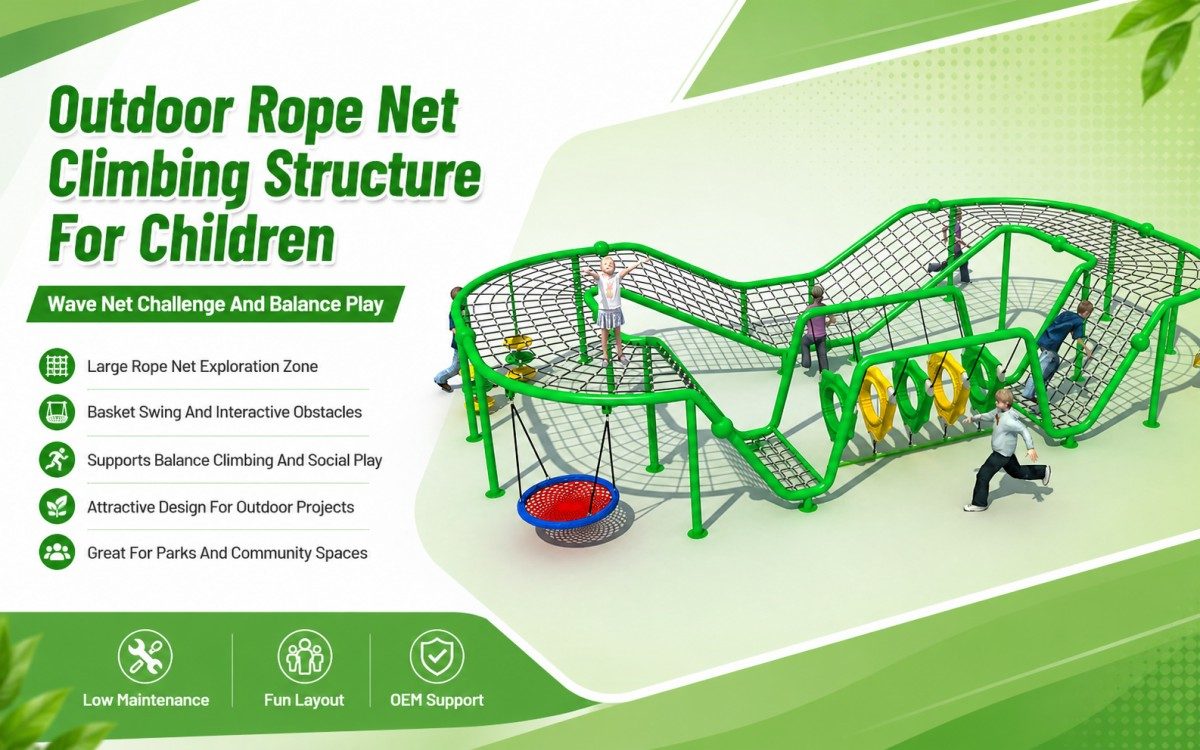
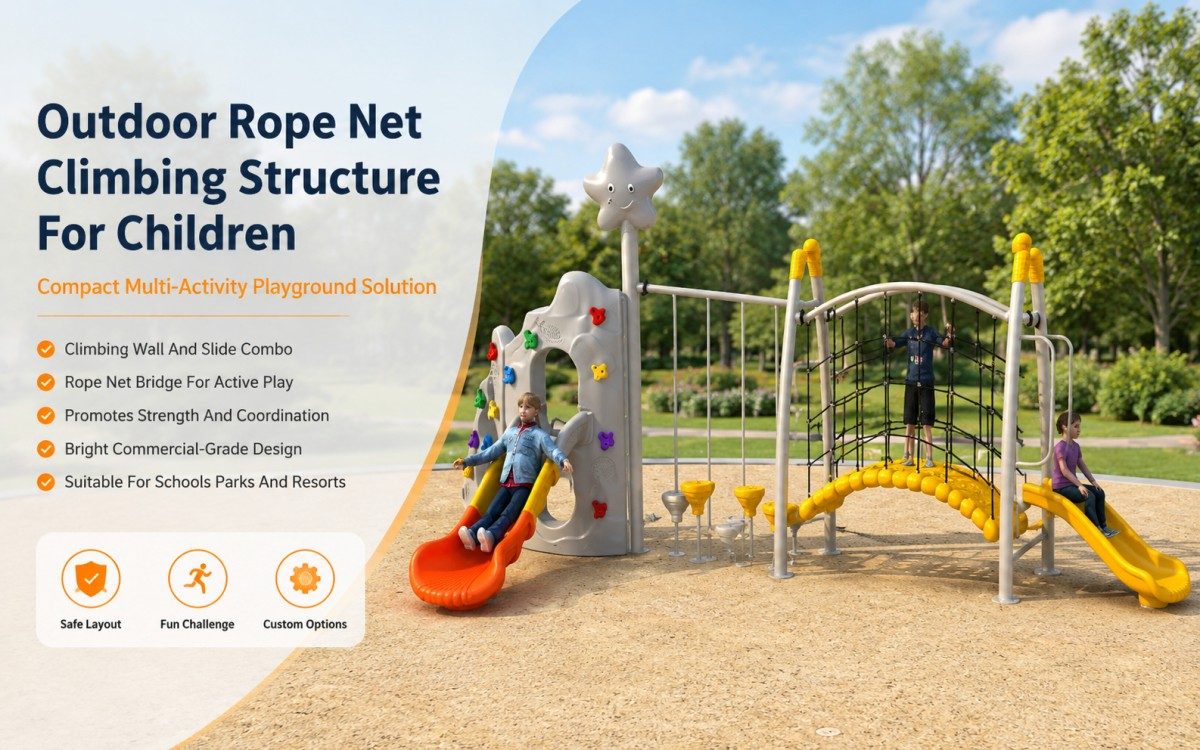
An outdoor rope net climbing structure for children may use pyramid nets, rope towers, arched climbers, domes, horizontal traverse courses, net bridges, or combination units with slides and activity panels. When selecting an outdoor rope net climbing structure for children, a school usually needs open sightlines, moderate height, clear circulation, and different challenge levels. A public park may prioritise capacity, vandal resistance, multiple entry points, and all-weather durability. A resort or shopping venue may prefer a themed outdoor rope net climbing structure for children that is highly recognisable in photographs. A residential project may need a smaller footprint, lower visual obstruction, and simple maintenance.
Before requesting a price, define the intended age group, site dimensions, expected number of simultaneous users, maximum fall height, climate, operating hours, supervision method, and whether the net will be freestanding or connected to other equipment. A well-designed outdoor rope net climbing structure for children lets children move upward, downward, across, and through the play space. Major playground brands also describe rope climbing as supporting balance, coordination, strength, spatial awareness, cooperation, and shared play.
The best outdoor rope net climbing structure for children is therefore not automatically the tallest model. Ask the supplier to explain traffic flow, entry and exit routes, user capacity, rest points, challenge progression, and supervision visibility. A useful proposal should show how children use the outdoor rope net climbing structure for children, not only how the outdoor rope net climbing structure for children looks.
Check Rope, Frame, Connectors, And Structural Tension
Materials directly affect the appearance, stability, and service life of an outdoor rope net climbing structure for children. The ropes in an outdoor rope net climbing structure for children commonly use synthetic outer fibres around a reinforced core. Steel-core rope improves strength, shape retention, and resistance to deliberate damage. UV-stabilised polypropylene or polyester outer layers help reduce colour fading and weather-related degradation. Established commercial suppliers offer steel-reinforced, UV-resistant rope systems for outdoor playgrounds.
Do not compare rope by colour alone. For each outdoor rope net climbing structure for children, request the rope construction, core material, outer fibre, nominal diameter, UV treatment, abrasion resistance, connector type, and replacement method. The correct specification depends on net span, climbing height, mesh geometry, intended load, local climate, and applicable safety requirements. A thick rope cannot compensate for weak connectors, incorrect tension, or poor net geometry.
The supporting frame of an outdoor rope net climbing structure for children also needs careful review. Hot-dip galvanised steel is frequently chosen for humid outdoor environments, while powder coating adds colour and another protective layer. Stainless-steel fasteners and enclosed connectors can improve corrosion resistance at high-wear joints. Check that welds are smooth, exposed edges are rounded, bolt ends are protected, and hollow posts can drain water.
Tension is part of the engineering. If an outdoor rope net climbing structure for children is too loose, routes deform and openings may change. If it is over-tensioned, the rope, connectors, masts, and foundations may carry unnecessary stress. For the outdoor rope net climbing structure for children, the manufacturer should supply a tensioning procedure, anchor layout, foundation drawing, and retightening instructions. The buyer should also confirm whether adjustment requires ordinary tools or specialist equipment.
A dependable outdoor rope net climbing structure for children should allow individual ropes or net sections to be replaced without dismantling the entire system. Ask how spare parts are identified, how long matching rope colours remain available, and whether connectors can be serviced locally.
Verify Safety Standards, Age Suitability, And Surfacing
Safety documents for an outdoor rope net climbing structure for children should be reviewed before the order is approved. For public-playground projects in the United States, ASTM F1487 covers safety and performance requirements for public playground equipment, while ASTM F1292 addresses impact attenuation of playground surfacing. The CPSC handbook works alongside relevant ASTM standards and advises purchasers to check local, state, insurance, and project-specific requirements.
For European and many international projects, buyers often specify EN 1176. For an outdoor rope net climbing structure for children, a statement such as “materials meet EN 1176” does not prove that the final outdoor rope net climbing structure for children has been assessed in its actual configuration. Request test reports, certificates, drawings, and model numbers that match the product being purchased. Confirm whether the documents cover the complete unit, selected components, or only a similar design.
Age suitability is essential. The July 2025 CPSC handbook explains that flexible climbers require more advanced balance than rigid climbers. It recommends that nets providing access to platforms be securely anchored at both ends, with ground anchors below ground level and beneath the protective surface. It also advises that flexible climbers should not be the sole access method for toddler and preschool equipment, and that freestanding flexible climbers are not recommended for those younger groups.
Every outdoor rope net climbing structure for children needs impact-attenuating surfacing selected according to fall height. Concrete, asphalt, ordinary grass, and dirt should not be treated as protective surfacing beneath elevated equipment. The CPSC recommends shock-absorbing surfacing under and around elevated equipment and states that the surfacing critical-height rating should be at least equal to the relevant equipment fall height.
The safety review of an outdoor rope net climbing structure for children should also cover mesh openings, head and body entrapment, internal fall paths, protrusions, exposed foundations, connector access, entanglement points, and the required use zone. For an outdoor rope net climbing structure for children, the final layout must consider nearby paths, walls, trees, benches, fences, and other play equipment. Clothing cords, helmet straps, and unauthorised ropes can create entanglement risks, so warning signs and supervision rules remain important.
Customise The Equipment Around Real Project Conditions
Good customisation of an outdoor rope net climbing structure for children solves a site problem. The design process for an outdoor rope net climbing structure for children should begin with an accurate plan showing boundaries, levels, entrances, underground services, trees, drainage, nearby equipment, circulation paths, and surfacing limits. The designer can then adjust the footprint, climbing height, mast positions, rope angles, entry routes, colours, and connected activities.
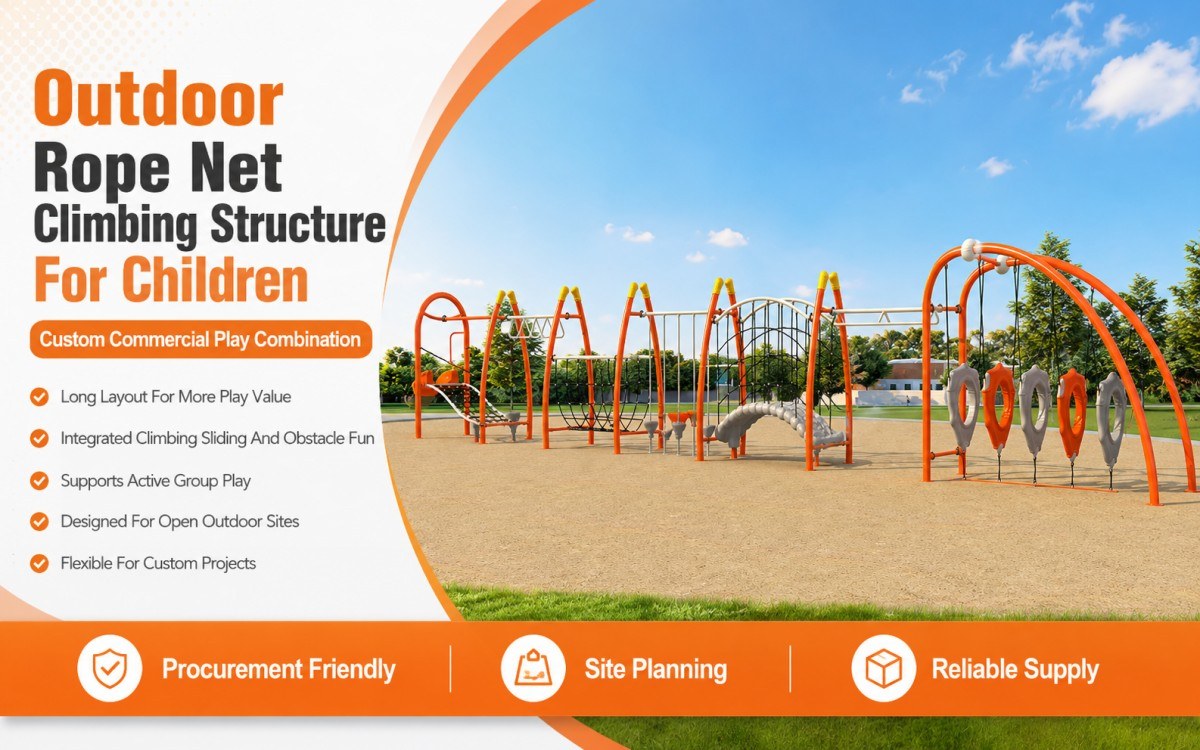
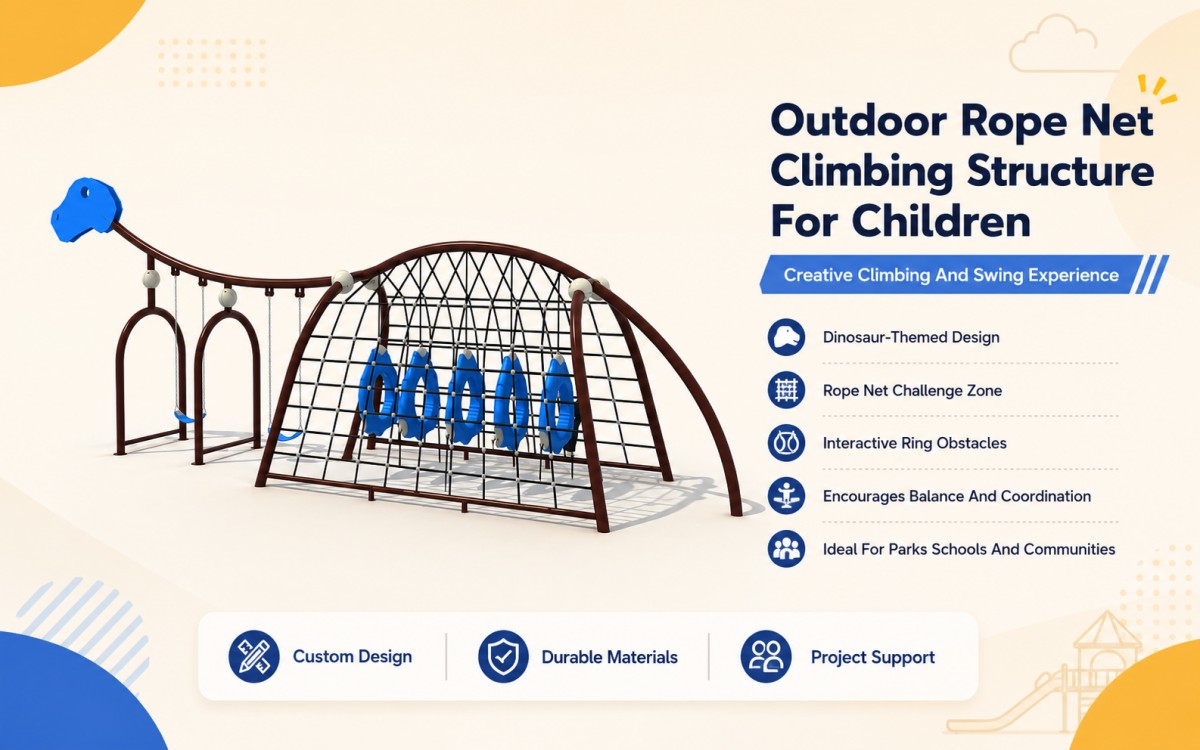
A narrow site may benefit from a linear traverse net or an arch instead of a wide pyramid. A landmark park may use a central mast and multi-directional spatial net. A school may require graduated routes so less-confident children can start low and progress gradually. A mixed-use park can combine an outdoor rope net climbing structure for children with lower ground-level activities, sensory panels, seating, and accessible routes, allowing children with different abilities to share the same play area. U.S. accessibility guidance applies to newly designed or constructed play areas for children aged two and older and requires accessible routes to connect accessible play components.
Colour has both visual and practical value. High-contrast ropes can make routes and boundaries easier to identify. Custom colours can match a school, landscape theme, or commercial brand. Buyers should still consider UV resistance, heat exposure, dirt visibility, and future replacement availability.
Before approving a customised outdoor rope net climbing structure for children, request a dimensioned site plan, 3D views, age range, capacity, fall height, use-zone drawing, foundation details, surfacing requirements, material specifications, component list, and installation method. A change to mast location, net geometry, platform height, or attachment points can affect loads, foundations, fall zones, and compliance. Final drawings should therefore be signed off before manufacturing begins.
An experienced factory should also identify ideas that are visually attractive but unsuitable for the site. Responsible customisation may involve lowering a route, widening circulation, changing an entry angle, moving a mast, or separating an outdoor rope net climbing structure for children from high-speed equipment.
Compare Total Cost, Delivery Scope, And Installation Requirements
The price of an outdoor rope net climbing structure for children is influenced by rope construction, steel reinforcement, mast quantity, connector count, net complexity, galvanising, powder coating, custom engineering, certificates, packaging, freight volume, foundations, safety surfacing, lifting equipment, and local labour. Two products in the outdoor rope net climbing structure for children category with similar dimensions may have very different specifications and total installed costs.
Ask all suppliers to quote the same scope. One price may cover only the equipment, while another includes anchors, spare parts, installation tools, drawings, trial assembly, inspection, freight, or on-site guidance. A low-priced outdoor rope net climbing structure for children may become expensive if specialised foundations, cranes, surfacing, replacement ropes, or local engineering are excluded.
For custom equipment, production time usually includes drawing approval, material preparation, rope fabrication, steel processing, surface treatment, trial fitting, quality inspection, and export packing. Request a milestone schedule covering design confirmation, payment, production, inspection, packing, shipment, and expected arrival. School openings and park launches should also allow time for customs clearance, site preparation, concrete curing, surfacing installation, tension adjustment, and final inspection.
Installation quality directly affects the finished outdoor rope net climbing structure for children. For an outdoor rope net climbing structure for children, the supplier should provide numbered parts, assembly drawings, foundation plans, anchor templates where necessary, tensioning instructions, and an installation checklist. The CPSC advises following the manufacturer’s instructions and completing a thorough inspection by a qualified person after assembly and before opening.
Buyers should confirm who is responsible for foundations, unloading, lifting, assembly, tensioning, surfacing, inspection, and local approval. This responsibility table prevents disputes and makes the real project budget for the outdoor rope net climbing structure for children easier to control.
Select A Reliable Factory And Plan Long-Term Maintenance
A capable supplier should explain the complete process behind an outdoor rope net climbing structure for children. Ask for factory images or video, rope and steel specifications, welding procedures, surface-treatment details, quality-control records, relevant project references, packaging methods, warranty terms, spare-part support, and installation guidance. Certificates and reports should correspond to the proposed model rather than serving only as general company documents.
Our factory can provide site-based planning, colour and structure customisation, production drawings, component manufacturing, trial assembly, inspection feedback, export packaging, installation instructions, and after-sales replacement parts. For every outdoor rope net climbing structure for children, we recommend confirming the destination market and required standard at the start so the dimensions, materials, documentation, and testing plan match the actual project.
Maintenance planning for an outdoor rope net climbing structure for children should be completed before shipment. The owner needs an inspection schedule covering rope abrasion, broken strands, loose connectors, unusual sagging, damaged coatings, corrosion, exposed foundations, displaced surfacing, blocked drainage, vandalism, and unauthorised accessories. Busy parks, coastal locations, and severe climates may require more frequent checks. The CPSC maintenance guidance highlights loose bolts, missing caps, cracks, worn components, and deteriorated surfacing as routine inspection concerns.
The right outdoor rope net climbing structure for children is the one that fits the users, site, safety target, budget, installation capacity, and maintenance plan. Buyers should compare verified materials, relevant documentation, engineering detail, complete delivered scope, and long-term service rather than choosing from appearance or initial price alone.
For a customised outdoor rope net climbing structure for children, send us the site dimensions, target age group, expected capacity, preferred style, destination country, applicable standard, and budget range. We can use this information to prepare a practical layout, product proposal, and quotation for your project.


 English
  Español
  Français
  Deutsch
  Português