


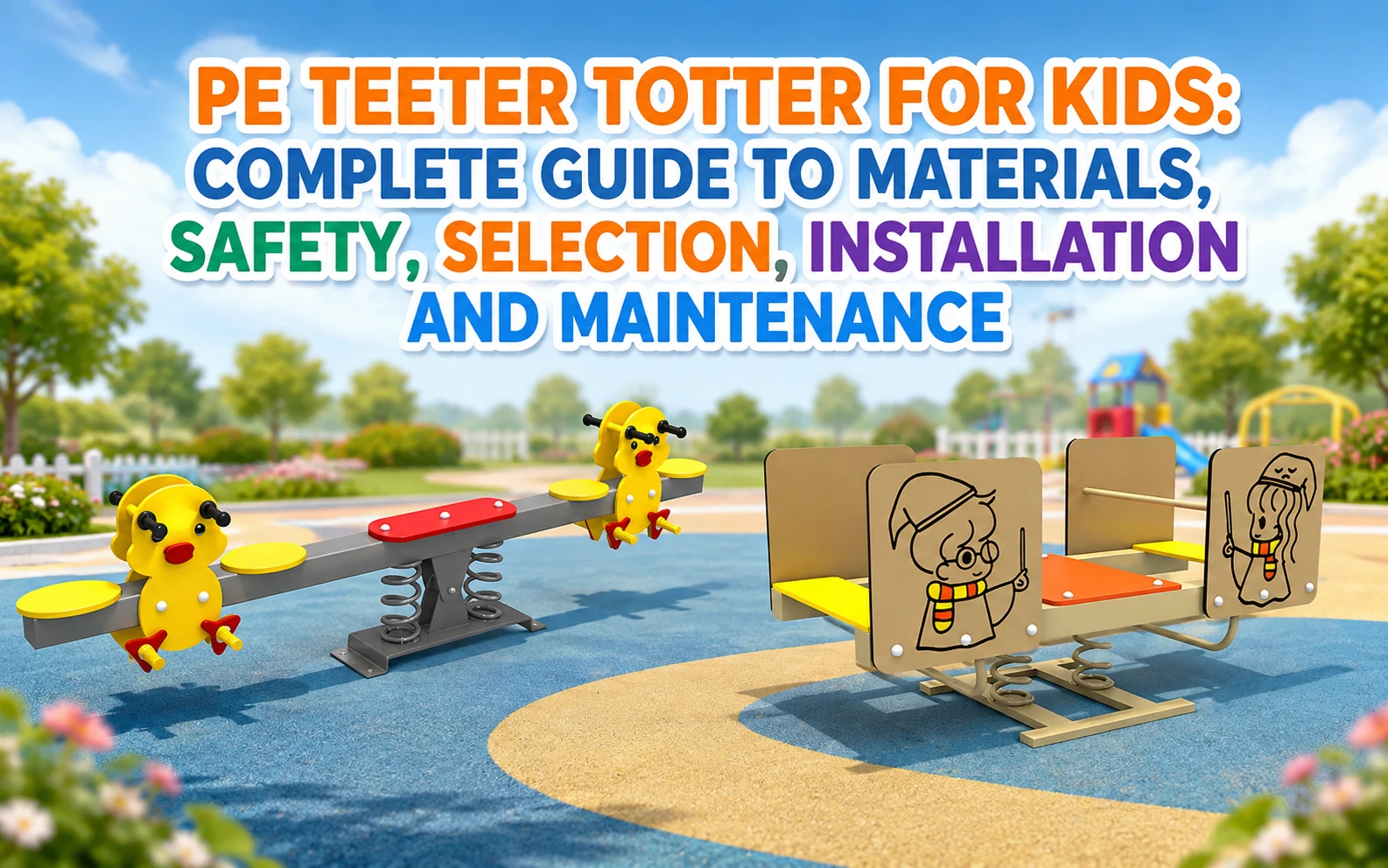
A well-designed PE teeter totter for kids combines outdoor-grade PE or HDPE panels with a strong supporting structure, secure handholds, anti-slip footrests, controlled rocking, and impact-reducing components. It should also match the destination market’s safety requirements. The following sections answer the questions buyers usually need resolved before requesting a quotation. For procurement teams, the PE teeter totter for kids should be evaluated as a complete play system rather than a decorative accessory.
What Buyers Should Confirm Before Ordering
A PE teeter totter for kids is a rocking playground unit in which two or more users move around a central pivot or spring-supported mechanism. Traditional two-seat models encourage children to coordinate their movements, communicate, and respond to another rider. Modern products may use animal shapes, vehicle themes, back supports, multi-seat layouts, or gentler spring motion. The play quality of a PE teeter totter for kids depends on smooth, predictable movement as much as its visual design.
Define the project before selecting a PE teeter totter for kids. A kindergarten usually needs low movement, easy-grip handles, rounded panels, and clear adult sightlines. A public park needs stronger anchoring, vandal-resistant fasteners, weather-resistant materials, and components suitable for repeated daily use. A distributor may also need compact packaging, mixed colors, manageable minimum quantities, and reliable spare-part supply.
The PE teeter totter for kids should always be specified by age and ability. Never assume the age range from a product photo. Ask for the recommended user age, capacity, overall dimensions, required use zone, free height of fall, and installation drawing. The seat height, handle position, movement range, and user ability all affect suitability. Official playground guidance treats a seesaw or teeter-totter as moving equipment around a central support, so its clearance and impact area must be planned with the product. s For Commercial Playground Projects
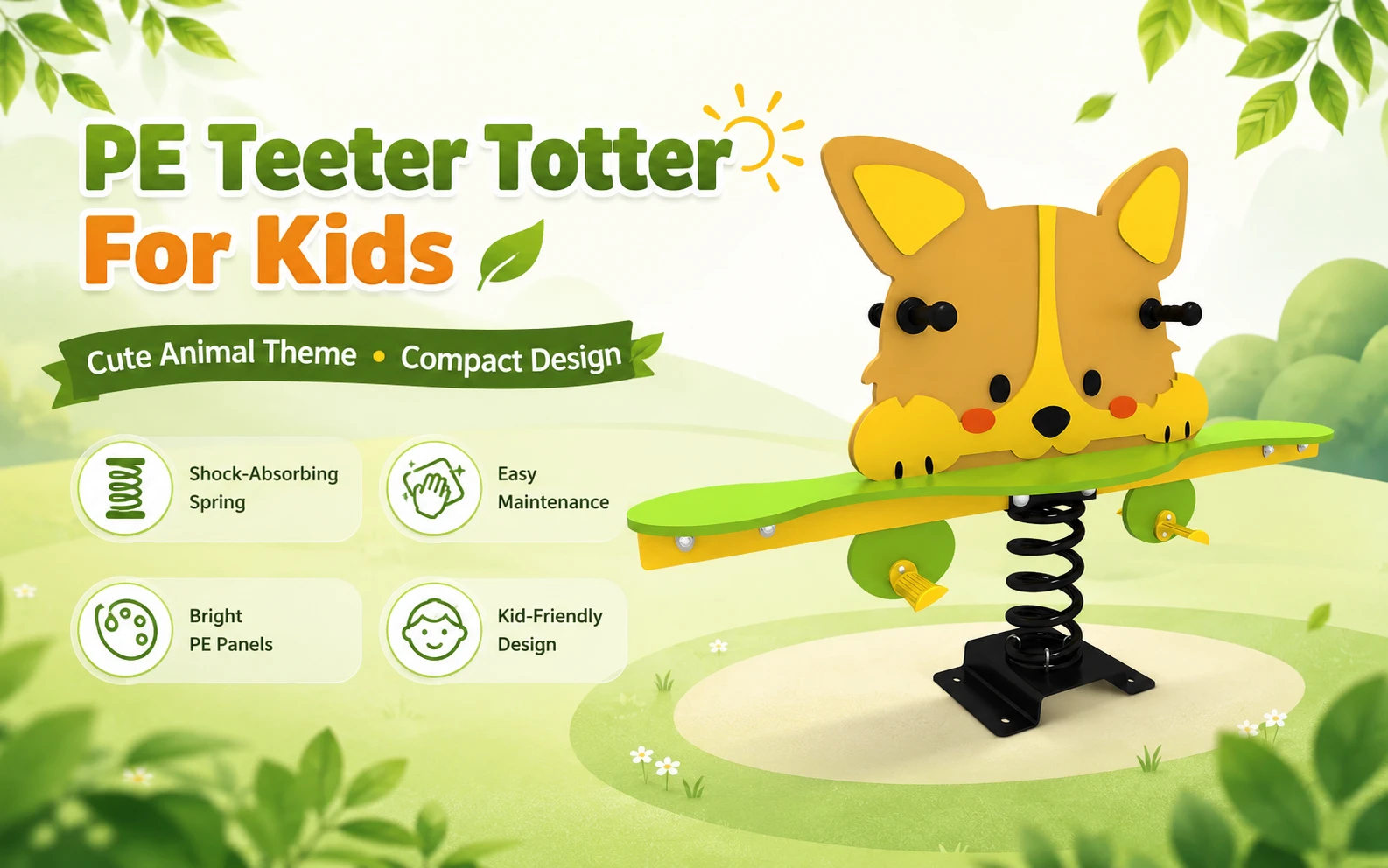
The visible body, seats, decorative sides, or foot supports of a PE teeter totter for kids may be made from PE board. PE describes a family of polyethylene materials, while HDPE is a denser grade widely used for rigid playground panels. Buyers should request the exact grade, thickness, UV stabilization, color construction, and technical data because “plastic” is not a sufficient material specification.
For outdoor projects, the material package of the PE teeter totter for kids directly affects cleaning, appearance, and replacement needs. Outdoor-grade PE board does not splinter like untreated wood or rust like unprotected metal. It can be cut into rounded profiles, engraved with patterns, and coordinated with a project theme. Color-through HDPE can make normal scratches less noticeable than damage to a thin painted coating. Its smooth, non-porous surface also supports practical routine cleaning.
However, not every PE teeter totter for kids uses equivalent panel quality. Check panel thickness, edge finishing, fastening points, reinforcement, and unsupported span. Decorative panels should not be treated as structural beams unless the design has been engineered for that load. A buyer comparing a PE teeter totter for kids should therefore review both the panel specification and the hidden support structure.
The central support, pivot housing, anchors, or frame of a commercial PE teeter totter for kids will normally require metal strength. Galvanized or powder-coated steel and corrosion-resistant fasteners are common because PE provides child-contact surfaces and design flexibility, while steel carries dynamic loads. Major commercial brands similarly combine HDPE plates with hot-dip galvanized steel components. Right Model And Quotation
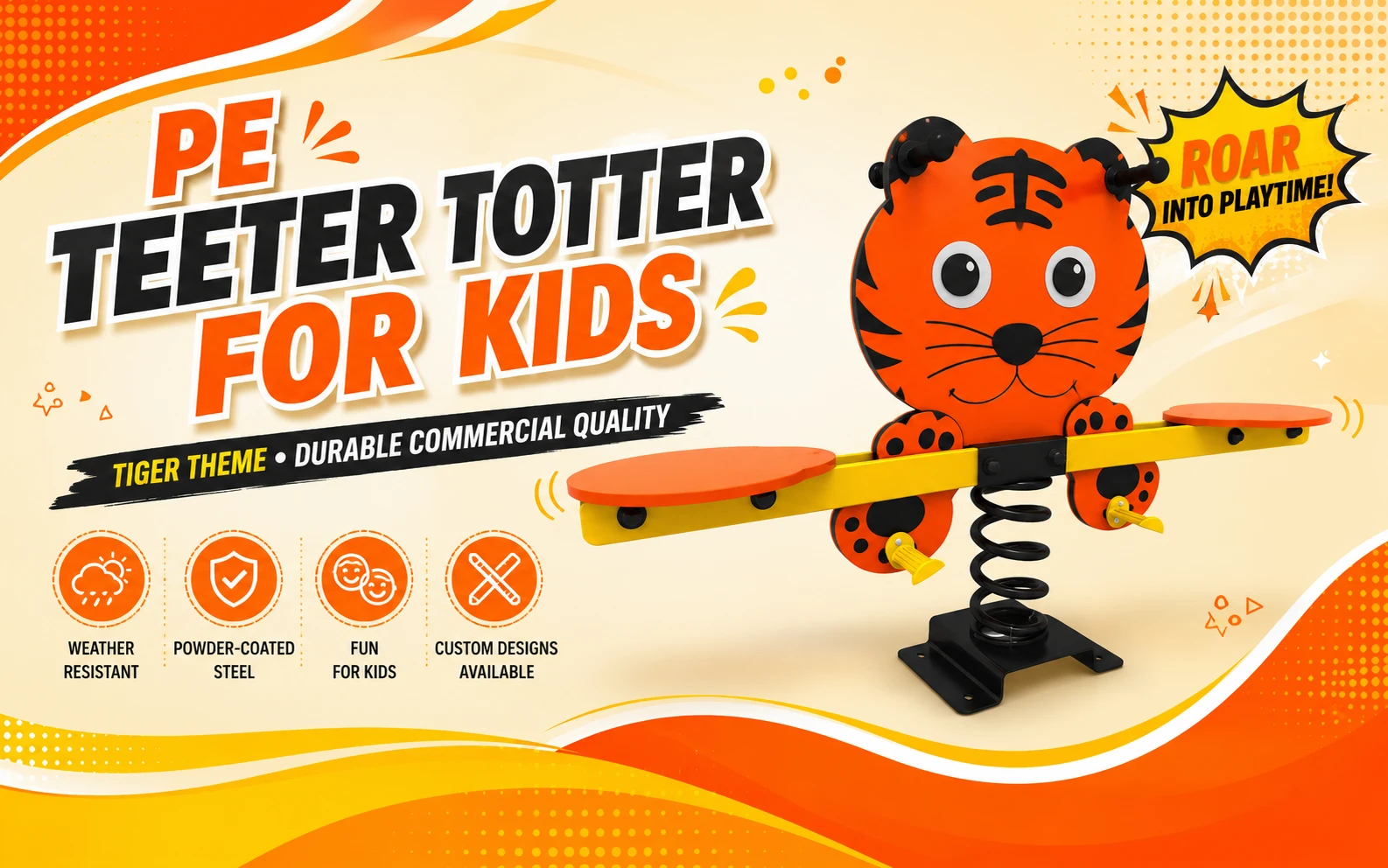
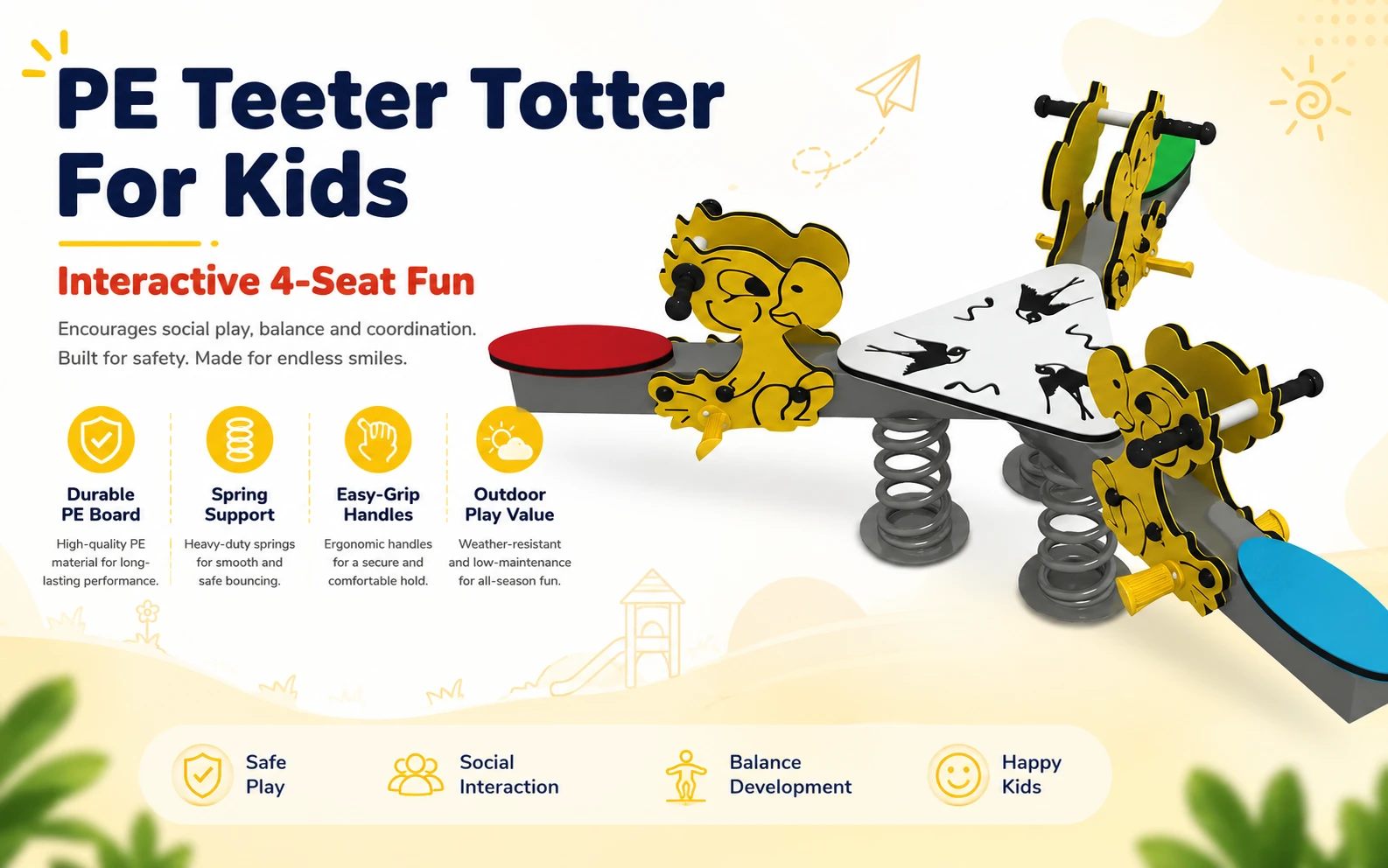
Match the PE teeter totter for kids to the site, users, and expected traffic. A low-profile two-seat model may suit a preschool better than a long traditional beam. A busy public park may require a reinforced pivot, sealed bearings, protected fasteners, replaceable bumpers, and sufficient access for inspection. Multi-seat products increase social play value but need a larger use zone.
The quotation for a PE teeter totter for kids becomes easier to evaluate when every supplier answers the same technical questions. When comparing a PE teeter totter for kids, ask these questions:
- What are the recommended age range and user capacity?
- What are the installed dimensions and safety-area dimensions?
- Which parts are PE or HDPE, and what is their thickness?
- What materials are used for the support and pivot?
- Are handles and footrests non-slip and replaceable?
- How is downward impact reduced?
- Are the bearings sealed, self-lubricating, or replaceable?
- Which standard is the offered model designed to meet?
- What foundation and safety surface are required?
- What spare parts, warranty terms, and installation documents are included?
The PE teeter totter for kids should be priced as a complete delivered and installed scope. A professional quotation for a PE teeter totter for kids should distinguish the equipment price from freight, foundation work, installation, safety surfacing, taxes, and customization. A low unit price can be misleading if it excludes anchors, protective caps, commercial packaging, or replacement parts. Compare the complete installed scope and expected operating cost, not only the factory price.
Which Safety Features And Standards Matter
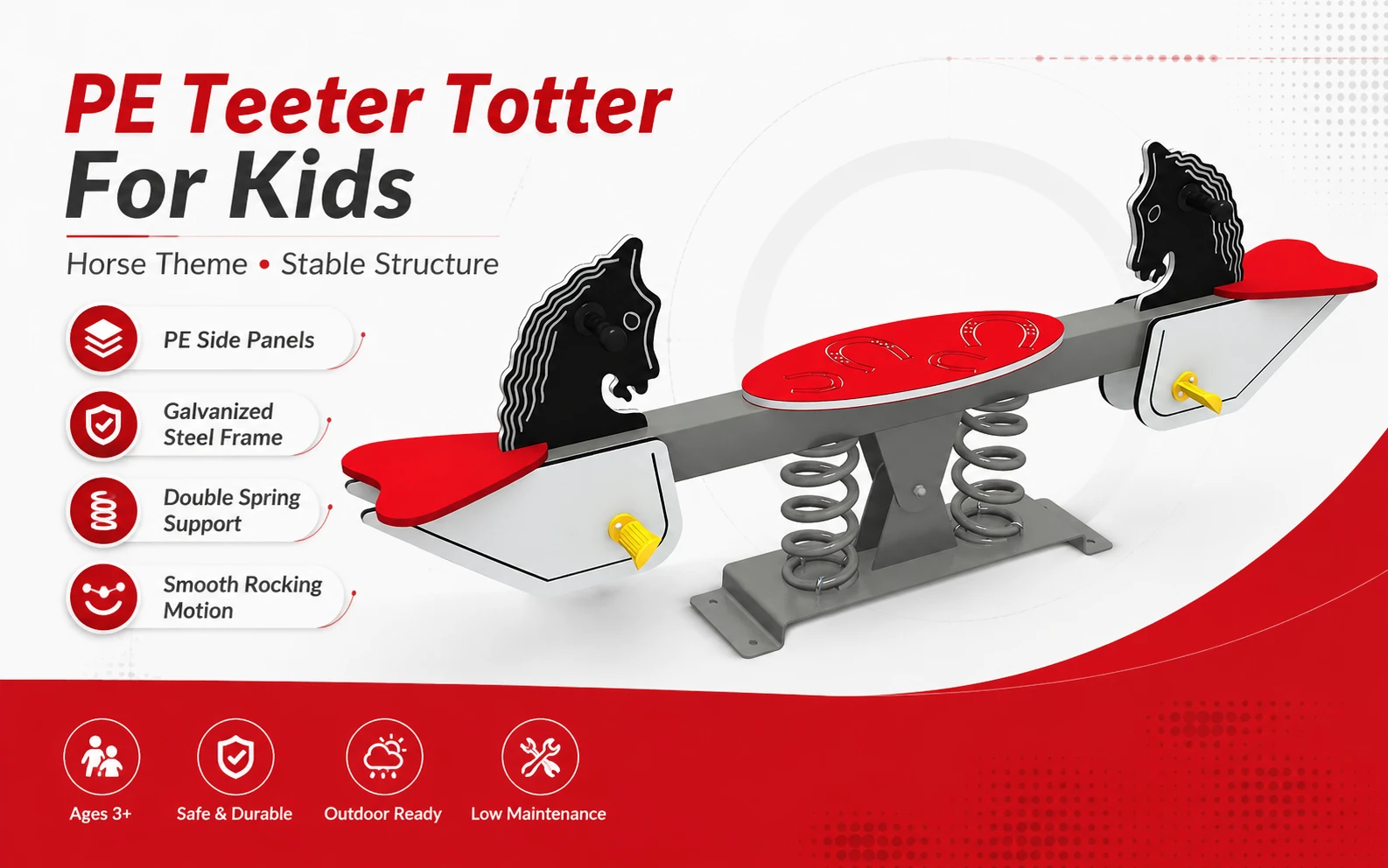
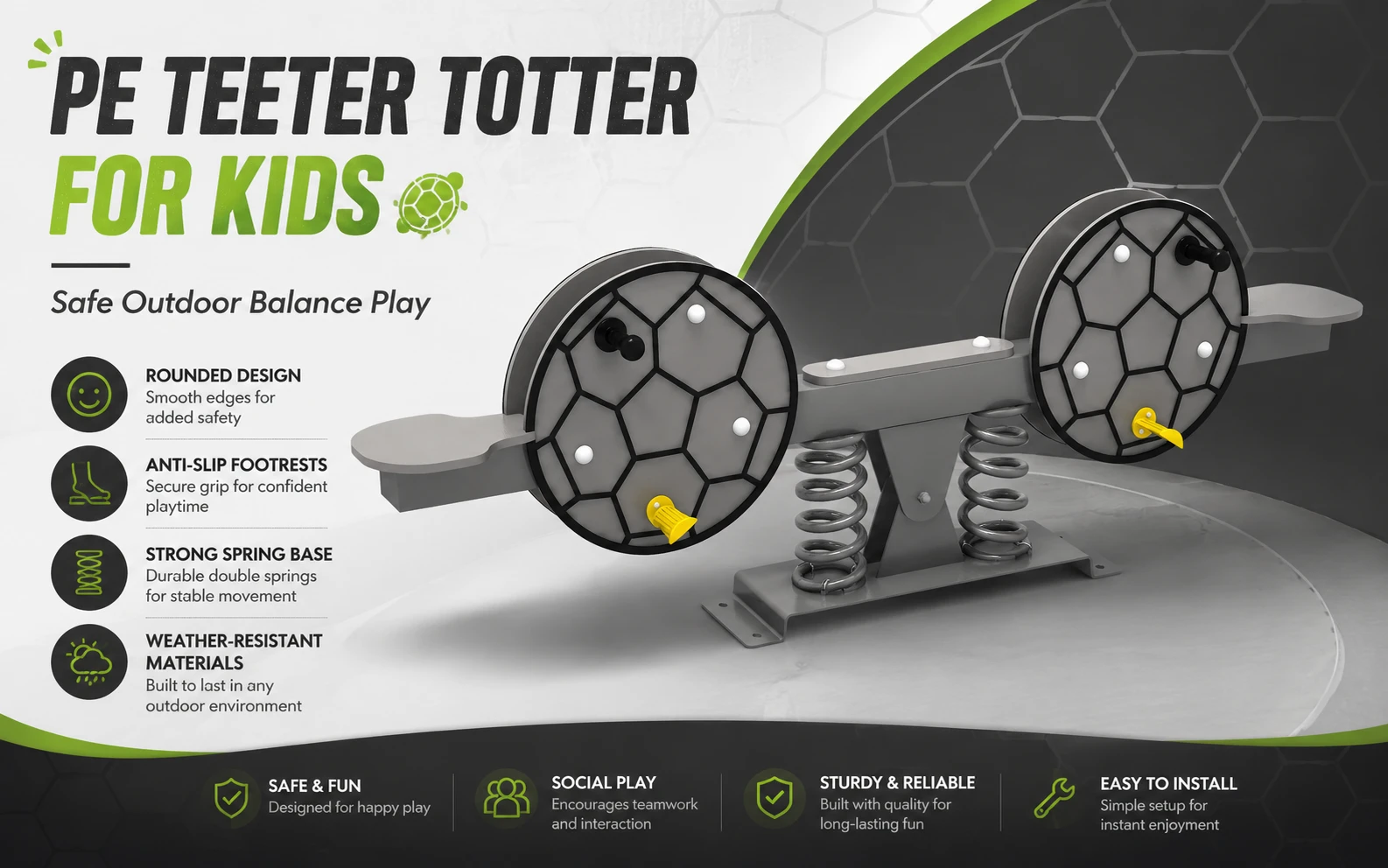
Safety must be evaluated at component level. A commercial PE teeter totter for kids should have rounded exposed edges, protected bolts, stable seats, secure handholds, non-slip footrests, controlled movement, and no accessible crushing, pinching, or entrapment points. The central mechanism should shield children from moving metal parts. Seat geometry and grip position on a PE teeter totter for kids should also match the intended users so children can maintain a stable posture.
Impact control is especially important. A PE teeter totter for kids may use EPDM rubber bumpers, spring control, or another engineered stop to reduce abrupt ground contact. The supplier’s technical file should show the pivot design, movement limit, seat arrangement, anchoring method, and required surfacing rather than using general statements such as “safe design.”
For public-use projects, ASTM F1487 covers safety and performance requirements for public playground equipment. EN 1176-6 provides additional requirements and test methods for rocking equipment, including seesaws. A project may also reference the CPSC Public Playground Safety Handbook or local rules. Request model-specific test reports, technical documents, or compliance evidence instead of relying only on a certificate logo. for kids** also needs an appropriate use zone and impact-attenuating surface. The correct system depends on fall height, climate, drainage, local standards, and maintenance planning. Foundations should remain below the finished surface, and concrete or anchors must not become exposed hazards.
Where It Works Best And What Can Be Customized
A PE teeter totter for kids is suitable for kindergartens, preschools, schoolyards, public parks, housing communities, resorts, family recreation areas, and commercial playground projects. It offers a recognizable activity without the cost or footprint of a large composite play structure. Because a PE teeter totter for kids is freestanding, it can also be added during a phased playground upgrade.
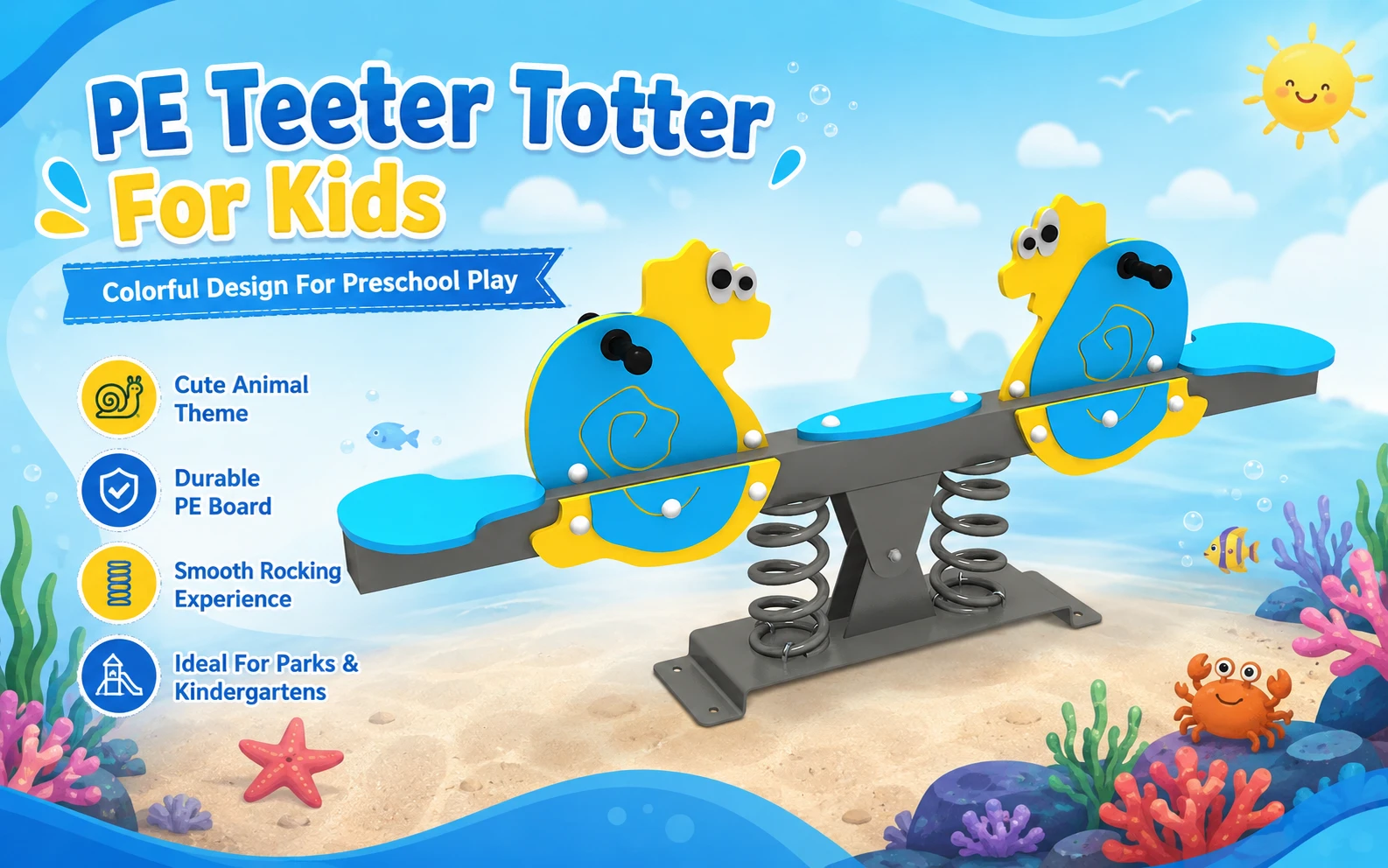
In a school, the PE teeter totter for kids supports cooperative play during short activity periods. In a community park, it can fill a smaller zone beside swings, spring riders, or sensory panels. For resorts and themed spaces, custom-cut PE panels can follow ocean, jungle, farm, transport, or local-culture concepts. Distributors can use one proven structural base with several panel shapes to simplify inventory and spare parts.
Useful customization includes panel color, engraved graphics, animal shape, logo position, seat configuration, handle location, and theme coordination. Send the supplier a site plan, target age group, preferred colors, expected traffic, required standard, installation environment, and budget range.
Before approving a custom PE teeter totter for kids, confirm which changes are decorative and which affect engineering. Color and engraving may be straightforward. Changes to beam length, pivot height, seat spacing, movement range, or user capacity may require structural review and additional testing.
How To Install, Maintain, And Evaluate A Manufacturer
The installation team should treat the PE teeter totter for kids as moving equipment with a defined use zone. Correct installation determines whether the PE teeter totter for kids performs as designed. Check ground level, drainage, soil conditions, and underground services before foundation work. Follow the anchor drawing, allow the concrete to cure, align the pivot, install all protective caps, and complete the safety surface without reducing movement clearance.
After handover, inspect the PE teeter totter for kids according to traffic and local rules. Look for loose fasteners, worn grips, damaged footrests, cracked panels, unusual bearing noise, reduced movement control, corrosion, exposed foundations, damaged bumpers, and displaced surfacing. Moving parts and high-use connections deserve more frequent attention than decorative panels. Maintenance documents for the PE teeter totter for kids should identify inspection points, replacement components, and tightening procedures.
A capable supplier should provide material specifications, model drawings, quality-control records, packing details, installation instructions, and spare-part support. JQ Playground, operated by Wenzhou Jiqi Amusement Equipment Co., Ltd., states that it has more than 30 years of industry experience, a production base exceeding 60,000 square meters, custom design capability, and support covering planning, manufacturing, installation guidance, and after-sales service. Buyers should confirm the exact certificate, warranty, lead time, and configuration for their selected PE teeter totter for kids in the final contract.
The best PE teeter totter for kids is not selected by appearance alone. A strong purchasing decision balances play value, age suitability, PE panel quality, structural strength, controlled motion, compliance, installation scope, and serviceability. When the PE teeter totter for kids is specified with clear technical and service requirements, a complete site brief and detailed RFQ will help the manufacturer provide an accurate proposal and reduce hidden costs.


 English
  Español
  Français
  Deutsch
  Português