


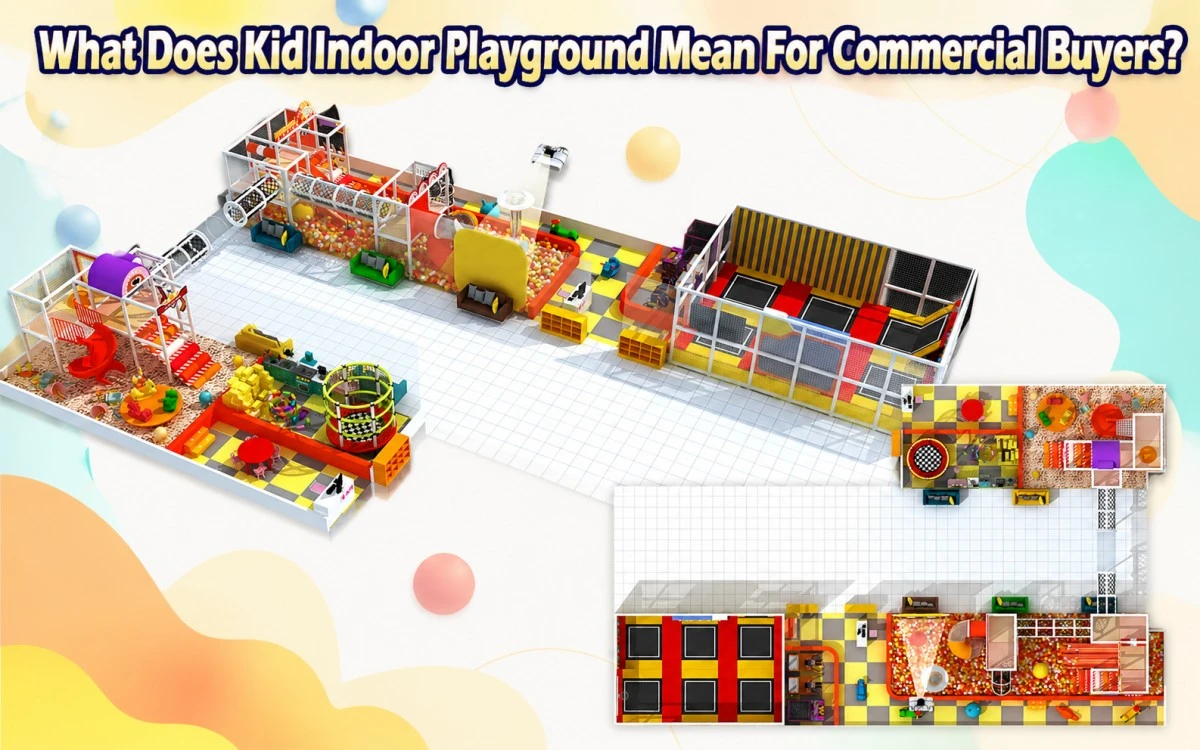
Kid indoor playground searches usually come from buyers planning commercial spaces that need safe, compact, and profitable play zones. Malls, schools, preschools, family entertainment centres, and hotels all use the term differently, but they compare the same basics: equipment type, safety control, custom layout, and supplier fit.
The term refers to a child-focused indoor play space with commercial equipment and planning needs. That usually means soft play structures, slides, crawl zones, and activity panels designed for supervised use, not a home toy set. Buyers then check how the layout suits the age group, how the materials support daily traffic, and whether the supplier can match the site size, theme, and installation plan.
What “Kid Indoor Playground” Usually Means in Commercial Sourcing
The query kid indoor playground is commercially useful, but it is not precise. On SERP pages, you usually see mixed results: product pages for indoor playground equipment, supplier listings, venue ideas, and design examples, which shows buyers are searching for a purchasable project, not a dictionary definition of “kid”.
For B2B sourcing, the term normally means a child-focused indoor play installation that can be specified, priced, and installed in a commercial setting. That includes layout planning, age zoning, material selection, fixing methods, and safety checks, because one site may need a 12 m x 8 m soft play zone while another needs a compact 20 m² preschool corner.
Who usually buys under this search term
You are usually dealing with one of these buyer groups:
- Shopping centre operators planning a family traffic zone
- Preschool and school facility teams fitting supervised play space into a building
- Family entertainment centre developers comparing attraction mix and floor area
- Hotel, resort, and restaurant owners adding child dwell-time features
- Contractors, importers, and distributors sourcing indoor soft play for a project order
The commercial meaning is practical. If you are buying for a venue, you need a supplier that can translate a search term into dimensions, age bands, and component lists.
How the term maps to sourcing language
In supplier talks, “kid indoor playground” usually maps to product categories such as modular soft play, climbing frames, slides, crawl tunnels, ball pits, and activity panels. Buyers may also ask for themed zones, anti-slip flooring, or wall-mounted features, depending on the site.
That matters because the phrase covers both the play experience and the build format. A 3-year-old preschool corner and a 10-year-old family venue zone both sit under the same search, yet they need different indoor playground equipment layouts, different impact protection, and different supervision lines.
What SERP behaviour tells you
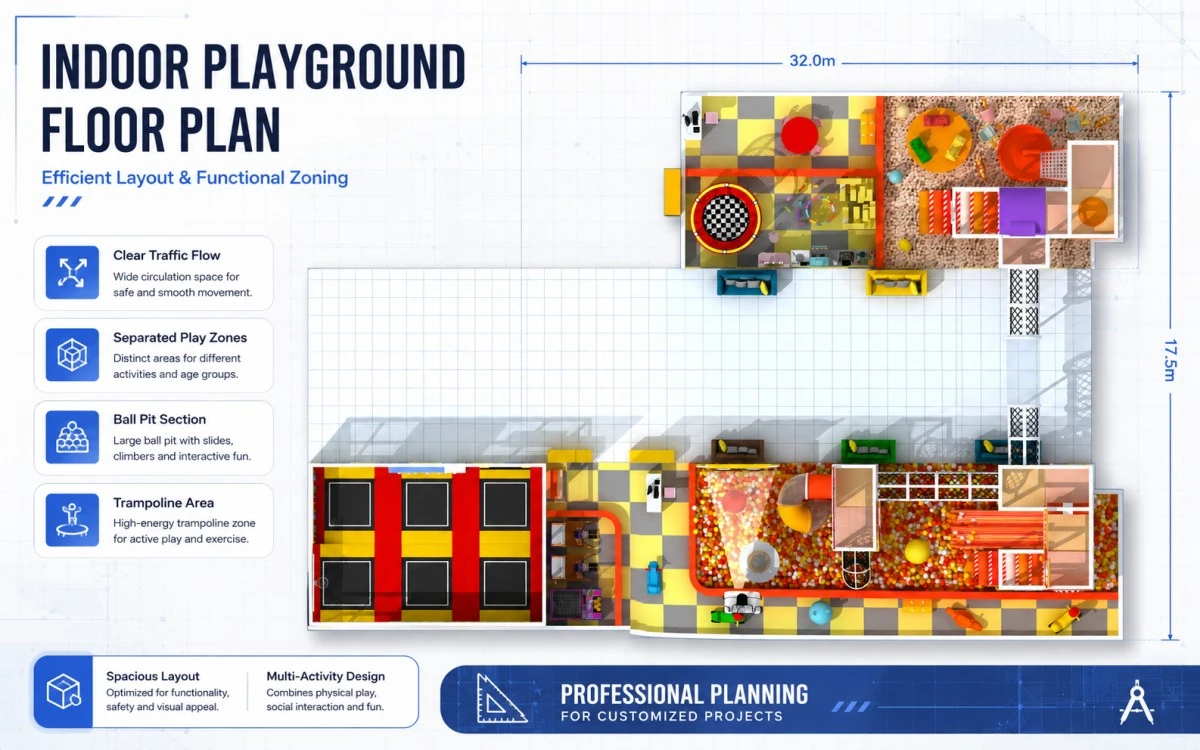
Search results for this keyword are commercially mixed rather than informationally pure. You can see venue photos, supplier pages, and product categories appearing together, which usually means the intent is part inspiration, part procurement, and part quotation research.
That mix matters for buyers. It tells you the searcher is usually trying to answer three questions at once:
- What type of indoor play system fits the site?
- What size and age group does it suit?
- Which supplier can build it to spec?
So, in B2B terms, the phrase points to a commercial play project, not a toy purchase. If you treat it as a sourcing brief, you can move faster from idea to layout, pricing, and installation planning.
Indoor Soft Play and Playground Equipment for Malls, Schools, and Family Venues
For a kid indoor playground, buyers usually need a mix of soft play zones and challenge features, not one standalone item. The strongest commercial layouts combine 3 to 6 play functions, so children can move from climbing to sliding, then into quieter sensory play.
Soft play zones for younger age groups
Soft play works best in preschools, nursery centres, family lounges, and shopping centres where the priority is low-impact play. Foam blocks, padded ramps, and enclosed play corners reduce hard-edge exposure and suit children aged 2 to 6, where floor-level play keeps supervision easier.
A typical soft play zone often includes 4 core parts: padded flooring, foam obstacles, mini climbers, and crawl-through pieces. In compact venues, a 12 to 20 m² zone can handle basic activity without crowding walkways. Larger family venues usually separate toddler play from mixed-age play to cut conflict between age groups.
Climbing elements for active circulation
Climbing elements suit community facilities, indoor leisure centres, and tourism venues that need higher-energy activity in a controlled footprint. Net climbs, stepping pods, and low wall climbs give children a clear route choice and keep traffic moving.
You should match climb height to supervision levels. A 1.2 m to 1.8 m climbing structure fits many commercial indoor projects because it stays visually open and easier to monitor than taller tower forms. Where space is tight, a PE board playground structure can add vertical interest without filling the entire floor.
Slides for clear movement and repeat play
Slides usually perform best as the anchor feature in malls, preschool play rooms, and family entertainment areas. A single straight slide, a tunnel slide, or a short wave slide gives a simple reward path after climbing or crawling.
For commercial layouts, slide entry points must stay visible from the main circulation area. That matters in shopping centres and school settings, where adults need to see the top platform and landing zone from 2 or 3 angles. If you are planning mixed-age use, separate small slides for younger children from taller slides for older groups.
Ball pits and crawl tunnels for sensory play
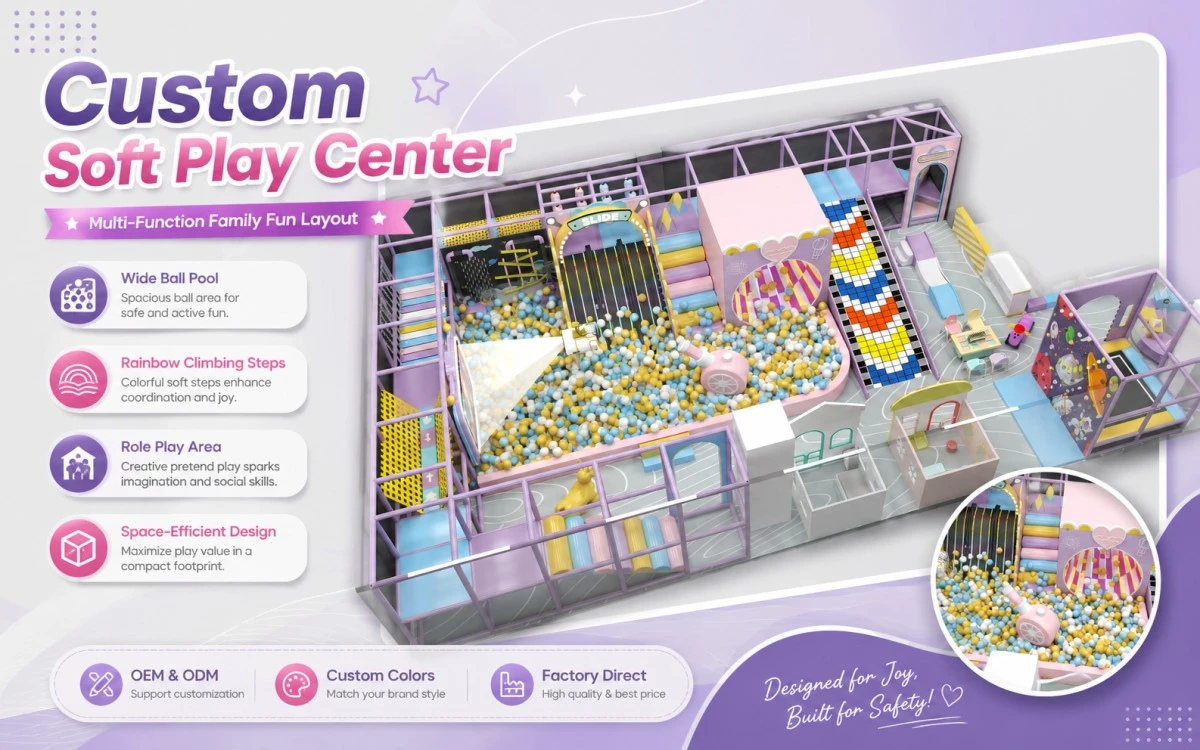
Ball pits fit best in enclosed soft play corners, toddler areas, and indoor family venues with controlled cleaning routines. They add 1 high-engagement zone, but they work only if you can manage hygiene, ball replacement, and constant visibility.
Crawl tunnels suit preschools, early years centres, and indoor attractions with lower ceiling heights. A tunnel run of 2 m to 4 m is common in compact plans because it keeps the path short and reduces bottlenecks. These pieces also help bridge zones, so children move from one activity to the next without a blank section.
Activity panels for quiet and repeat interaction
Activity panels work well in schools, waiting areas, libraries, and community facilities where noise control matters. They give a child 1 to 2 minutes of focused play without large body movement, which is useful next to reception desks or circulation edges.
You can group panels by function: gear turning, matching, sliding beads, shape sorting, and tactile learning. That gives you a cleaner zone mix than filling every wall with the same panel type. In commercial layouts, panels often fill the dead space at perimeter walls, so you keep the centre clear for movement.
Where each category fits best
- Shopping centres: soft play zones, slides, and activity panels for short-stay family traffic.
- Preschools: crawl tunnels, low climbers, and quiet panels for age-controlled movement.
- Tourism venues: climbing elements, slides, and ball pits for longer dwell time.
- Community facilities: mixed soft play and sensory features for broad age use.
- Water playground concepts with indoor dry play nearby: pair splash-style theming with padded zones only where moisture control is planned.
A good commercial mix usually uses 3 levels of intensity: calm, active, and high-energy. That structure helps you place each item where children can use it safely, while adults still keep clear sightlines.
Modular Sets, Themed Layouts, and Custom Indoor Playground Builds
For a kid indoor playground, the sourcing choice usually comes down to three routes: modular kits, semi-custom packages, or a fully custom playground build. Each option changes the budget, lead time, design freedom, and installation effort.
Modular kits suit buyers who need a faster purchase cycle and a predictable parts list. Fully custom builds suit sites with odd room shapes, ceiling constraints, or a strong theme brief.
Modular kits: fastest to order, simplest to install
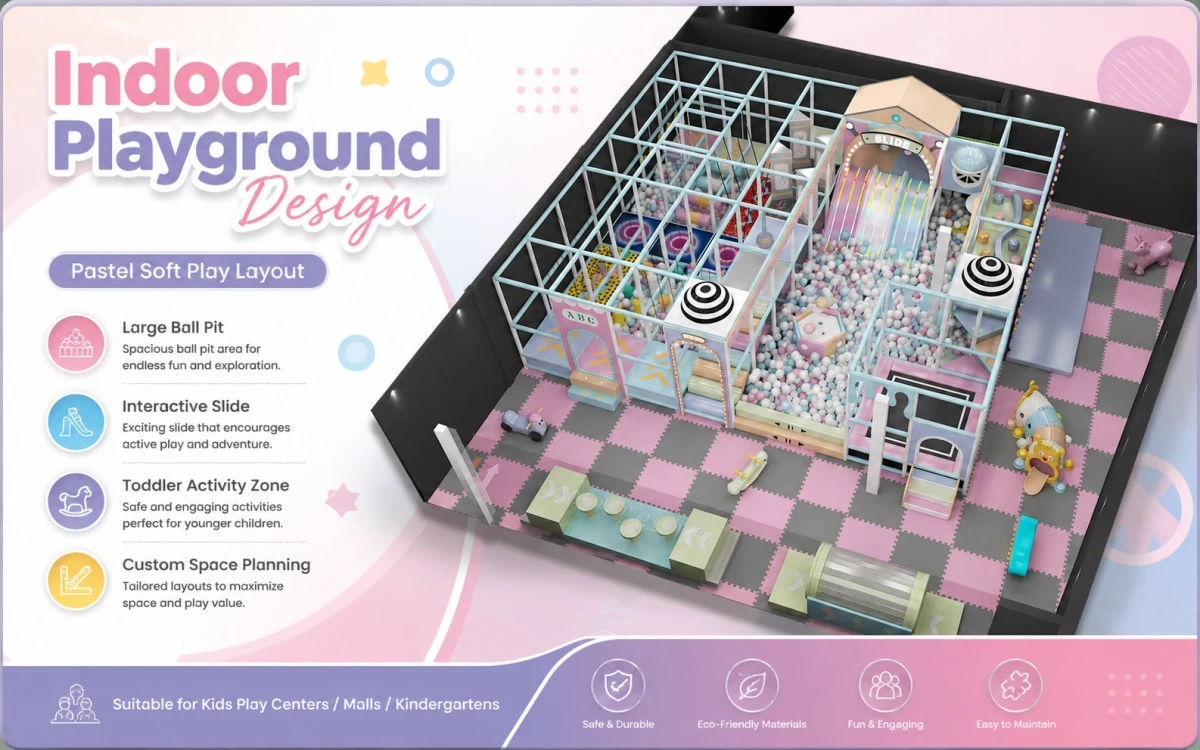
A modular kit usually arrives as pre-designed frames, panels, slides, and soft elements sized to fit a standard footprint. That makes planning easier, because you start with a known layout instead of a blank sheet.
Use modular sets if you need:
– a tighter budget
– shorter lead times
– repeatable parts for multi-site rollout
– simpler spare-parts planning
The trade-off is design flexibility. You may get 2 or 3 layout choices, but not a fully unique play route.
Semi-custom packages: a middle path for most buyers
Semi-custom packages often keep the core structure fixed while changing colours, graphics, entry points, or selected activities. That works well for malls, preschools, and family venues that want a branded look without a long engineering cycle.
Compared with modular kits, semi-custom packages usually give you:
– more theme control
– better fit to room dimensions
– moderate lead time impact
– slightly higher installation complexity
This route is often the practical choice if you want a custom playground appearance without paying for every element to be drawn from zero.
Fully custom builds: highest flexibility, highest coordination
A fully custom build starts with your site plan, traffic flow, age range, and brand theme. The supplier then designs the play route, structure heights, access points, and decorative elements around your brief.
This option suits complex projects, such as:
– irregular floor plates
– mixed-use venues with columns or service risers
– flagship family entertainment centres
– themed attractions with strong visual storytelling
You get the most design freedom, but the project needs more decisions up front. Expect more drawing revisions, more material sign-off, and more installation planning.
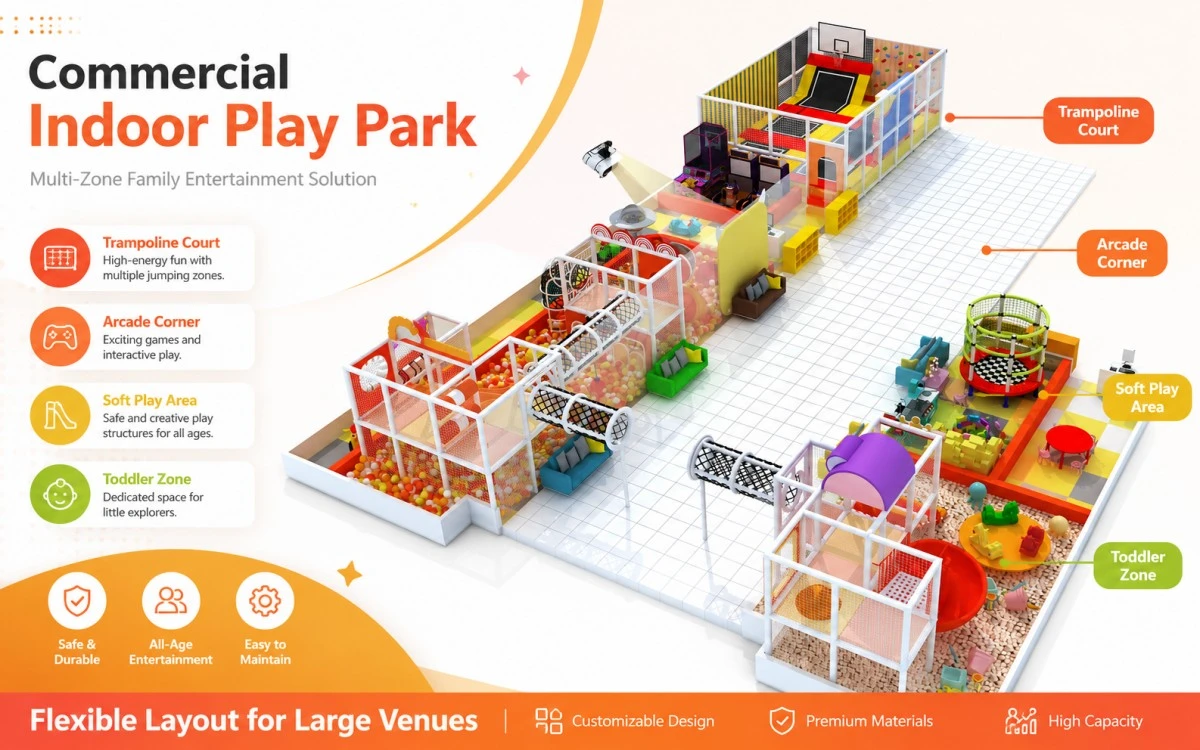
How the three options compare
| Option | Budget impact | Lead time | Design flexibility | Installation complexity |
|---|---|---|---|---|
| Modular kit | Lowest | Shortest | Limited | Low |
| Semi-custom package | Medium | Medium | Moderate | Medium |
| Fully custom build | Highest | Longest | High | High |
The pattern is simple. More customisation usually means more drawings, more approval rounds, and more site checks.
What to request from manufacturers
Ask for a layout pack before you compare prices. A useful pack usually includes:
– floor plan drawings with dimensions
– elevations or 3D views
– material options for frames, padding, netting, and decking
– colour palettes and print examples
– theme customization samples, such as jungle, ocean, space, or city themes
You should also request a comparison between standard and upgraded finishes. For example, a package may offer 2 panel graphics, 3 frame colours, and 2 flooring options, which helps you compare cost changes clearly.
If your site has a low ceiling or an awkward corner, ask for a drawing that shows clearance zones in millimetres, not just metres. That level of detail reduces redesign risk before production starts.
The best supplier response is visual and specific. If they can show 2 layout variants, 3 material choices, and 1 theme example set, you can judge feasibility quickly and move to the next review stage.
Age Fit, Supervision, and Safety Checks for Kid-Focused Indoor Play Areas
A kid indoor playground works only when the age plan matches the equipment and the supervision plan matches the child behaviour. If you mix toddlers, primary-age children, and older siblings without zoning, you raise collision risk and make staff visibility harder.
Match the play zone to the age band
You should separate age groups by height, access point, and play intensity. A 2–5 year area usually needs lower decks, shorter drops, and wider crawl routes than a 6–10 year zone.
| Age group | Practical layout signals | Typical safety focus |
|---|---|---|
| 0–3 years | Low platforms, soft flooring, gate-controlled entry, simple panels | No loose parts, no steep climbs, constant line-of-sight |
| 3–5 years | Small slides, padded steps, tunnels, sensory panels | Guardrails, edge padding, clear fall zones |
| 6–10 years | Taller climbing nets, multi-level routes, faster slides | Impact surfacing, load control, better circulation |
A 1.2 m platform is a very different risk profile from a 0.6 m platform. Buyers should ask where the highest deck sits, because that one number shapes guardrail height, landing depth, and staffing needs.
Supervision needs visible circulation
Staff need to see children from multiple points, not just from the entrance. Curved tunnels, blind corners, and dense themed walls can hide 3 to 5 children at once, so you should check sightlines before approving a layout.
Good circulation also reduces pushing and backtracking. Wide routes, separate entry and exit points, and at least 1 obvious emergency access path make supervision easier in commercial venues such as malls, preschools, and family entertainment centres.
Look for fall protection, edge control, and load checks
You should ask for the exact material and structural details, not just a rendered image. Padded edges, recessed bolts, rounded corners, and covered joins matter because a child’s head or elbow often hits the outer frame first.
For commercial use, check these points:
– Surface materials with wipe-clean finishes and no exposed splinters, sharp seams, or peeling skins.
– Edge protection on platforms, steps, handrails, and slide exits.
– Load considerations for decks, bridges, and climbing nets, especially where 4 to 8 children may gather together.
– Anchoring details for freestanding modules so movement stays controlled during repeated use.
– Maintenance-friendly design with removable panels and access points for inspection.
A 50 mm padded cover is more useful than a decorative wrap if it stays intact after daily traffic. That is the kind of detail buyers should compare line by line.
Safety proof buyers should request
For a kid indoor playground, evidence matters more than decoration. Ask for references to recognised playground safety standards, fall-height limits, and surface performance data where relevant to the market.
Useful documents and checks include:
– Material safety data for foam, plastics, coatings, and adhesives
– Edge and corner treatment details
– Maximum user load per platform or route
– Cleaning and replacement instructions for high-wear panels
– Inspection points for joints, netting, and fasteners
If the play area sits beside outdoor fitness equipment or a café edge, the boundary needs extra clarity. A child should not be able to run straight from a soft play opening into a hard-surface circulation route.
Behaviour control matters as much as structure
You are not only managing falls. You are also managing running, climbing in the wrong direction, and crowding around one popular feature such as a slide or ball pit.
Simple controls help:
– One-way entries on narrow routes
– Age-specific signage with 1 clear rule per zone
– Padding around high-traffic corners
– Staff positions at bottlenecks, not only at the front desk
Even a playful pet playground style concept needs this same logic: clear boundaries, visible movement, and surfaces that tolerate repeated contact. In child-focused spaces, those controls are not optional extras.
What to verify before approval
Before you sign off the layout, confirm 4 things: the youngest age band, the tallest climbing point, the easiest supervision line, and the maintenance access plan. If any one of those is unclear, the layout is not ready for commercial operation.
That level of checking keeps the project practical for operators and gives you cleaner input for OEM and ODM discussions.
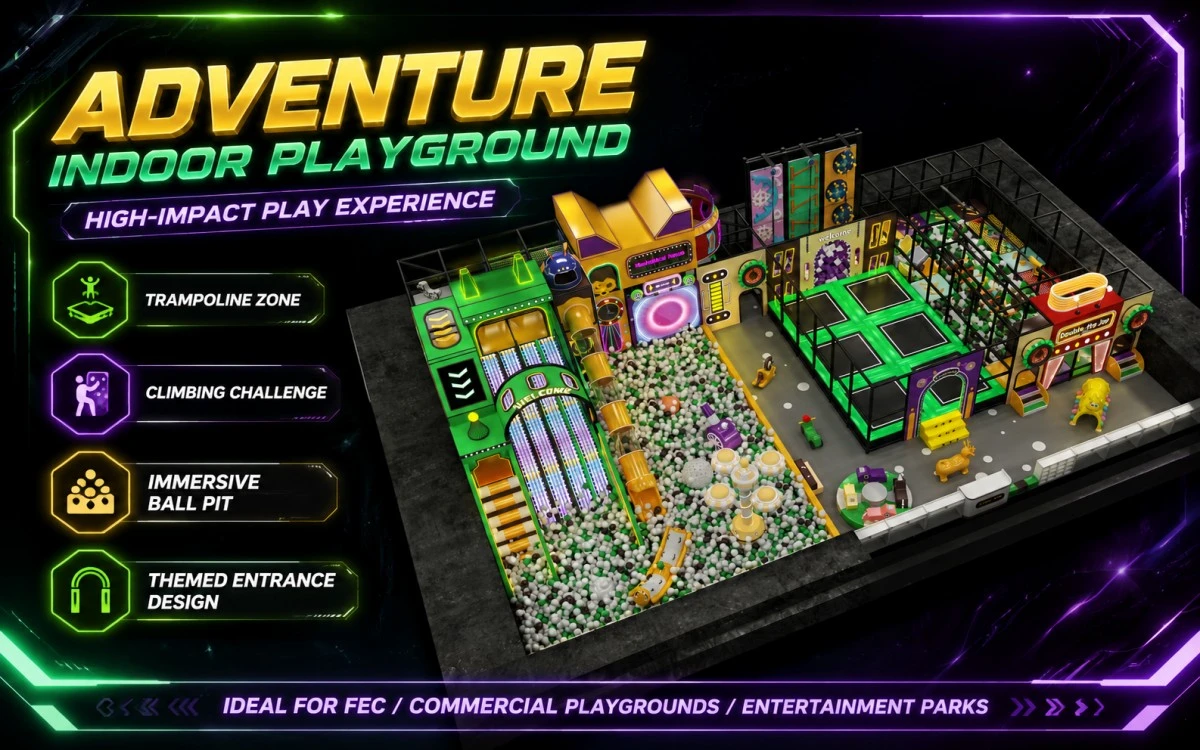
OEM and ODM Supply for Importers, Contractors, and Project Developers
For a kid indoor playground project, supplier selection starts with factory capability, not catalogue style. You need a partner that can show how it turns drawings into shipped parts, then into a working playground facility with 1:1 fit and clear installation steps.
- Check manufacturing scope first. Ask whether the supplier handles steel frames, MDF or plywood panels, soft foam sections, rope elements, printing, and final packing under one workflow or through split subcontracting.
- Request project references. A useful reference set usually includes 3 items: a completed mall build, a school or preschool installation, and one export project with long-distance shipping.
- Confirm customisation depth. Good OEM and ODM supply should show 2 levels of change: colour/theme changes and structural changes, such as platform size, slide angle, or zone sequence.
- Ask for drawings before pricing. You should receive plan view, elevation, and a basic parts breakdown, because a quote without drawings often misses 1 or 2 install-critical items.
- Match materials to venue use. For commercial indoor play, buyers commonly ask for powder-coated metal, E0 or E1 panels where applicable, closed-cell foam, and PVC or PU coverings for easier cleaning.
- Require packing detail. Export packs should show carton count, crate size, gross weight, and marked part numbers, especially if the site team will receive 20 cartons or more.
- Check compliance documents early. International buyers normally request material specs, test reports, and product conformity files before final approval, not after production starts.
- Confirm installation support. Many B2B projects need 1 of 2 support models: remote fit-out guidance with labelled drawings, or on-site supervision for larger builds.
- Ask about spare parts and after-sales. A practical package includes replacement netting, connectors, padding, panels, and a contact path for 12-month maintenance planning.
- Share RFQ inputs in a fixed format. The supplier can price faster when you provide site dimensions, age band, theme direction, target budget, delivery window, and destination port or project address.
A commercial playground equipment manufacturer China will usually quote faster when you send the same 6 inputs in one file: layout size, preferred materials, custom colours, quantity, shipping method, and inspection needs. That reduces back-and-forth and helps you compare 2 or 3 supplier offers on the same basis.
If you are sourcing internationally, treat the first quotation as a capability check. One supplier may offer low unit pricing but no packing list, while another may cost 8% to 12% more and give drawings, export marks, and fitter guidance that save days on site.
For RFQ screening, the strongest suppliers answer with evidence, not adjectives.
That evidence should include drawing sets, material schedules, packing breakdowns, compliance files, and a clear installation scope. Once you have those items, you can move into the final RFQ checklist with far less redesign risk.
What to Confirm Before Requesting a Quote for a Kid Indoor Playground
A clear RFQ saves time, because a kid indoor playground quote changes fast when room size, age band, or ceiling height is vague. If you give a playground equipment supplier the right inputs first, you reduce redraws, rework, and shipping delays.
Use this pre-quote checklist before you request pricing:
- Site dimensions
- Share the usable floor size in metres or feet, including length, width, and any columns, ducts, doors, or fixed counters.
- Mark the exact clear area for play equipment, circulation, queue space, and staff access.
-
If the room is irregular, include a simple sketch with all wall-to-wall measurements.
-
Indoor ceiling height
- Give the lowest clear height, not the highest point.
- Note beams, lighting, sprinklers, vents, and hanging signs, because one low obstacle can change the full layout.
-
If the ceiling varies across the room, provide heights for each zone.
-
Target age range
- State the exact user band, such as 2–5 years, 3–8 years, or 6–12 years.
- Tell the supplier whether you need toddler-only play, mixed-age play, or separated zones.
-
Age range affects slide height, climbing access, barrier height, and supervision visibility.
-
Theme direction
- Share the preferred theme, such as jungle, ocean, space, city, or pastel soft-play.
- Include colour preferences, logo placement, and any brand-style references.
-
If you have 3 reference images, send them together; suppliers can match style faster than with a text brief alone.
-
Budget range
- Give a realistic range for equipment only, or for a full project including shipping and installation.
- Break the budget into line items if possible: structure, soft play pieces, flooring, graphics, transport, and fitting.
-
A playground equipment factory can quote a simpler package when it knows whether your ceiling for the build is £20,000 or £120,000.
-
Installation location
- Specify the country, city, and site type, such as mall, school, hotel, leisure centre, or preschool.
- Confirm whether the site is ground floor, upper floor, or rooftop, because access affects unloading and assembly.
-
Include loading bay details, lift size, stair access, and any restricted delivery hours.
-
Delivery timeline
- State your required quotation date, production start target, delivery window, and installation deadline.
- If you are working to a fixed opening date, include it in the first message.
-
A 4-week lead time and a 12-week lead time are two very different sourcing plans.
-
Power, floor, and room constraints
- Confirm whether the room has finished flooring, bare concrete, or a raised platform.
- Share any power points, lighting limits, or fire-safety features that affect layout.
-
If you need wall fixing restrictions or no-drill installation, say so before design starts.
-
Shipping and packing preferences
- Tell the supplier if the site needs compact packing, palletised delivery, or split shipments.
- State whether you need labelled cartons, spare-part packs, or photo-based packing confirmation.
-
These details help reduce damage risk and speed up site checks on arrival.
-
Document pack for quotation
- Send a floor plan, ceiling-height notes, target age range, theme references, budget band, delivery site, and timeline in one file set.
- Add any required drawings, if you already have them, so the quotation can match the room on the first pass.
- When a buyer sends all seven inputs together, the first quote is usually closer to the final build, with fewer revision rounds.
Project support from JQ Playground
JQ Playground (Wenzhou Jiqi Amusement Equipment Co., Ltd.) is a professional manufacturer specializing in children’s playground equipment, founded in 1993 with over 30 years of industry experience.
For a kid indoor playground project, share the site size, age group, target capacity, theme direction, safety standard, timeline, and budget range so JQ Playground can prepare layout options and a practical quote.
For RFQ details, samples, packaging, or custom service options, confirm the exact model fit with the sales team before ordering.
About JQ Playground (Wenzhou Jiqi Amusement Equipment Co., Ltd.)
JQ Playground (Wenzhou Jiqi Amusement Equipment Co., Ltd.) is a leading children’s playground equipment manufacturer with 30+ years of industry experience. The company integrates design, customization, large-scale manufacturing, sales, and after-sales service. Main product range: Outdoor Playground, Indoor Playground, Indoor Soft Play, Water Playground, PE Board Playground, Custom Playground, Children Furniture, Outdoor Fitness Equipment, Pet Playground, and Playground Facility. Factory: 60,000+ square metres, 100+ patents, ISO/BSCI/Sedex/TÜV/ASTM/CE/CPC certified. Services cover site planning, design, manufacturing, installation guidance, and after-sales support for parks, communities, schools, commercial complexes, tourism projects, and government facilities worldwide. Contact: [email protected] / +86 18906666228.


 English
  Español
  Français
  Deutsch
  Português