


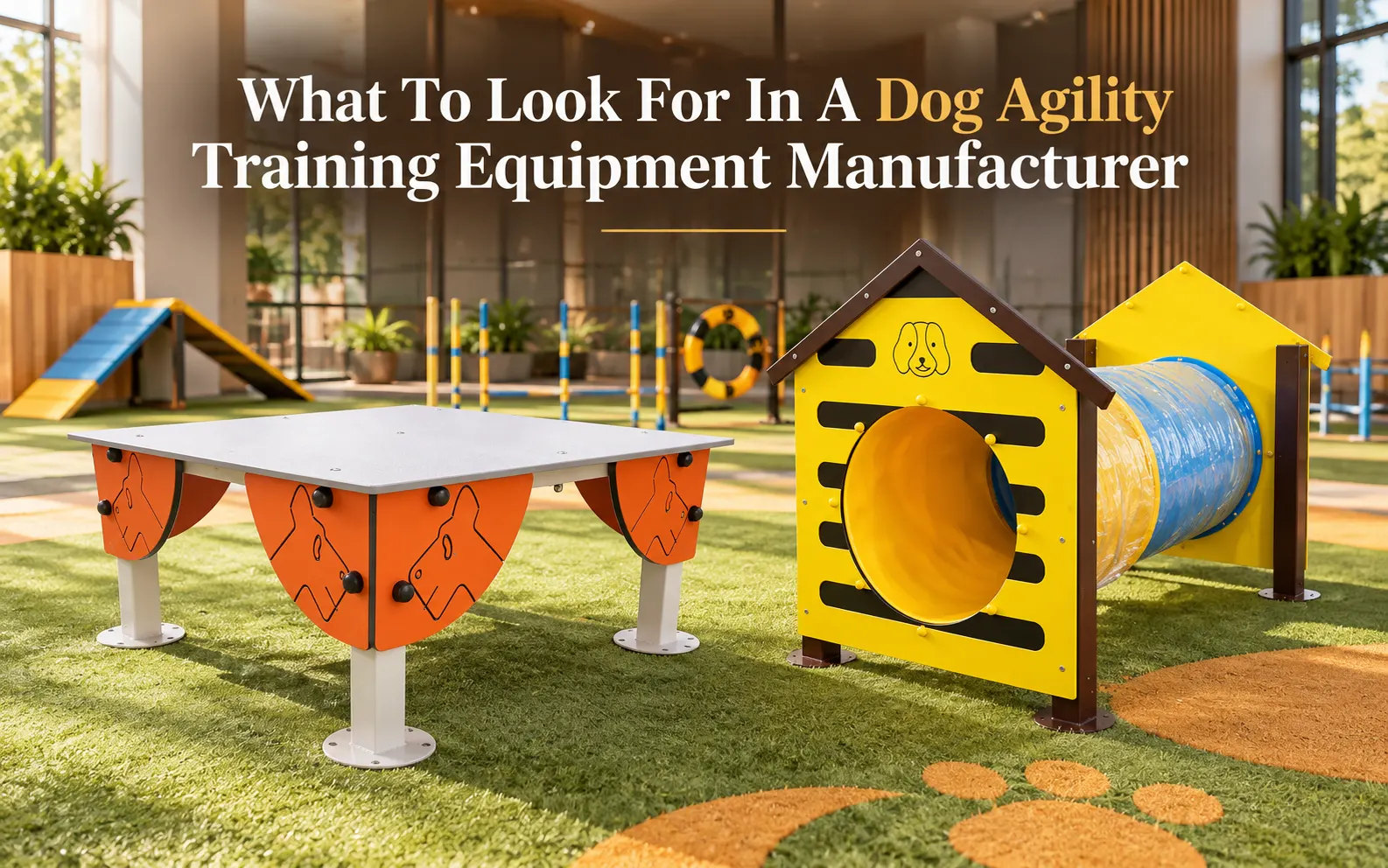
Choosing a dog agility training equipment manufacturer is not only about price or appearance. Without a reliable rubber coating or slip-resistant sand paint, dogs may slide, fall, or injure their paw pads. Two-section dog-walk boards can create dangerous gaps, while loose bolts or stiff hinges may make gaps wider and moving parts unstable. Poor spacing and missing physical guidance, such as channels or wire guides, can also cause repeated failures during weave-pole or drop-bar training.
These problems reduce training confidence and create avoidable safety risks. The right manufacturer solves them through safer surfaces, precise engineering, testing, and dependable support.

What Is Dog Agility Training Equipment?
Dog agility training equipment consists of specialized obstacles and tools used to guide a dog through a timed, off-leash course to test speed, coordination, and obedience. A well-designed dog agility course should challenge the dog progressively while giving the handler clear control over direction, rhythm, and reward timing.
For clubs, professional trainers, schools, rehabilitation centers, and active pet owners, dog agility equipment must combine safe movement, stable construction, easy adjustment, and practical storage.
Essential Agility Equipment Types
- Jumps And Hurdles: Bars, panel jumps, or wing jumps that dogs leap over. Heights are typically adjustable, ranging from 4 to 24+ inches, to match the dog’s size, experience, and training objective. Breakaway or lightweight elements can help reduce impact risk.
- Agility Tunnels: Flexible or rigid tube-like fabric structures, often 15 to 18 feet long with a 24-inch opening, that dogs sprint straight through or bend around. A dependable tunnel needs a smooth interior, reinforced fabric, secure anchoring, and enough flexibility for repeated setup.
- Weave Poles: A line of 6 to 12 vertical poles, commonly spaced 24 inches apart, that the dog weaves through in a continuous slalom pattern. Adjustable channels and guide systems can help beginners learn the correct entry and exit path.
- Tire Jumps: A suspended circular ring or tire frame that the dog must leap cleanly through. The frame should be visible, stable, and designed to reduce dangerous contact if the dog misjudges the jump.
- Contact Obstacles: Large climbing structures featuring designated contact zones with non-slip rubber or textured surfaces where the dog must touch with at least one paw:
- A-Frame: Two large ramps joined at the top to form an A shape.
- Dog Walk: A raised central plank with ascending and descending ramps on each side.
- Teeter-Totter Or Seesaw: A pivoting balanced plank that tilts to the ground as the dog crosses its center.
- Pause Table Or Pause Box: A flat, elevated platform where the dog must pause, sit, or lie down for a designated number of seconds during a run.
- Fitness And Conditioning Aids: Balance discs, platforms, cavaletti rails, and ladder drills used off-course to build core strength, improve body awareness, and support appropriate conditioning.
Training And Product Selection Insight: The best dog agility training equipment is not simply a collection of obstacles. It is a coordinated system that supports safe learning, repeatable handling, efficient course layout, and long-term use in changing weather conditions.
A careful manufacturer should make every obstacle part of a safer, more teachable, and more dependable dog agility course.
Looking For Something In Particular?
A professional buying process should begin with the actual needs of your dog agility course rather than a generic product list. A home user may need foldable dog agility equipment that can be stored in a garage, while a training club may require heavy-duty equipment for daily sessions, group classes, and local competitions.
A municipal recreation project may need a complete outdoor layout, impact-conscious surfaces, drainage planning, and installation guidance. Identifying the use case first helps the manufacturer recommend the correct size, material, anchoring method, and level of adjustment.
When reviewing a dog agility training equipment manufacturer, ask whether the product range covers complete training requirements. Important categories may include adjustable jumps, contact obstacles, tunnels, weave-pole systems, tire jumps, pause tables, long jumps, soft walls, carrying bags, tunnel weights, and conditioning platforms.
A supplier that only offers isolated items may not coordinate dimensions across the whole dog agility course. Consistent specifications matter when several obstacles share one training area.
Customization is another practical consideration. The manufacturer should discuss colors, obstacle heights, surface textures, logo placement, frame finishes, storage formats, and layout dimensions. For schools, pet resorts, and commercial training centers, dog agility equipment may need to match an existing landscape or brand identity.
For professional clubs, it may need to follow target competition dimensions. A clear technical drawing helps prevent misunderstandings about openings, platform heights, hinges, contact zones, and anchoring points.
It is also useful to ask about replacement parts. Rubber surfaces, tunnel connectors, bars, fasteners, hinge components, and guide poles may eventually need maintenance. A responsible dog agility equipment manufacturer should provide clear part identification and practical after-sales support instead of treating every small issue as a new order.
Before purchasing, request a product list, technical drawings, surface details, packing information, installation instructions, and a realistic production schedule. This turns a product inquiry into a structured project review and helps you build a dog agility course that is safer and easier to manage.
Featured Products
A strong dog agility training equipment range should combine foundational obstacles with products that make the dog agility course easier to teach, adjust, and maintain.
For beginners, adjustable jumps and guided weave-pole systems allow gradual progression. For experienced dogs, competition-style hurdles, contact obstacles, tires, tunnels, and long jumps create varied sequences that develop speed, commitment, accuracy, and handler communication.

Dog Jumping Ring
A dog-themed circular obstacle suitable for incorporating a jumping activity into a supervised pet playground. Buyers should review opening size, frame stability, and suitable training use.

Raised Activity Platform
A freestanding elevated pet activity platform that may be incorporated into a coordinated play layout. The platform height, finish, and intended activities should be confirmed before selection.
Contact equipment deserves particular attention. An A-frame, dog walk, or seesaw must offer a stable frame, carefully controlled movement, durable joints, and clearly defined contact areas. The surface should provide traction without creating an abrasive texture that damages paw pads.
The transition between sections should be engineered to reduce unexpected movement and unsafe gaps. A manufacturer should also explain how the equipment is inspected, adjusted, and maintained after repeated use. These details are more important than decorative color because they directly affect confidence and consistency during training.
The range should also include support items. Tunnel sandbags or anchoring systems prevent movement during fast runs. Carrying bags help clubs transport portable dog agility equipment. Course numbers, boundary markers, fencing, and storage racks organize group lessons.
Balance platforms, discs, and ladder drills improve coordination away from the main dog agility course. These products can be sold individually or in starter, club, and professional packages.

For project buyers, featured products should be presented as solutions rather than isolated catalog entries. A manufacturer may recommend a compact dog agility course for a school, a modular layout for a pet resort, or a full outdoor training zone for a community project.
Packages can be adjusted for space, dog size, daily use, climate, and budget. When evaluating dog agility training equipment, look for clear photographs, dimensions, material descriptions, stability guidance, care instructions, and warranty terms. Transparent information makes quality comparison and installation planning easier.
Choosing The Right Equipment For Different Dog Training Facilities
Not every pet-friendly space needs a competition-style course. The most practical equipment combination depends on the expected dogs, supervision level, available space, and intended activity.
Small Dog Training Areas
Compact pet spaces may benefit from low platforms, short tunnels, simple weaving activities, and adjustable jumps. Prioritize clear circulation paths and equipment appropriate for the users.
Dog Daycare And Pet Resorts
Commercial operators may prefer coordinated obstacles that are easy to inspect and clean. A flexible dog agility course can support different supervised activity sessions.
Professional Training Venues
Training clubs should prioritize measured obstacle dimensions, adjustable heights, stable contact surfaces, and consistent equipment performance. Competition use requires verification against the relevant rulebook.
For municipalities, apartment communities, and recreation contractors, commercial dog agility equipment should also be evaluated for maintenance access, user supervision, and long-term replacement needs.
Built To Compete. Made To Last.
Durability begins with engineering decisions that are easy to overlook. A dog agility equipment manufacturer should carefully control the connection between boards, frames, bolts, hinges, support legs, and moving components.
Fasteners should remain secure under repeated use, while hinges should move smoothly without becoming loose or creating pinch points. Two-section boards need a precise junction so that the connection does not open into a dangerous gap. Rounded edges, protected hardware, stable bases, and well-finished welds all contribute to safer daily operation.
Surface performance is equally important. Contact zones require dependable traction in both dry and damp conditions. A rubber coating or appropriate non-slip treatment should remain attached to the substrate and resist peeling, cracking, or excessive wear.
The texture must balance grip and comfort: a surface that is too smooth may cause slipping, while one that is too harsh may irritate paw pads. Buyers should ask for information about the coating process, curing, weather resistance, cleaning requirements, and recommended inspection frequency.

A professional dog agility training equipment manufacturer should also have a quality-control process that goes beyond final visual inspection.
Useful checkpoints include incoming material review, dimensional checking, weld and fastener inspection, surface adhesion checks, hinge and movement testing, trial assembly, packing verification, and pre-shipment photographs.
For customized dog agility equipment, the production team should compare the finished item with the approved drawing before packing. This helps prevent incorrect heights, missing components, mismatched colors, and installation problems at the destination.
Important Safety And Compliance Consideration: A product described as competition-style or commercial-grade should not automatically be considered approved for official events. Buyers must confirm the applicable dimensions, obstacle specifications, testing documentation, and governing-body requirements for their intended use.
Long service life also depends on maintenance support. The supplier should explain how to clean tunnel fabric, tighten fasteners, inspect contact zones, store equipment in severe weather, and replace worn components.
A clear warranty should identify coverage and normal wear. Spare parts reduce downtime for clubs and commercial facilities. When selecting a manufacturer, consider years of support after the first shipment. Reliable dog agility training equipment should remain functional, repairable, and safe as the program grows.
How To Plan A Commercial Dog Agility Course
Successful facility planning combines appropriate obstacles with practical site design. Before ordering dog agility equipment, buyers should consider the relationship between running routes, equipment foundations, visibility, drainage, and everyday maintenance.
Review The Site
Provide site dimensions, ground conditions, photographs, entry locations, and any existing fencing. Identify drainage concerns, shaded areas, and available supervision points.
Select The Obstacles
Choose components according to dog sizes, training goals, and expected use. A beginner-friendly layout may differ significantly from a club-level training sequence.
Confirm The Layout
Review equipment clearances, movement direction, anchoring, access paths, and service areas before approving drawings and production specifications.
Modular Designs For Future Expansion
A modular dog agility course allows operators to introduce new obstacles without redesigning the entire facility. Portable items can support changing lesson plans, while fixed structures may suit permanent commercial installations.
For outdoor projects, evaluate corrosion-resistant finishes, weather exposure, surface durability, and reliable anchoring. For indoor areas, prioritize convenient storage, hygiene, comfortable circulation, and compatibility with the available floor structure.
Well-planned dog agility training equipment should support both immediate use and future operational changes rather than requiring costly replacement whenever a facility expands.
Shipping, Returns & Miscellaneous
Shipping should be discussed before confirmation because dog agility equipment often includes long, wide, or irregularly shaped components.
A supplier should explain packing methods, package dimensions, loading plans, production time, shipping terms, and customs documents. Contact obstacles, tunnels, bars, platforms, and frames may need different packaging. Good packing protects surfaces, coatings, fabric, hardware, and connection points during transport.
For international buyers, request a packing list identifying each product, quantity, package number, gross weight, net weight, and dimensions. Photos before loading can confirm that bars, bolts, hinge parts, guide systems, and accessories are included.
If the dog agility course requires installation, ask for assembly drawings, video guidance, labels, and remote technical support. Clarify whether local installation is separate or included in the quotation.
Returns and claims should also be defined in writing. Before ordering, confirm the procedure for reporting transit damage, missing parts, incorrect products, visible manufacturing defects, or quality issues discovered during installation.
The agreement should state the required evidence, notification period, response process, and responsibility for replacement or repair. A professional dog agility training equipment manufacturer should respond to a genuine issue with a practical investigation rather than asking the buyer to repeat the same information several times.
Miscellaneous details can affect the total project cost. Ask about minimum order quantities, samples, colors, replacement parts, storage, labeling, installation tools, and payment milestones.
For a public facility, confirm whether technical files, material information, safety documentation, and market-specific compliance documents are available. A transparent quotation should separate product cost, customization, packaging, inland transport, freight, installation support, and optional accessories.
This clarity helps buyers compare dog agility equipment and avoid unexpected expenses.
Jiqi Playground Equipment Co., Ltd.: One-Stop Manufacturing Support
Jiqi Playground Equipment Co., Ltd. is a professional manufacturer specializing in children’s indoor and outdoor playground equipment and kids furniture. Established in 1995, the company has more than 30 years of industry experience in playground-related manufacturing.
It integrates product design, customization, large-scale manufacturing, sales, and after-sales service to deliver one-stop playground solutions. This playground-engineering experience supports buyers seeking customized dog agility training equipment, outdoor activity zones, or related recreational installations.
Jiqi’s products are used in parks, communities, schools, commercial complexes, tourism projects, and government facilities. Its range includes outdoor and indoor playground equipment, customized playgrounds, and kindergarten furniture.
Based on local safety standards, site conditions, and project requirements, it provides site planning, design, manufacturing, installation guidance, and after-sales support. For a dog agility course, this approach helps coordinate layout, foundations, surfaces, access routes, and maintenance.
Since 1995
Decades of playground manufacturing experience supporting commercial recreation and customized pet activity projects.
60,000+ m²
A large manufacturing site with workshops and production equipment supporting multiple recreational product categories.
OEM & ODM Support
Flexible assistance with product configurations, colors, dimensions, layout development, manufacturing, and installation guidance.
Jiqi reports experience serving more than 50 government projects and participation in projects related to the FIFA World Cup Qatar 2022. With a production base of more than 60,000 square meters, dedicated workshops, an R&D team, management systems, and manufacturing equipment, the company supports large-volume production and customized recreational projects.
This makes its manufacturing services relevant to distributors, contractors, schools, municipalities, pet resorts, and commercial facilities seeking project-based dog agility equipment solutions.
Quality Documentation And International Procurement
Jiqi references international quality systems, audits, and product-related documentation, including ISO, BSCI, Sedex, TÜV, ASTM, CE, And CPC within its broader manufacturing and procurement materials.
Certificate Applicability Must Be Confirmed: Not every certificate or standard applies to every product. Buyers should request valid, product-specific documents and verify the exact scope, issuing organization, applicable requirements, and destination-market acceptance before ordering.
Jiqi welcomes distributors, project contractors, and government buyers to connect with the company and arrange factory visits. Whether you are planning a municipal activity area, professional training site, or compact outdoor dog agility course, the team can support product selection, customization, manufacturing, delivery coordination, and after-sales communication.
What To Check Before Choosing A Dog Agility Equipment Supplier
When comparing several manufacturers, a structured evaluation makes it easier to identify the most suitable supplier. The lowest unit price does not necessarily represent the lowest overall ownership cost.
- Product Suitability: Confirm whether each obstacle is intended for casual pet recreation, supervised training, or a specific competition environment.
- Material Specifications: Ask about frame materials, panel thickness, surface treatments, weather resistance, and replacement options.
- Technical Drawings: Request dimensions, fixing details, obstacle clearances, and assembly information.
- Quality Inspection: Confirm how surface grip, stability, connections, and moving components are checked.
- Customization: Verify available colors, branding, equipment combinations, and layout options.
- Order Terms: Clarify minimum order quantity, production schedule, packaging, and Incoterms.
- After-Sales Support: Ask about replacement components, installation guidance, warranty scope, and damage claims.
For distributors sourcing dog agility training equipment, consistent specifications and spare-part availability can be as important as the initial product price. Contractors building a commercial dog agility course should also request project drawings and installation documentation before approving production.
Frequently Asked Questions About Dog Agility Equipment
What Equipment Is Needed For A Beginner Dog Agility Course?
A beginner dog agility course may start with low adjustable jumps, suitable tunnels, basic weaving obstacles, and simple balance activities. Equipment should match each dog’s physical ability and training experience, with professional supervision where appropriate.
Can Dog Agility Training Equipment Be Customized For Commercial Projects?
Yes. Customized dog agility training equipment can be discussed in terms of dimensions, materials, colors, configurations, branding, and site layout. The final specifications should account for the intended dogs, applicable safety requirements, and installation conditions.
Is Outdoor Dog Agility Equipment Different From Indoor Equipment?
Outdoor dog agility equipment typically requires additional attention to weather resistance, drainage, corrosion protection, and anchoring. Indoor equipment should be evaluated for floor compatibility, available clearance, storage, cleaning, and ventilation.
How Do I Choose Between Portable And Permanent Agility Obstacles?
Portable components offer flexibility for changing training layouts and occasional events. Permanent installations may be more suitable for public parks and commercial recreation facilities that need stable, regularly accessible activity stations. The choice depends on operational needs, supervision, maintenance, and site restrictions.
What Information Should I Send To A Manufacturer For A Quotation?
Provide your site dimensions, destination country, preferred equipment types, expected dog sizes, intended use, required quantity, and estimated budget. If you need a complete dog agility course, including a site drawing or reference photos can help the manufacturer recommend appropriate product combinations.
Summary
The right dog agility training equipment manufacturer protects dogs, supports trainers, and reduces project risk. Choose dog agility equipment with stable structures, non-slip contact zones, precise guidance, reliable packaging, clear documentation, and responsive after-sales service for a safer, longer-lasting dog agility course.
For commercial buyers, selecting equipment based on project needs, long-term maintenance, and verifiable technical requirements is more valuable than focusing on appearance alone.
Find The Right Equipment For Your Next Project
Looking for customizable dog agility equipment for a commercial pet park, training facility, residential community, or outdoor recreation area?
Share your project dimensions, equipment preferences, and destination country with JQ Playground. Our team can discuss available product options, customization possibilities, and project-specific manufacturing support.
Explore Pet Playground Equipment


 English
 Español
 Français
 Deutsch
 Português